Showing posts with label horror. Show all posts

03 August 2011

Tea Party Outsiders

Having let this blog go dormant for the better part of a year, due largely to the fact that I felt like it lacked any sense of purpose, I have to admit to a certain embarrassment to posting now just for the sake of getting something out of my system. (And perhaps insomnia and sleep deprivation play a role in this) But, oh well, the inspiration is there and better to write about it than to leave it turning over in my head.

I was motivated to write by today's Maureen Dowd column in the New York Times, Washington Chainsaw Massacre, in which Dowd draws parallels between our current political situation and the plots of some major horror works in literature and film and references Lovecraft. Now, don't get me wrong, I mostly agree with Dowd. There's certainly plenty of Fear and Loathing to go around in our current political climate, and it's not difficult to imagine the Capitol--currently occupied by one overly sensitive party and one that has fallen into somnambulance--splitting apart like the House of Usher.

And it's kind of cool to see Lovecraft referenced in the New York Times, but as sometimes happens, I can't help feel it's done in a way which reinforces the image of Lovecraft as a writer who mostly just called things "indescribable" and then threw a lot of adjectives around. The passage in particular is:

In the short story “The Outsider,” Lovecraft’s narrator offers a description that matches how some alarmed Democrats view Tea Partiers: “I cannot even hint what it was like, for it was a compound of all that is unclean, uncanny, unwelcome, abnormal and detestable. It was the ghoulish shade of decay, antiquity and desolation; the putrid, dripping eidolon of unwholesome revelation; the awful baring of that which the merciful earth should always hide. God knows it was not of this world.”

There's something about the choice of this quote that feels, well, like Dowd just skimmed a Lovecraft Best of... until she found the first sentence that seemed purple and horrific enough. Where to start? How about the fact that the narrator in this case is describing his own reflection, which actually seems like an interesting commentary though not one that Dowd seems be to trying to make. Or how about the fact that both the Tea Parties and Lovecraft have a soft spot for the 18th century? Or how the past in Lovecraft's fiction often takes on a dual role of both idyllic refuge and source of menace? Not to mention that some of these descriptors just seem off. (Do Democrats really think of the Tea Party as a "shade of decay" or an "unwholesome revelation"? Isn't it the Republicans who are more likely to think in terms of moral disgust?)

To tell the truth, as a Lovecraft nerd, as someone who has read more than a couple of biographies about him, as someone who thinks it's kind of cool how he went from being a cult writer to having a Library of America printing, I feel a certain degree of affection for Lovecraft and an almost protective reaction when I see him portrayed in a reductive way, especially by people who perhaps should know better (*cough*StephenKing*cough*). And I don't really feel like the Lovecraft quote Dowd chose adds a whole lot to her argument. It's just a series of pejoratives, taken out of context in a way that deprives them of much of their meaning. It seems like, had she read a little more deeply into Lovecraft, she might have turned up something more appropriate or interesting. And I guess that's what I find most disappointing.

12 February 2010

Review: Mr. X


In Mr. X, Peter Straub writes about identity, family and the way the past influences our present. He also pays literary homage to weird writer H.P. Lovecraft. It was this last item which most got me interested in reading Mr. X and, sadly, the element I found most disappointing. Straub can write great literary horror, as seen in his Ghost Story, which pays homage to the ghost stories of Henry James and Nathaniel Hawthorne, but he seems to stumble here. This isn't entirely Straub's fault, as the Lovecraft homage or pastiche can be harder to pull off than it looks. Argentine author Jorge Luis Borges gave it a shot with "There Are More Things," and while it's a decent story, it's not one of Borges' best nor is it likely to make you forget "The Rats in the Walls." Writing a Lovecraft homage is a little like playing a Led Zeppelin cover song. Just because it's been done badly so often doesn't mean that doing it well is easy.

The premise is intriguing, and for the first of its six sections the book moves swiftly, drawing the reader into its sense of mystery. And the life of our protagonist, Ned Dunstan, is full of mystery. There is the strange premonition he gets of his mother's impending death; the question of his father, a man he has never met and about whom his mother has refused to talk; the feeling of missing something or someone in his life; and finally, the terrible attacks he has had every year on his birthday, starting when he was three years old. Only Ned knows, however, that what other people see as seizure-like episodes, he experiences as vividly real dreams. In these dreams, he witnesses terrible crimes committed by a strange figure dressed in a black coat and hat. He identifies this bogeyman by the name of Mr. X.

Interspersed with Ned's narrative are journal entries from Mr. X. Mr. X describes his own childhood, the discovery of certain supernatural powers and the revelation that he was descended from beings known as the Great Old Ones to help bring about their reign on earth. Later he discovers the work of H.P. Lovecraft and identifies his own story with that of the Providence author, going so far as to become obsessed with Lovecraft and his stories, believing them to be prophecies.

The premonition of his mother's death has brought Ned back to his hometown of Edgerton, where he spends time with his aunts and uncles as well as some of his mother's old friends. He also begins to search for the father he never knew and becomes embroiled in a local businessman's shady dealings. As you can see, there are a lot of elements here, and had Straub managed to blend them well, it would make for a real tour-de-force.

One central problem is Mr. X, who makes an effectively creepy villain for a little while but becomes less frightening the more journal entries we read. About a third of the way into the novel I came to the conclusion that Mr. X was easily the whiniest of the Bastard Spawn of the Great Old Ones I had ever encountered. (I imagine he avoids Old One family reunions lest he suffer Cyclopean wedgies at the hands of Wilbur Whateley.) There's something to be said for bogeymen willing to be quietly ominous, or if they're going to rant, it should reinforce the sense of menace, not undermine it. Mr. X's purple prose might be intended as a parody of Lovecraft's writing style but comes across as bad Lovecraft fanfic, especially when Mr. X is expressing such non-Lovecraftian sentiments such as:
I HATE ART. ART NEVER DID ANYONE A BIT OF GOOD. IT NEVER WON A WAR, PUT FOOD ON THE TABLE, SWEPT THE FLOOR, TOOK OUT THE GARBAGE, OR SLIPPED YOU A TWENTY WHEN YOU WERE DOWN AND OUT. ART DOESN'T ACT THAT WAY.

This may be a consequence of the weakness of the villain, but I found myself pretty bored with all of the characters. Ned is compelling as a confused young man beset by mystery but less so as a pulp detective figure hunting down the various threads of family and criminal intrigue. His aunts and uncles are a motley crew who are meant to be sort of charming in their twistedness, but every time one of them said some variation on "We are Dunstans" to reference the family's low standing in Edgerton, they crossed closer to self-parody. There have always been Dunstans in Cold Comfort Farm, after all. Ned also has a love interest, Laurie Hatch, who is tangentially connected to the criminal dealings. (She's the husband of a local, corrupt businessman.) She has a cute kid with musical talent and is quite sexy in a panther-like sort of way but sadly lacks much in the way of a personality.

The lack of engaging characters ends up undermining some of what should be the novel's strengths For example, Straub's prose has a nicely literary quality, such as when he describes Ned and Laurie's lovemaking:
Some of the women I had known may have been more passionate than Laurie, but none were more gracefully attuned to the capacity of each individual moment to spread its wings and glide into the next. She also had the gift of what some would call a dirty mind and others inventiveness. The more we explored our bodies and celebrated their abilities, the more unified we became until we seemed to pour into each other and become a single, profoundly interconnected thing.

It's nicely written and would be almost transcendent if I felt some connection to the characters, but since I don't it just seemed sort of purple to me, high-toned Harlequin romance.

This deleterious effect also extends to some of the novel's twists. We learn three different backstories for Laurie, and if she were a character I had cared about, I would have been struck with a feeling of suspense and wanted to know which was true. I didn't really care, though, and so felt that reading one backstory was punishment enough. Other twists were undermined by Straub's decision to riff off certain elements of Lovecraft's "The Dunwich Horror." This isn't bad on its own, but some twists that should have been surprising seemed obvious if you were familiar with the original.

Straub probably should have taken the advice offered up to Joseph Curwen about not calling up what you cannot put down, since I think the Lovecraft homage proves particularly damaging to the novel. Lovecraft had many weaknesses as a writer, but his portrayal of a universe where cosmic forces easily overwhelm a humanity to which they are indifferent was quite radical for its time and still retains the power to inspire dread. In discussing Ghost Story, Peter Straub says he realized that the "low key and restrained" horror story was self-defeating, and that "horror stories were best when they were big and gaudy, when the natural operatic quality in them was let loose." It's an effective strategy when riffing off of James or Hawthorne, but Straub doesn't adjust it for Lovecraft. In "The Dunwich Horror" Lovecraft gives us a monster that is like a big elephant, octopus thing with a huge face on one side of it's body. Mr. X has a guy who teleports around and stabs people. There's a bit of a scale problem there. Compared to Lovecraft's tales of horrors from beyond the borders of the known universe, the intrigue over trust funds and daddy issues come off as so much small potatoes, all those twists and turns just soap opera.

No scene illustrates Straub's failure to capitalize on the Lovecraft homage than the library scene. Yes, a library scene. If you've read many Lovecraft stories or even Lovecraft pastiches, you're familiar with it. When Ned discovers Mr. X's library he finds "multiple copies of every edition of Lovecraft's books... first editions, paperbacks, trade paperbacks, library editions." This is the Lovecraftian equivalent of leaving cash on the table. There's no texture there, none of the frisson between real and fictional works. By the time Mr. X was written, Lovecraft had become the subject of so many works, the pastiches of Arkham House, the periodical Lovecraft Studies, the Simon Necronomicon, the Hay Necronomicon, The Starry Wisdom. These last three all deal, to different extents, with the question of Lovecraft's fiction as cosmology, so they would be just the sort of thing you'd expect someone like Mr. X to own.

I realize that many of my criticisms wouldn't be shared by a reader who is less of a Lovecraft fan, and so I am hesitant to discourage anyone from reading the book. There are some good aspects. Straub's prose has its usual polished middlebrow quality. Edgerton--especially its seedier side--really comes alive sometimes. There also a certain audacity to all the twistiness, which I probably would have enjoyed if I had engaged more with the characters or didn't know what to expect. I almost wish I could read or at least review this book as someone who was not a Lovecraft fan, but it's not something that I'm able to do.

I think despite the homage, it's not really a book for Lovecraft fans. I'm not sure it would appeal to the reader who is wholly ignorant of Lovecraft's Mythos, either. That still leaves a good portion of horror readers, who tend to be ambivalent about Lovecraft and who would possibly really enjoy the novel. I hate to end a review on such a noncommittal note, but, seriously, your mileage may vary.

10 July 2009

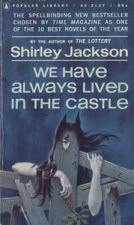
Review: We Have Always Lived in the Castle


The title of the novel is no accident, for it is as gothic a tale as any that was ever set in a crumbling castle on the banks of the Rhine. Its treatment of human evil, isolation and madness could easily qualify it as the pinnacle of 20th Century American Gothic.

A shadow has fallen across the house of Blackwood. Though once a prominent family, a possibly accidental poisoning has reduced their numbers to three (two sisters, an uncle) and made the townspeople suspicious of the survivors. The uncle, Julian, has been left physically crippled and one of the sisters, Constance, has developed a phobia about the world outside the house which does not prevent her from accepting visitors. It is left to the younger sister, Merikat (short for Mary Katherine), to venture into town on necessary errands.

Gothic literature often features singular characters, individuals who seem eerily plausible yet who are warped in a way that makes them unlike anyone else we've ever encountered. Merikat, who is the narrator and thus our guide through this story, is just such a character. It is clear that she views the townspeople with hostility, going so far as to craft charms--ordinary household items such as books or mirrors placed in odd locations or strange configurations--to keep the world at bay.

But soon it does intrude, in the figure of Charles, a cousin from an estranged branch of the family. His healthiness and level headedness seem to promise an opening up of the Blackwood home, a return to normality. But Merikat sees in him a representative of the crudity and selfishness of the outside world and seeks to drive him out through more and more powerful charms. The last of these results in a terrible reaction from the townspeople which sends the Blackwoods into greater isolation, leading to a hauntingly melancholy end to the story.

We Have Always Lived in the Castle is an incomparable achievement, a story that will equally charm and disturb in ways that sometimes can be almost intolerable. And you will probably never forget Merikat Blackwood.

25 February 2009

Review: Black Magic - 13 Chilling Tales

Black Magic is an anthology of short stories ostensibly all dealing with the theme of black magic, forbidden sorceries and texts, voodoo and diabolism. It does fall somewhat short of that, with one story about a mad scientist and another about a vampire. (By Nathaniel Hawthorne and Ray Bradbury, respectively.) However, those are both quite striking stories, so perhaps it's not so bad to break a little from the premise of the collection.

The other stories are grouped into five sections: Devil Worship, Witchcraft, Curses, Magic Writing and Incantation, and Voodoo. As well as the Hawthorne and Bradbury, there's entries from Algernon Blackwood, H. G. Wells, M. R. James, Avram Davidson, and Theodore Sturgeon. Of particular note are James' "Casting the Runes," a nicely atmospheric tale of supernatural vengance, and Davidson's "Where do you live, Queen Esther?," which reflects that author's talent for mixing the fantastic and everyday to stunning effect.

I also quite liked Margaret Irwin's "The Book," a tale of a cursed object leading to a man's doom; the story uses a rather novel approach towards the first symptoms of the curse. Blackwood's "Ancient Sorceries" was nicely atmospheric, though the end explained the strange phenomena in a way that felt a little too pat. (I would have prefered it a little more ambiguous.)

As with all collections, some stories are stronger than others, and if I had to pick a low point, it'd be "Cheese" by A. E. Coppard, which seemed like it should either be funny or scary, but didn't manage to do either quite right.

I wouldn't recommend seeking out the collection, as most of these stories could be found elsewhere. But if you ever run across this little bit of pulp in a used book store, it's definitely worth a look.

12 February 2009

Kali, Lovecraft, and Simmons (not Richard or Gene)


For a more straightforward review of Song of Kali, check the 999 Challenge Blog.

As I mentioned before, my first encounter with Kali came when I was learning about Thuggee to write a roleplaying campaign. Since the Illuminatus! Trilogy (which I was drawing on) featured Satanism, I figured I had found my perfect devil stand-in. I knew that drawing an equivalence between Kali and Satan was rather silly, but I figured 90% of 19th century Europeans wouldn't sweat the difference, so if the Satanists turned out to be Kali worshippers, it would make some degree of sense. (At least within the sort of paranoid, over-determined world of conspiracy theories.)

So, the concept that portrayals of Kali and Kali worshippers in the Western media have been a little on the unfair side has never been surprising to me. I'm not faulting Indiana Jones and the Temple of Doom here, whatever its shortcomings as a movie. Since Indiana Jones is an homage to 1930s adventure serials, it seems fair that it relies on some rather archaic or incoherent portrayals of India and Hinduism.

In my review of Song of Kali, I mentioned Dan Simmons verging on racism (or Eurocentrism or Orientalism or whatever you want to call it) and felt that deserved a little more explanation. I am, however, going to veer off a little into some thoughts regarding the horror/spiritual nature of the Goddess Kali.

Because what surprised me on my recent read of the novel was that despite the amount of research that Simmons put into the novel (judging by the collection of facts and quotes) he seems to stick with a one-sided, dated portrayal of Kali. Kali is a fairly rich figure, one whose appearance and attributes vary quite a bit depending on the nature of the devotee. (I recommend David Kinsley's work, such as this essay.)

Not that this makes Kali unsuitable as the bogeyman in a horror story. In fact, I rather think there's some similarities between the sort of spiritual reality that Kali implies and some of Lovecraft's fiction. Quoting Kinsley in Tantric Visions of the Divine Feminine:

There is an insistence in Hinduism that the world as it appears to us is a show, that there remains hidden from our normal view an aspect of reality that is... shockingly different from our ego-centered way of apprehending it.

The Mahavidyas... are awakeners, visions of the divine that challenge comfortable and comforting fantasies about the way things are in the world.


Based on that quote, I'd say the biggest distinction between the above and the sort of truth presented in Lovecraft's fiction is that the Tantrica believes that it's ultimately positive to see reality as it is, whereas nothing good ever comes in an HPL story from learning the truth. But ultimately, whether you're gazing on Kali or Cthulhu, I would argue, you're going to get a big batch of truth that is going to unsettle you.

Simmons opts for a simpler portrayal, where Kali alone embodies "the dark underside of an essentially benign universe" (emphasis mine) and "the focus and residue of all the atavistic urges and actions which ten thousand years of conscious strivings had hoped to put behind." Kali here doesn't represent uncomfortable but necessary truths (as in Tantra) or even terrifying but unavoidable truths (as she would if she were a Cthulhvian figure) but a straightforward adversary, the personification of everything we would be better off without but sadly can't entirely eradicate. (Towards the end of the novel, the protagonist begins referring to her as "that bitch," which pretty much sums up the reductionist view presented.)

Of course, if it was only the portrayal of Kali, it might be a missed opportunity but hardly racist. However, Simmons seems to use Kali as a stand-in for Indianness, its primitiveness and barbarity. In its horror aspect, the novel sometimes channels Lovecraft, both for its atmospheric settings and in its notion of non-Euclidean spaces. Unfortunately, it also seems to channel Lovecraft's distaste towards teeming hordes of brown people. In setting up the battle lines between good and evil, Simmons makes it clear that Indian culture stands on the wrong side.

Early on, the protagonist contrasts his wife Amrita's memories of India as a place of "cluttered cheapness of everything" with their current home, which is "as clean and open as a Scandinavian designer's dreams, all gleaming bare wood, comfortable modular seating, immaculately white walls, and works of art illuminated by recessed lighting."*

This contrast of the Western, orderly and good with the Indian, chaotic and bad reaches its peak intellectually about halfway through the novel. The protagonist is sitting down for tea with an Indian writer, who browbeats him into accepting that his horror at the poverty and squalor of Calcutta are do to his own Western prejudices. Then, Amrita, who is Indian-born but Western-educated, interrupts by arguing that Indian culture is utterly dysfunctional. Hers is the last argument. The Indian author has no further arguments, at least none that are shown.

One other detail is worth mentioning in why I think the novel presents an unfair picture of India. Simmons starts each chapter with a short epigraph. Most of these are from Indian sources, often describing the horror of Calcutta. But once the worst tragedy takes place and the survivors must move on and find redemption, the epigraphs switch over to Yeats. This coincides with the image of a terrible and degrading India which can only be escaped in the safe and orderly ways of the civilized West.

Alone, one of these elements--the reduction of Kali to bogeyman, the portrayal of Calcutta as fundamentally horrifying, the arguments about Indian culture, the shift of poetic sources--wouldn't make me think that Simmons is working from his own prejudices. But they consistently create an impression of India and Indian culture as backwards and brutal, something to be avoided, as contrasted with the humanistic, orderly ways of the West.

I'm not really looking to castigate Simmons for his politics, just elaborate on an aspect of the novel that made me uncomfortable. I'd be curious to hear from anyone with any thoughts, even if it's just to call me a PC thug.


*I was surprised at the extent to which reading this description of their house brought out my inner Tyler Durden. Was this image of smug first-world wealth meant to make the principals sympathetic, and if so, why did it so make me want to see them taken down a notch?

14 April 2008

Horror as Initiation: Lee Foust

I wanted to piggyback onto my blog from a few days ago to mention an alternative take on similar material. Lee Foust has a couple of brilliant essays on the h2so4 site.

The Horrific Experience of Countercultural Initiation

The Horrific Experience of Coming Face to Face with the Other 2

I find the distinction between female and male gothic modes rather interesting. Which I think gets back to what I find interesting with Lovecraft. It's common knowledge that Lovecraft projected a certain degree of his racism onto his monsters, often using similar terminology to describe both. Yet, I think Lovecraft also projected a certain amount of his own self image onto those monsters.

I'll mention one early story "Facts in the Case of Arthur Jermyn," which can be read as a neurotic phobia of miscegination. Yet, when HPL describes how the first Jermyn seemed to prefer being put in a madhouse to being around to see his son grow up, I find myself wondering about Lovecraft's own father who ended up in a madhouse and wasn't there to see his son grow up. Jermyn's son, as it becomes clear, is clearly monstrous, only half-human.

So, with respect to female and male gothics, where does Lovecraft fall? Except for a few pieces, his monsters aren't just entities to be beaten so order can be restored. I would argue several of his better regarded stories ("The Shadow Over Innsmouth", "At The Mountains of Madness", "The Outsider") present rather human monsters. But does Lovecraft really fall into the female gothic, where the monstrous ultimately comes to be accepted as good and beautiful? So, does Lovecraft present us with a male or a female gothic, or is it actually something weirder, some form of hermaphroditic gothic?

16 March 2008

Books Compared:Diary/Rosemary's Baby/"The Shadow Over Innsmouth"

Diary is the second of the three books put out by Chuck Palahniuk in which he sought to reinvent the horror genre. It is also written as an homage to the work of Ira Levin, particularly Rosemary's Baby. At the time I read Diary, I was not directly familiar with the work of Levin and the comparison that first came to mind was with an older, shorter story: H.P. Lovecraft's "The Shadow Over Innsmouth." (I was indirectly familiar with the work of Levin in that Baby and The Stepford Wives, particularly in their film adaptations, are so well known as to be part of the lexicon.)

Diary is told as a series of entries in a coma diary, kept by a middle-aged woman (Misty Marie Wilmot) for her husband, a contractor who is in a coma after an unsuccessful suicide attempt. As a young woman she aspired to be an artist and live in a big, beautiful house. In art school, she met a young man whose family lived in a big, beautiful house on an the rather exclusive (and very isolated) Waytansea island. She became pregnant, and they got married and moved back to the island. Both her and the island have fallen on hard times by the time the husband attempts suicide. As the story progresses, the "island people" push Misty into painting again (which she hasn't done in years) and messages start to turn up in the houses that Peter had worked on. These messages warn hysterically about some doom that is to come upon the "summer people" who have begun to rent from the island people.

Rosemary's Baby is the story of a woman who moves into a large gothic building in New York with her husband. Shortly before she gets pregnant, strange things begin to happen around her, beginning with the suicide of a young woman she met in the basement of the building. As the story (and her pregnancy) progresses it becomes clearer that the people around her (especially the other inhabitants of the building) have some ulterior motives regarding the child growing in her womb.

"The Shadow Over Innsmouth" is the first-hand account of a young man following an antiquarian tour of New England in which he found himself taking a detour into an old dilapidated town by the name of Innsmouth. It was an old trading port which was decimated by some sort of plague and became isolated, its inhabitants developing odd deformities, perhaps as a result of inbreeding or miscegination. While there, he sought out on old drunk named Ezekiel who told him some very strange things about the history of the town. Then the bus out of town broke down, and he was forced to spend the night in the local hotel.

And from here on out There be spoilers!

Not surprisingly, things turn out to be far stranger and sinister than the hapless protagonists expected.

The young antiquarian whose name is never given soon learns that the town has been taken over by hybrid fish-men who worship a strange, ancient deity and seek to interbreed with humans. After a night of frightening close calls, he manages to escape. Not long after his escape, however, he comes to learn that he is himself descended from the strange fish-men and is slowly transforming into one. He sinks into despair, considers suicide, then finally chnages his mind and heads to the sea to start his new life as a monster.

Rosemary finally stumbles upon some clues that the friendly old people in the building are, in fact, witches. Fearing for the safety of her child, she attempts to flee. But she is turned in by the doctor she confides in and taken back to the apartment, where she gives birth. She is told that the baby is born dead, but doesn't believe it and sneaks into the apartment of the head witches. It turns out that the child is the offspring of Satan, whom the witches summoned up to rape her. Though she considers killing the child, she changes her mind and decides that even the Son of Satan deserves a mother's love.

Misty eventually learns that her painting and the diary are both part of a larger scheme. Every hundred years, a woman who was not born on the island will paint a series of pictures which render people catatonic (via Stendahl syndrome). This will allow the "island people" to enact a major tragedy on the "summer people" (and quite a few of themselves, as well) which will make them rich again. It has been done twice before, after which the island people enjoyed 90+ years of prosperity before going nearly bankrupt and having to enact another massacre. The diary is key because the two former artists also kept diaries, and it is important to reproduce the events in the life of the artist for the plot to unfold. Misty attempts to stop the tragedy but is stopped by the police, and the massacre unfolds. She ends her story by mailing a copy of her diary to Palahniuk so he can write a book to, I guess, stop the pattern a hundred years hence.

Of the three, Diary is the one that tries hardest to be readable as allegory. As par for the course for Palahniuk, it is meant to be a statement on the plight of the artist, the nature of capitalism, and gentrification and immigration (ie. Portland property values). Baby appears to have been inspired by a certain 60s era anxiety over the increased secularization of the American populace. One character mentions that the death of God is not just a line from Nietzchie but an actual event taking time at that place. (Palahniuk himself interprets Baby as presenting a strongly pro-choice argument, but I suspect he hasn't read the novel.*) Shadow reflects some of Lovecraft's phobias--of foreigners and the ocean, in particular--but ends is powerfully ambiguous note, calling into question its own assumptions about monstrosity.

Curiously enough, though Lovecraft tends to be a far more verbose writer in terms of style, Shadow probably has the strongest, most disciplined finale of all three works. After Rosemary decides she wants to nurture her Satan Spawn, she has an argument with the head satanist about whether the baby is to be named Adrian or Andrew. Meanwhile, a Japanese satanist who shouts "Hair Satan!" (difficulty with "l"s) takes pictures of everyone. I'm not sure if Levin had campiness in mind when he wrote that scene, but there sure is a lot of it and it undercuts whatever eerieness the final revelation is supposed to bring.** Misty, in her attempt to foil the final step of the plot, ends up running around in front of a crowd, yelling, "You're all going to die! I'm Leonard da Vinci! I'm Lord Byron." It's hard not to sympathise with the crowd for thinking she's nuts. By contrast, the slow realization of the narrator of Shadow that he's becoming a monster and his wrestling with what to do about it are written as a slow accumulation of details. By the time he writes "I cannot be made to kill myself," it has an almost existentialist courage to it.

One of the things that struck me about Diary was the extent to which Palahniuk's attempt at allegory conflicts with the power of the story. There's an unresolved question at the heart of the plot: who or what is really behind the plot in question. The book implies that the first time it happened was by accident, and the second was only discovered when it was already taking place. It would appear that the island people stumble onto some pattern of human sacrifice older than them. In fact, the paintings that Misty paints are photo quality reproductions of scenes of the island itself, which again reinforces the idea that it is the island itself that seeks the massacre with the island people secondary beneficiaries. This appears to take human agency largely out of the equation, which makes it less convincing as social allegory regarding the evils of gentrification. And frankly a time scale of 100 years suggests that it is not the island which sets the plot in motion but an author looking for a nice round number.***

Curiously enough, Waytansea island is fish-shaped and it is described as a place where "even the dogs are inbred" which connects it strangely to Lovecraft's Innsmouth. It's an odd parallel, but one that makes me wonder: Was Palahniuk aware of this parallel when he sought to reinvent the horror novel? And if not, has he ever considered that he might himself be a "summer person" on this particular genre/island, just another interloper whose read a few guidebooks but doesn't know the territory or understand the history?

* This may be an unfair charge, but his interpretation seems a case of wishful thinking more than anything else. Rosemary starts out wanting a baby, and once she realizes something is up ends up fearing for the life of her child against those who would see it as less than a person. It might represent a certain degree of pregnancy anxiety but is a pretty insubstantial argument for legalized abortion.


** And seriously, satanists? I know it was written 40 years ago, but does anyone really find satanists scary? Perhaps it's just me, but I find them two-dimensional and dated. In Shadow, someone says the Innsmouth people were accused of being devil worshippers but that it's a pretty silly charge. Then it turns out the "devils" they worship (and are) don't really care about Christian theology.


*** I can't help but wonder what Borges would have done with a story about an artist whose act of writing reproduces a tragedy 100 years old. Although I think a nice touch would be to rewrite Diary with Sonia Greene as the practical aspiring artist finding herself forced to work to support the family and Lovecraft himself as the creepy artist of ambiguous sexuality with the weird family.

19 December 2007

Lugones' "The Horses of Abdera"

An interesting story which reads like something of a parable. The city of Abdera prides itself on its horses and spoils them until they rebel, besieging the city that has spoiled them. As with "The Firestorm" there's something creepy about the scenes of urban destruction, this time by a somewhat fantastic variation on the violence of mobs. It ends with a deus ex machina (emphasis on the deus) that had me scratching my head, making it a little less satisfying then Firestorm. It was hard to tell what the horses were meant to represent. Spoiled youths? Immigrants? The working class? (My guess would be the latter, though I'd have to know more about Lugones' politics to say definitively.)

13 December 2007

Lugones' "The Bloat Toad"

The story of a certain kind of frog that will come back to life and kill anyone who slays it. It's very short but creepy, with some atmosphere. Its spare compared to Poe, and it does feel as if it needs something else, a twist or red herring. Perhaps it's just my 21st century sensibility, but it would have been nice to see the threat drawn out a bit more.

09 November 2007

Books Compared: Lullaby/My Work is Not Yet Done

Only a cynic can create horror. For behind every masterpiece of the sort
must reside a driving daemonic force that despises the human race and its
illusions, and longs to pull them to pieces and mock them.

-Howard Philips Lovecraft


I think I've been mentally comparing the works of Thomas Ligotti and Chuck Palahniuk since the first time I read Haunted.* Both are cult authors with reputations as nihilists, and both write with distinctive styles and thematic concerns. 2002 turned out to be an interesting publication year for both. (Pardon the familiarity of using first names; but both have rather long surnames.) Chuck published his first foray into horror with the novel Lullaby; Thom published his longest work, a novella by the name of My Work is Not Yet Done in a collection of the same name. (I won't get into the other two, much shorter stories included in that book.)

The similarities extend beyond publication date. Both feature disaffected narrators who find themselves acquiring supernatural powers of a questionable nature, but more importantly both are intensely dark, funny and philosophical works. There's even overlapping themes, such as concerns over mortality, criticisms of modern capitalism, and some apocalyptic musings.The main contrast is the characteristic style. Chuck's minimalism is descended from Hemingway by way of Amy Hempel and Raymond Carver. It emphasizes the use of verbs over adjectives, and he prefers short sentences that mirror the way people speak. Thom's style, on the other hand, reflects the baroque and surreal influences of authors such as H.P. Lovecraft (adjectivitis!) and Bruno Schulz.

I imagine most people will find Chuck's style a little more accessible. MWINYD is actually among the lower end of the baroque for Thom, but overall I find his style more effective, especially at evoking the requisite atmosphere of a horror story, than Chuck's.

Lullaby is easily Chuck's best work, but as a work of horror fiction it has some flaws. As I've already stated, his minimalism is less effective at creating atmosphere than Thom's subtle surrealism. Horror fiction revolves around the emotion of fear and its various permutations, and Lullaby is not particularly scary.

My other criticism of Lullaby as a work of horror is Chuck's handling of the supernatural element. Supernatural elements can be tricky to handle effectively in fiction, especially horror. When handled skillfully, they serve to effectively bind the story together, giving substance to submerged or displaced issues. (i.e., the way Cthulhu embodies Lovecraft's pessimism or Dracula lurks in the shadows of Victorian sexuality) When handled poorly, they come off as plot contrivances with little rhyme or reason.

Lullaby falls somewhere in between. I liked its haunted houses and visions of sonic plague, but I thought the culling song hadn't really been though through properly and its grimoire was a little silly. MWINYD's supernatural elements, however, seemed a much more natural fit for the narrator/author's philosophy and his concern with the meaninglessness of existence.

Both books, in fact, struggle with the question of the meaningless of existence, which is approached from a perspective of profound skepticism bordering on nihilism. Though both authors are considered nihilists, there is actually a fair amount of difference with Chuck's sunny nihilism an interesting counterpoint to Thom's bleak nihilism. As Tyler Durden says in an earlier Chuck book: "It's only after we've lost everything that we're free to do anything." I suspect the Frank Dominio, the protagonist of MWINYD, learns we're never free completely free to do anything and losing everything is its own reward.

As with writing styles, I think Chuck's work is probably the more accessible. Behind the bleakness and the dark humor lurks a heart in search of redemption as sincere as that of a Dr. Phil fan. Thom's philosophy is bleaker, like a shadow version of Zen, where we are only free when we lose all illusions, but to do that you must accept freedom itself as an illusion.** (Again, personal preference here leans towards Thom's more absolute darkness.) Ironically, these different outlooks reflect to an extent their literary influences; contrast Hemingway's humanism with Lovecraft's cosmicism.

* Haunted's prologue invokes the conceptual slipperiness between human beings and their simulacra (puppets, mannikins, etc.); while this concept was certainly not invented by Ligotti, he has evoked it more uniquely and effectively than any author since Bruno Schulz.

** Or to contrast two interesting quotes, one from Haunted, one from "The Nightmare Network" (the third story in MWINYD):
Chuck: "Each of us striving to be the camera behind the camera behind the camera"
Thom: "The camera pulls back on the entire universe. There is no one behind the camera."

25 October 2007

Books Compared: Hyperion/Haunted/City of Saints and Madmen

Chuck Palahniuk's Haunted and Dan Simmons' Hyperion are both works of genre fiction structured around a framing narrative. Despite being genre works (science fiction and horror*, respectively) both novelists are unashamed to telegraph literary aspirations, not just structurally, but with reference to literary figures such as Keats (Hyperion) and Mary Shelley (Haunted). Hyperion is an innovative exploration of genre fiction in service of a larger story with philosophical and political themes; the other is a messy affair, intermittently concerned with its genre, poorly plotted and rife with implausibilities.

Hyperion tells the story of a group of people traveling to an important location on the planet Hyperion as the interstellar empire of which they are subjects hovers on the brink of war. Each of the travelers has a particular reason for making this trip, revealed through the respective stories they tell. Simmons uses this structure as an exploration of genre fiction, incorporating elements of hard sci fi, space opera, cyberpunk, philosophical sci fi, even horror and noir fiction. The universe that Simmons creates through these stories is a fairly ambitious amalgam of literary and mythical elements, and though not as innovative now as it was at the time of its original publication, is an entertaining and thought-provoking exploration of empire, technology, and free will.

Haunted tells the story of a group of people at a writer's retreat, all of them participants save for the organizer (Mr. Whittier) and his assistant (Mrs. Clark). The other characters do not use their names but colorful titles (Agent Tattletale, Countess Foresight, etc.) and have signed up believing that this writer's retreat will allow them to create their respective "masterpieces" that will make them rich and famous. (Except for the ones that are already rich and/or famous and the ones that are hiding from the law, mob, CDC, or international arts conspiracy.) The writer's retreat turns out to be an abandoned theater whose decadent furnishings are meant to evoke Poe's "Masque of the Red Death." Some characters rebel against being trapped in a rundown theater, others decide being trapped in a run down theater will be the perfect "real life" story that will make them rich or famous. (While some believe a run-down theater is the perfect place to hide from the law, mob, CDC, or international arts conspiracy.)

What makes Haunted inferior to Hyperion is the complete lack of focus, as the stories veer from graphic or psychological horror (with odd stabs at the supernatural) to tales of callow individuals behaving badly. The framing narrative is meant to provide a coherency to the various stories, but it's inertness compounds the problem. (I personally gave up any hope that the book would redeem itself shortly after a character tales a story about being a werewolf. His animalistic aspect has been sketched pretty heavily up until that point, so it's not implausible that within the main plot he really could be a werewolf. Yet none of the other characters seems to consider that the presence of a werewolf in their midst should be a cause for worry. What should have ratcheted up the tension only ends up draining it of what life it had left.) Palahniuk has a talent for shock value which serves to distract from all of the glaring plot holes. (Why, for example, does the Earl of Slander, who in his story "Swan Song" describes himself as a wealthy, Pulitzer-prize winning celebrity journalist, go to a writer's retreat?) My most generous take on the novel is that it is a "suicidal novel," a novel that refuses coherency and eschews plot or plausibility, in order to repudiate the very idea of writing or art. (Like a Pynchon novel taken a nihilistic extreme, or something the Teatro Grottesco would release in hardcover.)

This may be giving the novel too much credit as its self-mutilation appears to be motivated (as with the characters therein) out of a desire for financial success. As Palahniuk describes it, he was originally wanting to release a collection of short stories. His agent informed him that collections of short stories don't sell as well as novels, so he adapted a story about self-destructing critics into a frame story of self-destructing writers. The term applied to this sort of work is "fix-up novel," which makes Haunted an interesting comparison with Jeff Vandermeer's City of Saints and Madmen.

City of Saints and Madmen (just City from here on out) lies somewhere between anthology and novel, and I have seen it described as a "kaleidoscopic novel" or "mosaic novel." Like Haunted, City is a genre work of multiple stories, mostly fantasy though of an unconventional sort. (Vandermeer is one of the more prominent members of the New Weird, which defies conventional genre definitions.) However, while Haunted fails to gain coherence from its frame, City achieves a considerable coherency while dispensing with a conventional frame. City is structured as a collection of four novellas and an appendix of supporting material, but this set-up is deceptive. For example, the first story "Dradin, In Love" is a third-person narrative about a missionary having a mental breakdown after returning to Ambergris. (The city of which saints and madmen make up a significant portion.) Only later are we told that "Dradin, In Love" is a work of autobiography published in Ambergris. The third "novella" turns out to be a tourist pamphlet outlining the early history of Ambergris, in whose footnotes we catch a glimpse of another history of academic rivalries among Ambergrisian scholars. City is full of these Borgesian games, which seek to lend a degree of verisimilitude to the most outlandish of elements.

Both novels are concerned with the creative process, as it relates not only to writing but to other forms of art. Two stories, for example, which have striking similarities are Palahniuk’s "Ambition" (Terry Fletcher's/Duke of Vandals' story) and Vandermeer’s “The Transformation of Martin Lake,” both of which revolve around artists who find themselves drawn into shadowy conspiracies which push them into criminal acts. Interestingly enough, the description of the Duke’s paintings makes them sound kitschy, and the story attributes his success to his involvement with the cabal. (His paintings are of his mom, his girlfriend, and his dog named Boner.) Martin Lake’s works are presented as dark, surreal representations of the crimes in which he has become involved, crimes for which his only reward is continued survival. Palahniuk’s story comes off as a cynical take on how the pursuit of profit will manufacture success out of crap, whereas Vandermeer’s story is a more haunting meditation on art, its ability to both reveal and conceal, and the varied inspirations that give rise to it.

The same pattern holds for the two novels as wholes, with Haunted feeling unfocused yet insular, and City feeling like something of a city in itself, cohesive yet open.

* Haunted's failures as a work of horror outnumber its failures as a novel. However, the book was marketed as a horror novel, so I will not quibble whether it really qualifies as one.