Showing posts with label weird fiction. Show all posts

24 June 2009

CHM: The Real Road to the Church

"The Real Road to the Church" is the story of an Englishwoman who is living on an unspecified European island, in which she has trouble communicating with the locals. She hears that the chateu she is renting is on "the real road to the church," a phrase which she finds vaguely troubling and which nobody appears capable of explaining to her. This is mostly a nicely atmospheric in which not that much happens until a subtle climax which may or may not be a hallucination. It's an intriguing story, though definitely on the quiet side.

23 June 2009

Cold Hand in Mine: The Swords

Aickman has been on my TBR pile for a while now. To a large extent, this is mostly figurative since it was not until last year that I actually obtained some of his works. (I found Cold Hand in Mine for 25¢(!!) in a used bookstore in Madison, WI.) His work has been highly praised by (among others) Fritz Leiber, Robert Bloch and S.T. Joshi. One critic described his "strange stories" (as he called them) as "ghost stories in which there is no ghost." So, what I'm expecting is some good subtle weirdness.

"The Swords" certainly gets the collection off to a good start. The story is presented by the narrator as the story behind his first sexual encounter. It takes place during the two years in which he works as a traveling salesman. On one trip, he finds himself in a decayed English town holed up in a flophouse. (Accommodations having been arranged by the uncle who employes him.) With little to do, he visits a fairly pathetic carnival and wanders into a tent wherein a rather strange sideshow is being held.

The show features a young woman dressed up in sexy clothing and a collection of cheap-looking swords. The attendants to the show (who are all men) are each given the opportunity to stab the girl with one of the swords, after which they get to his her. Though she places her hands over the spot on her body into which the sword entered, no blood appears to flow and the girl evinces no pain. (Quite the contrary in fact.)

The boy sneaks off before his turn comes up, but he later runs into the girl and the showman in a restaurant. Here, the showman offers him a private performance by the girl. I'll skip summarizing what follows, since there's no way I could do it justice.

It's a perplexing story, one in which it seems pretty clear something strange is going on without it being really clear what.

25 February 2009

Review: Black Magic - 13 Chilling Tales

Black Magic is an anthology of short stories ostensibly all dealing with the theme of black magic, forbidden sorceries and texts, voodoo and diabolism. It does fall somewhat short of that, with one story about a mad scientist and another about a vampire. (By Nathaniel Hawthorne and Ray Bradbury, respectively.) However, those are both quite striking stories, so perhaps it's not so bad to break a little from the premise of the collection.
The other stories are grouped into five sections: Devil Worship, Witchcraft, Curses, Magic Writing and Incantation, and Voodoo. As well as the Hawthorne and Bradbury, there's entries from Algernon Blackwood, H. G. Wells, M. R. James, Avram Davidson, and Theodore Sturgeon. Of particular note are James' "Casting the Runes," a nicely atmospheric tale of supernatural vengance, and Davidson's "Where do you live, Queen Esther?," which reflects that author's talent for mixing the fantastic and everyday to stunning effect.

I also quite liked Margaret Irwin's "The Book," a tale of a cursed object leading to a man's doom; the story uses a rather novel approach towards the first symptoms of the curse. Blackwood's "Ancient Sorceries" was nicely atmospheric, though the end explained the strange phenomena in a way that felt a little too pat. (I would have prefered it a little more ambiguous.)

As with all collections, some stories are stronger than others, and if I had to pick a low point, it'd be "Cheese" by A. E. Coppard, which seemed like it should either be funny or scary, but didn't manage to do either quite right.

I wouldn't recommend seeking out the collection, as most of these stories could be found elsewhere. But if you ever run across this little bit of pulp in a used book store, it's definitely worth a look.

17 February 2009

"The Red Moon" by Roberto Arlt

Nothing foretold it that afternoon.

Commercial activities unfolded normally in the city. Waves of humanity swarmed in the crystal doorways of vast commercial establishments, or they paused in front of windows that occupied the length of dark streets, splashed in the smells of oilcloths, flowers or victuals.

The clerks, behind their crystal sentry boxes, and the rigid staff supervisors in the carpeted vertices of shopping centers, observed with careful eyes the conduct of their inferiors.

Contracts were signed and debts were cancelled.

In various parts of the city, at various hours, numerous couples of young men and girls swore eternal love to one another, forgetting that their bodies were perishable; some vehicles incapacitated careless strollers; and the sky, beyond the tall metal crosses painted green which held up high-voltage cables, was turning an ashen gray, as always happens when filled with watery vapors.

Nothing foretold it.

At night the skyscrapers were illuminated.

The majesty of their phosphorescent facades, incised in three dimensions over the foggy backdrop, intimidated simple men. Many developed an unreasonable idea with respect to the possible treasures concealed behind walls of steel and cement. Lusty watchmen, in accord with the received rules, in passing frequently before these buildings, carefully observed the wainscoting of windows and doors, lest there be abandoned there some infernal machine. In other places could be spotted the shadowy silhouettes of the mounted police, holding the reins of their horses and armed with holstered rifles and guns which fired tear gas.

Fearful men thought, “How well defended we are!”, and gratefully looked upon the sheathed mortal weapons; on the other hand, those tourists which cruised along made their chauffeurs stop, and with the tips of their canes pointed out to their companions the luminous names of faraway corporations. These gleamed in interminable staggered facades, and some delighted and prided themselves upon thinking of the might of their faraway homeland, whose economic expansion represented filial joys whose name was of necessity spelled out among the clouds. So high were they.

From elevated terraces, so high it appeared that one could touch the stars with one’s hand, the wind broke off snatches of blues music obliquely cut up by the gusts of air. Porcelain Bulbs lit up aerial gardens. Confused among the foliage of expensive vegetation, controlled by the responses and vigilant gaze of the wait staff, danced the elegant idlers of the city, young men and women, flexible from the practice of sports and indifferent from familiarity with pleasures. Some resembled butchers encased in smoking jackets smiled insolently, and all, when they spoke of those below, appeared to mock something which with a blow from their fists they could destroy.

The old men, arranged on chairs of Japanese straw, watched the blue smoke of their cigars or let pass across their lips an astute frown, at the same time that their hard and authoritarian gazes reflected an implacable sense of security and solidarity. Even among the buzz of the party it was impossible to imagine them less than presiding over the round table of a directorate, in order to approve a leonine loan to a nation of Arabs and mulattos, below whose trees ran veins of petroleum.
From inferior heights, in streets deeper and cloudier than canals, circulated the roofs of cars and streetcars, and in excessively illuminated places, a microscopic multitude caught the scent of cheap pleasure, going in and out of the gangways of cheap dancehalls, which vomited incandescent atmospheres like the mouths of tall ovens.

Up above, in oblique directions, the structure of skyscrapers detached itself from the greenish or yellowish skies, cubic reliefs, superimposed major over minor. These cement pyramids disappeared upon the extinguishing of the splendor of invisible luminous billboards, later they would newly appear as super dreadnoughts, creating a perpendicular and tumultuous threat of maritime warfare upon lividly lighting up among the mists. It was then that the strange event occurred.

The first violin of the Jardín Aéreo Imperius orchestra was about to place upon his music stand the score for the “Blue Danube,” when a waiter handed him an envelope. The musician rapidly tore it open and read the note within; then, glancing over his lenses at his comrades, he deposited his instrument on the piano, handed the letter to the clarinetist, and descended swiftly down the stairs that gave access to the stage, searching with his gaze for the exit to the garden, and disappeared via the service stairway, after trying futilely to call the elevator.

Upon observing the unusual and disrespectful conduct of that man, the hands of various dancers and their companions ceased as they brought glasses to their lips to drink. But, before the bystanders could overcome their surprise, the man’s example was followed by his companions, for it was seen that one after another abandoned the box, looking serious and somewhat pallid.

It is necessary to observe that despite the haste with which they executed these acts, the actors revealed a certain meticulousness. The one who stood out the most was the cellist, who enclosed his instrument within its case. It produced the impression that they wanted to signal that they were declining some responsibility and were “washing their hands.” Thus it was described later by a witness.

And if it had been them alone.

They were followed by the waiters. The public, mute in its astonishment, without daring to speak a word (the waiters in these places were quite robust) watched them remove their service frocks and toss them contemptuously on the tables. Upon observing that the clerk without bothering to close the register abandoned his tall seat, The service foreman doubted and, quite disturbed, joined the fugitives.

Some wanted to use the elevator. It didn’t work.

Suddenly the lights went off. In the shadows, next to the marble tables, the men and women who until a few moments ago debated between the subtleties of their thoughts and the delights of the senses, understood that they should not wait. Something was happening which paralyzed the expressive capacity of words, and then, with a certain fearful order, in an attempt to minimize the confusion of their escape, they began to descend silently down the marble stairs.

The cement building filled with buzzing. Not of human voices, since no one dared to speak, but of rubbing, rattling, sighing. Once in a while, someone lit a match, and throughout the snail shell of stairs, at different heights along the wall, moved silhouettes of twisted backs and enormous fallen heads; meanwhile in the angles of the walls the shadows fell apart in leaping irregular triangles.

No accident was recorded.

Sometimes, a fatigued old man or a terrified dancer would let themselves fall to the edge of the stairs, and remain seated there, with their head abandoned in their hands, without anyone stepping on them. The multitude, as its diffident presence on the edge of the marble could be guessed, traced a curve next to the immobile shadow.

The watchman of the building, during two seconds, lit up his electric lantern, and the circle of white light allowed him to see men and women, their arms indistinctly clutching each other, descending cautiously. Those who went near the wall had their hands resting on the banister.

Upon arriving at the street, the first fugitives eagerly sucked up long breaths of fresh air. Not a single light was visible in any direction.

Someone scraped a match across a metal grate, and then discovered in the thresholds of certain ancient houses, creatures seated there pensively. These, with a seriousness inappropriate for their age, lifted their eyes to those elders who illuminated them, but they did not ask anything.

Out of the doors of the other skyscrapers poured out a silent multitude.

An older woman wanted to cross the street, and tripped over an abandoned automobile; further on, some drunks, terrified, took refuge in a tram car whose conductors had fled, and so many, temporarily winded, allowed themselves to fall on the granite strips which marked off the street.

The immobile creatures, with their feet raised next to the borders of the thresholds, listened silently to the rapid footsteps of the shadows which passed in stampede.

In a few minutes the inhabitants of the city were in the street.

From one point to another in the distance, the light bulbs of flashlights moved irregularly as fireflies. One curious and resolute individual attempted to light the street with an oil lamp, and behind the pinkish glass screen the flame went out three times. Without humming, a cold wind blew, heavy with electrical charges.

The multitude thickened as time passed.

The shorter shadows, quite numerous, advanced within the other less dense and taller shadows of the night, with a certain automatism which made it understood that many had just left their beds and still maintained the incoherent movement of those half-asleep.

Others, in turn, grew unsettled by the fate of their existence, and silently marched towards the discovery of their destiny, which they guessed as rigid as a terrible sentinel, behind that curtain of smoke and silence.

From frontage to frontage, the width of all the streets that ran east to west was occupied by the multitude. This, in the darkness, created a denser and darker cover which advanced slowly, akin to a monster whose particles are bound to it by the panting of its own respiration.

Suddenly a man felt something tugging insistently at his shirt sleeve. He stammered questions to whoever was doing that, and when no reply came, he lit a match and discovered the flat and shaggy face of a large monkey which with fearful eyes appeared to interrogate him regarding what was happening. The unknown man, with a shove, separated himself from the beast, and many who were near him noticed that the animals were free.

Another identified various tigers mixed in among the multitude by the yellow stripe which sometimes glowed between the legs of the fugitives, but the beasts were so extraordinarily unsettled that, upon flattening themselves on their stomachs to signal their submission, they blocked the march, and it became necessary to expel them with kicks. The beasts took off at a run, and as if some order had been given, took their place at the front of the multitude.

They moved forward with their tails between their legs and their ears pressed to the skin of their skulls. In their elastic advance, they would turn their heads upon their necks, and their enormous phosphorescent eyes stood out, like spheres of yellow crystal. Despite the slow walk of the tigers, the dogs, in order to maintain position with them, had to move their legs briskly.

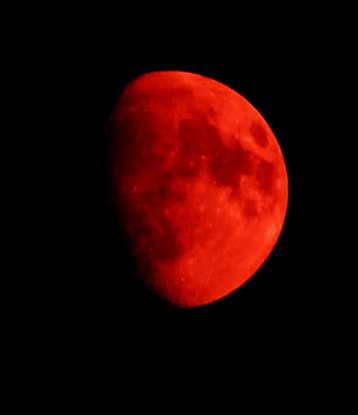
Suddenly, above the cement water tank of one of the skyscrapers, the red moon appeared. It looked like a bloody eye coming unstuck from the straight line, and its magnitude increased rapidly. The city, also reddened, grew slowly from the bottom of the darkness, until fixing the balusters of its terraces at the same height that filled the descending curve of the sky.

The perpendicular planes of the building fronts reticulated the tarry sky with scarlet alleys. Upon the staggered walls, the reddening atmosphere settled like a mist of blood. It seemed that above the terraces a terrible god of iron should have appeared, with his bowels cast in flames and his cheeks bulked up with a butcher’s gluttony.

No sound was heard, as if one of the effects of the vermillion light was that the people had been struck deaf.

The shadows fell, huge, heavy, cut tangentially by monstrous guillotines, on the marching humans, so numerous that shoulder to shoulder and chest to chest they filled the streets from beginning to end.

The irons and cornices projected parallel black lines at different heights into the depths of the vermillion atmosphere. The tall windowpanes gleamed like melting sheets of ice behind which fires blazed.

In the terrible and quiet luminosity it was difficult to distinguish the feminine faces from the masculine. All of them appeared equal and shadowed from the anguish of the effort they made, with their jaws clenched and their eyelids shut tight. Many wet their lips with their tongues, for they grew feverish with thirst. Others with the gestures of sleepwalkers placed their mouths on the cold cylinders of mailboxes, or on the rectangular vents of electrical transformers, and the sweat ran in thick drops down their faces.

From the moon, fixed in a sky blacker than tar, came off a bloody and thick slaughterhouse emanation.

The multitude did not in fact walk, but instead advanced in ebbs, dragging their feet, supporting one upon another, many half-asleep and hypnotized by the red light which, shining from shoulder to shoulder, made the dark recesses of eyes and rotten profiles deeper and more astonishing.

In the cross streets children remained quiet in the thresholds.

From the tumult of the beasts, enlarged by the horses, the elephant had broken away, and with its soft bustle raced towards the beach, escorted by two colts. These, with their manes in the wind and their lips turned towards the dazzling ears of the pachyderm, appeared to whisper a secret to him.

By contrast, the hippopotamuses at the head of the vanguard, gulped with fatigue at the air, gathering it with blows in the hollows of their armored snouts. One tiger rubbing its flank against the walls advanced reluctantly.

The silence of the multitude began to become intolerable. One man climbed a balcony and placing his hands in front of his mouth like a megaphone, shouted hysterically:

--Friends, what’s happening, friends! I don’t know how to speak, it's true, I don't know how to speak, but let's come to an agreement.

They filed by without looking at him, and the man, drying the sweat from his face with the shaggy top of his arm became mixed up in the crowd.

Unconsciously each of them brought a finger to their lips, one hand to their ear. There could now be no doubts.

In a distance blocked with fire and darkness, more shifting than an ocean of burning oil, the metal structure of a crane whirled slowly on its axis.

Obliquely, an immense black cannon placed its conical profile between earth and sky, spat flames and receded along its carriage, and a long whistle crossed the atmosphere with a steel cylinder.

Beneath a red moon, blocked by vermillion skyscrapers, the multitude let out a cry of fright:

--We don’t want war! No…, no…, no!...

This time they understood that the fire had broken out across the entire planet, and nobody would be saved.

16 February 2009

Arlt and his red moon (an introduction)


From my understanding, Roberto Arlt is considered an important figure in Latin American (particularly Argentine) literature but is not widely known outside that realm. Of all his works, only two--The Seven Madmen and The Mad Toy--have been translated. (Curiously, Los Siete Locos is only half of a story; that Los Lanzallamas, the second half of the story, has not been translated must make for a frustrating experience for the non-Spanish speaker.)

He's not generally considered a fabulist, more a student of Dostoyevsky than Poe, but the realism in his work can feature such strange elements as to seem more surreal. The Seven Madmen, for example, features a terrorist named The Astrologer, who plans to set-up prostitution houses all across Argentina to fund building of poison gas factories with which to take down the government.

(And on a brief side note, I considered comparing Arlt to Lovecraft. They were both autodidacts and outsiders who crafted their own unique literary styles. Of course, Arlt was the offspring of immigrants and Lovecraft thought himself something of a blue-blood, but the contrast only makes things more interesting. Mostly, though, I think I was pondering some mash-up tale where El Astrologo gets his hands on that Necronomicon in the UBA library. I'll leave it at that, though a little more on HPL later...)

As far as I can tell, his short stories have sadly not been translated. I first discovered "La Luna Roja" in a small collection of his short stories. From what I understand, it's a characteristically fantastic story for him, but one whose atmosphere of dread is quite palpable. The story moves from a somewhat mocking view of the city to a few strange incidents. People are out on the streets walking, though its unclear to where, in a way reminiscent of the prose poem Nyarlathotep. I won't reveal the end, since you'll have the opportunity to read it for yourself.

So, here I present my translation. I won't claim it's particularly good, since I don't really have much experience in this. On top of that, I found Arlt's Spanish somewhat idiosyncratic, probably not the kind of thing for a beginner to translate while trying to preserve both tone and coherence.

One last note: I'm not really sure about the legal status of this translation. Since Arlt's short fiction is up on the web, I figured that at worst it's technically a violation but one that's not being enforced. (Incidentally, you can find his stories here and the original to this story here.)

So, to follow is The Red Moon. I hope that I've done it justice.

29 January 2009

Schulz and genre labels

Just some random musing for the moment:

I once had a discussion with someone about the movie Crouching Tiger, Hidden Dragon and how to describe the supernatural elements. He had described the movie as surreal, but I had insisted that it was more like magical realism. My argument was that surrealism tends to reflect the fractured logic and imagery of dreams, while magic realism involves incorporating fantastic elements as extensions of a realistic narrative. (Although, I'm not certain that's the best description of magic realism.)

This all came back to me while reading Sanatorium Under the Sign of the Hourglass. I've got it tagged in my library as both weird fiction and surreal, but I'm wondering if it should be tagged as magical realism instead of or alongside weird fiction.

If one opts for a narrow definition of the weird tale or magic realism, it's obvious Schulz doesn't really count as either. That is, he's neither part of an early 20th Century set of authors publishing in Weird Tales magazine nor is he a Latin American (probably Caribbean) author publishing after 1960 or so.

I usually try to be more expansive with both of those labels. So, weird fiction is a category of fiction where the everyday existence is brought into contact with something decidedly uncanny, sometimes an entire strange reality. This intrusion into the normal is by its nature threatening, and so the pervasive mood is one of dread and uncannines. (So, for example, Lovecraft's stories feature entities whose very presence will drive a man insane.)

Magical realism, on the other hand, centers on a reality so rich in essence, that everyday existence finds unexpected fantastic outlets of expression. Those supernatural outbursts are not intrusions into so much as expressions of the everyday reality. (For example, the familial bond can cause a murdered son's blood to flow directly towards his family's home.)

But Schulz' stories sometimes seem to operate on both levels at the same time. There's certainly a surreal quality to be sure. And sometimes the supernatural seems to be an intrusion, quite threatening and uncanny. At other times, it appears to be a flowering of some normal though concealed aspect of the everyday.

Writing this out rather convinces me to give it both tags, since I think the world featured in his fictions is so permeable as to make percolations both into and out of the everyday through the fantastic sort of inevitable.

I don't know if this is particularly interesting to anybody else. I find the WF/MR distinction an interesting way to think about the way fantastic or supernatural elements are used in a story.

Review: Sanatorium Under the Sign of the Hourglass


It might be fair to say that this is the weaker of Schulz' two collections; that is, it is not 100% consistently mind-blowing. Perhaps only 90-98%. Schuz' prose has the quality of being downright intoxicating. His tales all deal with his family and life in his hometown, but the incandescent profusion of language and imagery reveals the transcendent behind the ordinary.

The first three stories feature an obsession with texts, starting with The Book of the story by that name, in which the Authentic is regenerated, and finishing with the strange season of "Spring," in which a stamp album holds the secrets to the Hapsburg dynasty and a youthful love triangle.

In the title story, the narrator visits his father at a convalescent home, where death is kept at bay through entrechment in the past. As the not-days progress, he soon learns that he is loving in recycled time.

"The Old Age Pensioner" and "Father's Last Escape" are haunting portrayals of the metamorphosis of old age and its approach to the final transmutation of death.

Schulz wrote like no one else, and his fantasies of the everyday are worth getting lost in.

25 January 2009

Review: La muerte y su traje


Santiago Dabove was a contemporary of Borges and, if JLB's introduction is any indication, something of an eccentric. He had little interest in publishing, and it was only the intervention of his more famous friend that managed to get this book edited and published after the author's death.

The stories here make for an interesting collection of strange stories, somewhat in the vein of Poe. The Poe influence shows up early, with the story "Ser Polvo" ("Being Dust") which seems to want to go Poe one better. While Poe was known to write about being buried alive, Ser Polvo describes a man being converted to earth while still conscious. It's a fascinatingly morbid work, rendered ambiguous by the narrators admission that he's dying and has taken large doses of heroine.

Another work which suggests Poe's "Facts in the Case of M. Valdemar", with a little Frankenstein (or Reanimator) thrown in for good measure, is "El experimento de Varinsky" ("Varinsky's Experiment) where a doctor uses a strange device to bring a man back from the dead, with strange results.

As you can see, death is a frequent theme in these stories, as one might expect from works influenced by Poe. Intriguingly, like Leopoldo Lugones or Macedonio Fernandez, Argentine authors publishing in this era, Dabove's work goes beyond copying Poe, incorporating philosophical or scientific elements to plum the uncanny in new ways, a process that would bear fruit with Borges himself.

It is an interesting mix of stories, if perhaps somewhat dark, but I found these little variations on the weird tale to be pretty entertaining.

06 April 2008

The Ritual in the House: Horror Tale as Initiation


I wouldn't say I was a huge fan of horror when I was growing up. I was more into science fiction, which could certainly provide some chills, as in the ending of The First Men in the Moon and the feeding scene from The War of the Worlds. I also picked up a library book by somebody (not Ray) Bradbury about super intelligent animals who gone on a killing spree. (I was in the public library looking for Ray Bradbury but did not pay significant attention to the author's first name.) And I guess I did read the winners of the Miami Herald's Halloween scary story contest and the odd ghost story here or there. But I never really sought out the stuff. I remember when all my classmates were reading Stephen King and V.C. Andrews my reaction was the 80s equivalent of "meh."

It wasn't until I had graduated from college that I found myself interested in reading horror as a genre. The catalyst for this change in taste took place while I was hanging out with my friend Steve at his house. We were discussing books, and he said to me, "You really should check out Lovecraft. He's pretty good" (or something to that effect) and handed me The Best of H.P. Lovecraft: Bloodcurling Tales of Horror and the Macabre with its rather lurid cover:


By this point I'd heard of Lovecraft, from my college roommate Josh (who had attempted to get a CoC campaign going with amusingly disastrous results) and from Illuminatus Trilogy. I was not quite sure what to make of the book and still a little suspicious of the genre, I decided I'd just start with the shortest story. This turned out to be "The Picture in the House" which I read while Steve puttered about on the computer. The story hit me with a certain indefinable force. It didn't have quite the visceral shock of other horror I'd read, but the thing seemed to worm its way into my head in a way that had me hooked. After that, I read pretty much everything Lovecraft had ever written and continued on to many of the pastiche works that fall under the "Cthulhu Mythos" category.

At some point, I became rather bored with the Cthulhy Mythos stuff, most of which is pretty derivative and lacks much of the power of the original works. As I tried to read more broadly in the genre, I've encountered works of a much more visceral nature (Palahniuk's Haunted) as well as those of a much more cerebral sort (Ligotti, Borges). Last year, though, I decided to re-read "The Picture in the House," thinking I might find it tame or hackneyed. I was surprised by how powerful it seemed.

Part of my surprise was because on some level the story shouldn't work. It's about a man travelling around the back country of Massacussetts. He wanders into an old house to avoid the rain and there meets up with a (New England) redneck who happens to be fond of a book with a drawing of a cannibal who is cutting up victims. It turns out that the old man is himself a cannibal and the consumption of flesh has allowed him to live far beyond his years. He is, in fact, over 150 years old. Shortly after the traveller realizes this, a bolt of lightning obliterates the house and knocks him unconscious.

So, murderous rednecks, cannibalism, deus ex machina--all elements that in another story would have me scoffing or throwing up my hands. (Yes, that's you, Haunted. Except for the rednecks.) So, what is it about the story that manages to transcend such hackneyed conventions? I've come to the conclusion that what makes the story so powerful is that it is a story about reading horror and about being affected by it.

The picture that the old man is so fond of is in a book called Regnum Congo, and the drawing is associated with an entry on the Anzique cannibals. If a picture is worth a thousand words, than this picture can be thought of as a horror story. Having "read" this horror story, the old man finds himself developing a strange fascination. As he says: "Queer haow picters kin set a body thinkin'."

Having read and been affected this horror story, he then proceeds to create his own horror story. Namely that of a murderous redneck who consumes human flesh. Though he attempts to cover up this story, he ends up relating it to the traveller nonetheless, who is now involved in his own horror story, which he relates to the reader. The reader thus finds himself reading a horror story about a man hearing a horror story about a man seeing a horror story. It is no surprise that one suddenly finds oneself wondering, however subconsciously, "Am I in a horror story?"

But what really makes this story potent is the strange speech of the old man. (It helped that at the time I had an interest in magical traditions, in Crowley and Sanskrit and the whole lot.) Not only does he say, "Queer haow picters kin set a body thinkin'." He later goes on to add, "Queer haow a cravin' gits a holt on ye." Somehow, the product of these lines echoed in my head, eventually transmuting into "Funny how an idea gets hold of you," a thought which stuck with me long after I had finished the story.

When he was writing horror, Chuck Palahniuk described how one of the features of the horror story is its cyclical nature. This is not a bad insight but seems overly schematic to me. The cyclical nature of the story suggests that it bears some kinship with the practices of pre-modern, pre-Christian life, dominated by its rituals of agriculture, of death and rebirth. I would posit in a world more and more divorced from its own cycles, both those of growth and harvest and those of birth and burial, horror keeps some of those themes alive, hovering on the edge of the culture which has spurned them.

But not all rituals nor all horror stories are or need to be cyclical. One of the oldest, best known horror stories has to be the Book of Revelations, and its reader base certainly believes that's only going to happen once. On a much smaller scale, it can be said no man will ever have more than one Bar Mitzvah. Certainly a community would see many Bar Mitzvahs, but the person for whom it means most will only experience it once. It marks something, a change which is irreversible, like the flow of time itself. It says, "Childhood is over. You can't return. The person you were is no more." In this, it points to the arrow of time, which has only one destination.

It is this aspect which so haunted me about "The Picture in the House" and which I still recognize when I go back to it. "Funny how an idea gets a hold of you." It suggests psychosis, but it also suggested to me one Thug's comment about their initiation ritual: "The Gur of the Tuponee changes you. It would change the nature of a horse." It doesn't matter what you might have thought you were. That is no more. Welcome to the new reality, where feeding on people creates monstrous new realities--where you look over your shoulder to make sure you're not living in a horror story, soon to repeat it to someone else who will be irrevocably changed by it. Then you no longer think "meh" when you see those lurid covers but find yourself fascinated by these stories you believed beneath you.

It really is funny how an idea gets a hold of you.

16 March 2008

Books Compared:Diary/Rosemary's Baby/"The Shadow Over Innsmouth"

Diary is the second of the three books put out by Chuck Palahniuk in which he sought to reinvent the horror genre. It is also written as an homage to the work of Ira Levin, particularly Rosemary's Baby. At the time I read Diary, I was not directly familiar with the work of Levin and the comparison that first came to mind was with an older, shorter story: H.P. Lovecraft's "The Shadow Over Innsmouth." (I was indirectly familiar with the work of Levin in that Baby and The Stepford Wives, particularly in their film adaptations, are so well known as to be part of the lexicon.)

Diary is told as a series of entries in a coma diary, kept by a middle-aged woman (Misty Marie Wilmot) for her husband, a contractor who is in a coma after an unsuccessful suicide attempt. As a young woman she aspired to be an artist and live in a big, beautiful house. In art school, she met a young man whose family lived in a big, beautiful house on an the rather exclusive (and very isolated) Waytansea island. She became pregnant, and they got married and moved back to the island. Both her and the island have fallen on hard times by the time the husband attempts suicide. As the story progresses, the "island people" push Misty into painting again (which she hasn't done in years) and messages start to turn up in the houses that Peter had worked on. These messages warn hysterically about some doom that is to come upon the "summer people" who have begun to rent from the island people.

Rosemary's Baby is the story of a woman who moves into a large gothic building in New York with her husband. Shortly before she gets pregnant, strange things begin to happen around her, beginning with the suicide of a young woman she met in the basement of the building. As the story (and her pregnancy) progresses it becomes clearer that the people around her (especially the other inhabitants of the building) have some ulterior motives regarding the child growing in her womb.

"The Shadow Over Innsmouth" is the first-hand account of a young man following an antiquarian tour of New England in which he found himself taking a detour into an old dilapidated town by the name of Innsmouth. It was an old trading port which was decimated by some sort of plague and became isolated, its inhabitants developing odd deformities, perhaps as a result of inbreeding or miscegination. While there, he sought out on old drunk named Ezekiel who told him some very strange things about the history of the town. Then the bus out of town broke down, and he was forced to spend the night in the local hotel.

And from here on out There be spoilers!

Not surprisingly, things turn out to be far stranger and sinister than the hapless protagonists expected.

The young antiquarian whose name is never given soon learns that the town has been taken over by hybrid fish-men who worship a strange, ancient deity and seek to interbreed with humans. After a night of frightening close calls, he manages to escape. Not long after his escape, however, he comes to learn that he is himself descended from the strange fish-men and is slowly transforming into one. He sinks into despair, considers suicide, then finally chnages his mind and heads to the sea to start his new life as a monster.

Rosemary finally stumbles upon some clues that the friendly old people in the building are, in fact, witches. Fearing for the safety of her child, she attempts to flee. But she is turned in by the doctor she confides in and taken back to the apartment, where she gives birth. She is told that the baby is born dead, but doesn't believe it and sneaks into the apartment of the head witches. It turns out that the child is the offspring of Satan, whom the witches summoned up to rape her. Though she considers killing the child, she changes her mind and decides that even the Son of Satan deserves a mother's love.

Misty eventually learns that her painting and the diary are both part of a larger scheme. Every hundred years, a woman who was not born on the island will paint a series of pictures which render people catatonic (via Stendahl syndrome). This will allow the "island people" to enact a major tragedy on the "summer people" (and quite a few of themselves, as well) which will make them rich again. It has been done twice before, after which the island people enjoyed 90+ years of prosperity before going nearly bankrupt and having to enact another massacre. The diary is key because the two former artists also kept diaries, and it is important to reproduce the events in the life of the artist for the plot to unfold. Misty attempts to stop the tragedy but is stopped by the police, and the massacre unfolds. She ends her story by mailing a copy of her diary to Palahniuk so he can write a book to, I guess, stop the pattern a hundred years hence.

Of the three, Diary is the one that tries hardest to be readable as allegory. As par for the course for Palahniuk, it is meant to be a statement on the plight of the artist, the nature of capitalism, and gentrification and immigration (ie. Portland property values). Baby appears to have been inspired by a certain 60s era anxiety over the increased secularization of the American populace. One character mentions that the death of God is not just a line from Nietzchie but an actual event taking time at that place. (Palahniuk himself interprets Baby as presenting a strongly pro-choice argument, but I suspect he hasn't read the novel.*) Shadow reflects some of Lovecraft's phobias--of foreigners and the ocean, in particular--but ends is powerfully ambiguous note, calling into question its own assumptions about monstrosity.

Curiously enough, though Lovecraft tends to be a far more verbose writer in terms of style, Shadow probably has the strongest, most disciplined finale of all three works. After Rosemary decides she wants to nurture her Satan Spawn, she has an argument with the head satanist about whether the baby is to be named Adrian or Andrew. Meanwhile, a Japanese satanist who shouts "Hair Satan!" (difficulty with "l"s) takes pictures of everyone. I'm not sure if Levin had campiness in mind when he wrote that scene, but there sure is a lot of it and it undercuts whatever eerieness the final revelation is supposed to bring.** Misty, in her attempt to foil the final step of the plot, ends up running around in front of a crowd, yelling, "You're all going to die! I'm Leonard da Vinci! I'm Lord Byron." It's hard not to sympathise with the crowd for thinking she's nuts. By contrast, the slow realization of the narrator of Shadow that he's becoming a monster and his wrestling with what to do about it are written as a slow accumulation of details. By the time he writes "I cannot be made to kill myself," it has an almost existentialist courage to it.

One of the things that struck me about Diary was the extent to which Palahniuk's attempt at allegory conflicts with the power of the story. There's an unresolved question at the heart of the plot: who or what is really behind the plot in question. The book implies that the first time it happened was by accident, and the second was only discovered when it was already taking place. It would appear that the island people stumble onto some pattern of human sacrifice older than them. In fact, the paintings that Misty paints are photo quality reproductions of scenes of the island itself, which again reinforces the idea that it is the island itself that seeks the massacre with the island people secondary beneficiaries. This appears to take human agency largely out of the equation, which makes it less convincing as social allegory regarding the evils of gentrification. And frankly a time scale of 100 years suggests that it is not the island which sets the plot in motion but an author looking for a nice round number.***

Curiously enough, Waytansea island is fish-shaped and it is described as a place where "even the dogs are inbred" which connects it strangely to Lovecraft's Innsmouth. It's an odd parallel, but one that makes me wonder: Was Palahniuk aware of this parallel when he sought to reinvent the horror novel? And if not, has he ever considered that he might himself be a "summer person" on this particular genre/island, just another interloper whose read a few guidebooks but doesn't know the territory or understand the history?

* This may be an unfair charge, but his interpretation seems a case of wishful thinking more than anything else. Rosemary starts out wanting a baby, and once she realizes something is up ends up fearing for the life of her child against those who would see it as less than a person. It might represent a certain degree of pregnancy anxiety but is a pretty insubstantial argument for legalized abortion.


** And seriously, satanists? I know it was written 40 years ago, but does anyone really find satanists scary? Perhaps it's just me, but I find them two-dimensional and dated. In Shadow, someone says the Innsmouth people were accused of being devil worshippers but that it's a pretty silly charge. Then it turns out the "devils" they worship (and are) don't really care about Christian theology.


*** I can't help but wonder what Borges would have done with a story about an artist whose act of writing reproduces a tragedy 100 years old. Although I think a nice touch would be to rewrite Diary with Sonia Greene as the practical aspiring artist finding herself forced to work to support the family and Lovecraft himself as the creepy artist of ambiguous sexuality with the weird family.

20 February 2008

Richard's "Tunga Tuggo, Lingua Dingua"

This is the story of two brothers out looking for the remains of their father, who has disappeared and is believed dead. One thing I really like about Richard's style is his skill at creating a feeling of place, one he has in common with my some of my favorite horror authors. Just as Lovecraft has his haunted New England and Ligotti's stories often seem to take place in a rust belt where decay has infested everything, Richard's vision of southern oceanside towns captures a sense of decadance that is both realistic and mythic. Ironically enough, though not a horror story, the brothers' adventure does end on a somewhat Lovecraftian note.

18 February 2008

Richard's "Charity"

The story is superficially similar to "The Birds for Christmas" since both deal with abandoned children in pediatric wards. However, "Charity" really ramps up the surrealism with its stranger assortment of fellow inmates and rather nightmarish, if oddly funny, conclusion. Though it's well-written, I think I prefered "Birds" with it's more bittersweet conclusion.

05 February 2008

Richard's "Charming 1 br" and "Never in this World"

As I tend to do way too often, I've fallen behind on blogging these stories and am now working on getting caught up. After these two, I hope to have all the posts up by next Friday.

The first story's full title is "Charming 1br., fr. dr. wndws, quiet, safe. Fee." which is probably meant ironically since it is a story of an insomniac living in a seedy neighborhood who watches some gangsters as they leave a nearby restaurant. Richard has a way of making the smallest things seem major. Though brief, there's a nice sense of a greater story going on.

"Never in this World" is about a boy and a girl out on a date. The boy is trying to tell ghost stories to get the girl in an amorous mood, without much success. Finally, he tells her two rather unique ghost stories, and though it is unclear whether they have the desired effect, the stories seem to reach out to a greater reality, towards the importance of memory and compassion.

21 December 2007

Lugones' "The Pillar of Salt" and "Psychon"

I decided to finish the book off early, so the last two stories get bunched into one entry...

"The Pillar of Salt" is the story of a hermit who achieves spiritual transcendence and then seeks out the remains of Lot's wife. At this point, I can say that there seem to be two story types in this collection: creepy semi-parables and plot-less science fiction. This story is an example of the first and is pretty good.

"Psychon" is a pretty cool title, and the story despite being of the second, plot-less kind is pretty satisfying. This one is about a scientist who has managed to isolate a gas he believes may be the elemental representation of consciousness. The ending is just about at the right level of creepy and funny.

Lugones' "Yzur"

The first-hand account of a scientist who tries to teach his pet chimpanzee to talk. Interesting and not quite as plotless as some of the others. Some questionable evolutionary and linguistic concepts are cited, and it's idea of apes as humans evolved backwards is intriguing. Ultimately, the scientist beats the chimpanzee because he believes the chimp is hiding his ability to speak, with tragic results.

20 December 2007

Lugones' "Viola Acherontia"

OK, I have to admit the whole plotlessness of Lugones' fiction is starting to wear on me. This story may be a brilliant gem or it may simply be a lot of botany technobabble concluded with a creepy description of a very singular plant. Intriguing, but starting to feel too repetitious.

19 December 2007

Lugones' "The Horses of Abdera"

An interesting story which reads like something of a parable. The city of Abdera prides itself on its horses and spoils them until they rebel, besieging the city that has spoiled them. As with "The Firestorm" there's something creepy about the scenes of urban destruction, this time by a somewhat fantastic variation on the violence of mobs. It ends with a deus ex machina (emphasis on the deus) that had me scratching my head, making it a little less satisfying then Firestorm. It was hard to tell what the horses were meant to represent. Spoiled youths? Immigrants? The working class? (My guess would be the latter, though I'd have to know more about Lugones' politics to say definitively.)

18 December 2007

Lugones' "Origins of the Flood"

This is the most Lovecraftian of the Lugones' stories so far as Lugones' narrator reveals a prehistoric vision of life on earth that is as vast and alien as that of "At The Mountains of Madness." The narrator is unidentified at first, but near the end of the story we learn that it is a medium channeling the thoughts of one of the few proto-human survivors, a creature which is (in adding to the overall Lovecraftian vibe) half-woman/half-fish and as white as the moon. Again, there is some pretty dense pseudo-science describing the strange chemistry of prehistoric life. The science is particularly dated, as Lugones suggests elemental transformatios versus chemical (as opposed to nuclear) reactions, which we now know is impossible; but it's still sort of fascinating, an attempt to ground the fiction in theory.

17 December 2007

Lugones' "The Omega Force"

(A title which sounds like it could be a cheesy action flick.)

Sort of a companion piece to Metamusic, since both deal with an eccentric individual who creates an invention that harnesses the properties of sound in an interesting way (with ultimately disastrous results). And pretty much everything that I said about that story would apply to this one as well.

14 December 2007

Lugones' "Metamusic"

Wow, Lugones has got to be the master of early 20th Century technobabble! This is a story about an inventor who builds a machine that allows for a visual expression of sound. A man tells the story of his friend, who is a music enthusiast and an amateur scientist. One day, he gets invited to his friend's house to see the invention. Then they discuss the theoretical basis for the sound visualizer, and this takes up at least a good third of the narrative. I still found it fairly impressive, since even a century later, Lugones is exploring some interesting ideas, making this story closer to hard sci-fi.