19 July 2010

The Cold Open (Guinea Pigs)

Books generally don’t have cold opens, which are a short teaser section before the titles roll. You could probably make a case for certain mass market genre novels that will throw a few paragraphs of suspenseful action from within the novel on the very first page of the book. (A practice that I recall from all of those cheesy AD&D novels I read when I was younger.) However, “Guinea Pigs,” the two-page chapter that follows the epigraph certainly feels like a teaser. It describes the basic premise of the novel, of a group of writers at an “isolated writers’ retreat” organized by an old man whose intentions end up being less than innocent, which makes for a nicely Gothic set-up.

Additionally, the narrator tells us that the writers gave each other pseudonyms, such as "The Matchmaker," "Lady Baglady" and "The Duke of Vandals." The narrator claims the nicknames are based on the sins or crimes or. It’s never clear exactly when, how or why these nicknames are determined, though perhaps there was a “Reservoir Dogs”-style meeting at some point. (“How come he gets to be a Duke but I’m stuck as an Earl?” “What are you talking about? An Earl is way higher than a Duke.” “No, you must be thinking of a Baron.”)

There are, of course, a couple of possible ways of reading this. If one were to take it at its most superficial level, it’s possible to see this as a twisted variation on the cast of characters of your typical slasher flick, which tends to feature characters easily identifiable as “The Jock, “The Nerd,” “The Rich Girl,” and so on. On another level, one keeping not only with the premise of “the opposite of superhero names” but also with the rest of Palahniuk’s oeuvre, these characters may be archetypes of a sort, the lost souls that haunt our contemporary world. The narrator describes them as:
Silly names for real people. As if you cut open a rag doll and found inside: Real intestines, real lungs, a beating heart, blood. A lot of hot, sticky blood.
It’s a brilliant description, and one that when I first read the book, gave me hope that the rest of the novel would manage a similar combination of the uncanny and the visceral. (The suggestion of the puppet as a stand-in for the human, in particular, recalls that modern master of the uncanny, Thomas Ligotti.)

One note on the narrator: This chapter and all subsequent chapters of the framing story are written from the first-person plural--that is the story is told by a “we.” It’s never spelled out who this “we” is but it’s pretty clear from the novel that it’s the collective voice of all (or almost all) of the writers. This is something of a departure for Palahniuk, whose previous novels, however experimental in some respects, were all narrated from the point of view of a single character.

I confess that even now, recollecting what I found frustrating or disappointing about the novel, I still find this opening quite effective. If nothing else, it's a crackerjack premise told with an economy that immediately leaves me wanting to read on.

15 July 2010

Every Story is a Ghost (The Epigraph)

Haunted kicks off with an epigraph from Poe’s “The Masque of the Red Death”: “There was much of the beautiful, much of the wanton, much of the bizarre, something of the terrible, and not a little of that which might have excited disgust.” I’ll probably delve more into the way that “Masque” informs the story, as well as Palahniuk’s take on Poe once we I get a little deeper into the book, but since we’re in Gothic territory, I want to delve into the past a little. Heck, let’s go all the way back to The Castle of Otranto, generally recognized as the first Gothic novel. Walpole incorporated all forms of supernatural elements which he figured might seem hokey to his then-modern audience, so he set the story in Italy of a couple of centuries back, believing this to be a time and place where such things might be more readily believed. The first edition of Otranto compounds this somewhat by including an introduction which states that the story is actually a translation of an old Italian manuscript written in the approximate era as that in which the story is set. I find it intriguing that the Gothic genre kicks off with this little bit of fraud, especially since it’s a mode of fiction that frequently makes use of hidden identities.

The full title of Haunted is Haunted: A Novel or Haunted: A Novel of Stories, either of which features a little bit of misrepresentation. Haunted did not begin as a novel, but as a collection of short stories. A framing narrative was added in order to take this disparate collection of stories, which do not appear to have been written around a central theme, and make a novel out of them. That narrative actually started out as a different story, a novella about critics isolating themselves from the world and then going slowly mad. It seems so very appropriate that a novel as concerned with stories as ghosts and vice versa features its own ghost of a story, one which actually lines up more closely with that epigraph. “The Masque of the Red Death” is the story of how in the midst of an epidemic of a very contagious and highly disease, Prince Prospero and his court lock themselves up in a palace and hold a masquerade ball. The masquerade features a collection of rooms, each designed around a color theme and with the goal of indulging the senses. All kind of outré and wild costumes and behavior are celebrated, but then someone walks in wearing a mask which reproduces the worst symptoms of the plague. This is too much for Prince Prospero who then (SPOILER WARNING) chases after the figure, only to find that it is the very plague itself in human form, and that he and his court have been trapped in with that which they had hoped to keep out. (Yes, that is a spoiler warning on a 150+ year old story, though if you haven’t already read “Masque,” I’m hoping this will serve as something of a wake-up call.)

In Palahniuk’s ghost of a story, the critics decide to isolate themselves from society because they have decided that they hate everything the culture that they review. They plan to set up their own community where they can create their own art, literature, etc. Yet because they are critics and not artists, they cannot create anything and so end up cannibalizing themselves and each other. (I’m tempted to stop here and ponder the irony of critics who dislike the very thing they center their careers around or question Palahniuk’s sharp dividing line between artists and critics. I think reading some reviews of Palahniuk’s Diary, especially that of Salon’s Laura Miller, will probably suffice to show what inspired Palahniuk to write that story.) As with “Masque,” a group of people hole themselves up hoping to escape something terrible in the outside and create their own idealized world only to find doom within that same enclosure they had believed would provide safety.

When discussing Haunted, Palahniuk sometimes talked about writing the sorts of "dark things Poe couldn't write about in his own time," which I confess I find a somewhat questionable notion. Though I'll have more to say on Poe later on, for now I wonder to what extent does a book itself serve as an author's escape from the threatening critics rampaging outside, and can a narrative trap itself by those strategies it had hoped would provide it with salvation?

Rereading Palahniuk's Haunted

Haunted was my first Palahniuk. I had been meaning to read Fight Club since after the movie came out, but hadn’t ever gotten around to it. In 2006, a coworker of mine offered to lend me a bootleg copy of the Haunted audiobook. I jumped at the chance because not only had I been intending to read Palahniuk for years, but what little I had read about Haunted intrigued me. Not so much the bit about people fainting as the fact that it was a work of horror from an author tagged as a nihilist, which made me hope I was in for the same sort of thrilling, revelatory experience I had as reading Thomas Ligotti’s Grimscribe. Also, though a novel, much of the book was made up short stories, which are generally a much better vehicle for horror.

What I read was both more and less than I expected. The first story (“Guts”) definitely left an impression, as well as some mild nausea. More horrors abounded, often through scenes of bodily destruction as well as some taboo defying behavior. Yet, overall, I was left with mixed feelings. There seemed to be a lot going on with the novel, yet it didn’t really hang together. The relationship between the short stories and the framing narrative seemed questionable, and neither did the social and philosophical commentary seem to mesh well with the events of the story. There was something of a Frankenstein quality to it, not because it was reminiscent of the classic tale from Mary Shelley, but because it felt stitched together. However, with so much going on, I considered the possibility that perhaps it was beyond me, too provocative for my middle class sensibilities while too subtle in its philosophy.

Looking back on it now, it strikes me as the sort of sentiment that must have been the product of a literary inferiority complex. I thought of myself as principally a reader of Lovecraft-type horror trying to branch out a little, so there must be some failure on my part. It couldn’t possibly be that an author as brilliant and respected as Palahniuk had flubbed something as low-brow as a horror story, could it? I confess that this conundrum inspired a certain degree of obsession with the book. I ended up seeking out all of the Palahniuk interviews related to the novel (Well, those available on the web) in the hopes of getting a better sense of the novel and later delved into Palahniuk’s other works. Since then, I’ve often considered revisiting Haunted, and I figured this is a good a time as any.

04 April 2010

Review: The Brontës Went to Woolworths by Rachel Ferguson


"How I loathe that kind of novel which is about a lot of sisters." So begins The Brontës Went to Woolworths with a touch of playful irony, as this happens to be a novel very much about sisters. The oldest (who also happens to be the narrator) is Deirdre Carne, who works as a journalist and has been attempting to get a novel published. Katherine, who is a little younger, is an actress still trying to achieve success in her career. The youngest of the three is Sheil. She is still young enough to have a governess present to guide her education. All three live together with their widowed mother in a London house in the 1930s.

The family members are drawn together by a very playful imaginative life. A large part of it revolves around humorous anecdotes regarding "family friends" which can be anything from childhood toys to prominent strangers. Among them is Judge Toddington, who Deirdre first saw when she had to serve jury duty. Deirdre describes these "friendships" in a such a matter-of-fact manner that I sometimes felt a little lost early in the novel, unsure as to what was real and what was not.

The family appears to have built up this world in part as protection for the challenges they face. Katherine gets kicked out of her acting class and has to decide whether to join a travelling show. Deirdre agonizes over whether her novel will find a publisher. Even the fantasy realm provides some degree of discomfort. Sheil's governess considers it foolish and grows increasingly frustrated with the sisters' talk about their "friends." While on holiday, the family attends a séance, where they appear to draw some attention from a couple of mysterious phantoms.

The major development comes when Deirdre gets a chance to know the real Lady Toddington during a charity bazaar. As the two become friends, the two families begin to get to know each other. The Toddingtons have no children of their own and so are flattered by the attention of the Carne family. What follows is a negotiation between imagined and real friendships.

I confess I'm more familiar with this sort of shared imaginative world in somewhat darker contexts, as in Peter Jackson's "Heavenly Creatures," and so for a good part of the novel felt sure that something awful was bound to happen. The novel never takes that sort of turn, though there is a sense of the disappointments of the wider world. Deirdre's narration was very entertaining, reflecting a very sort of English literary quirkiness. (Deirdre even tells how she once turned down a marriage proposal because she was too in love with Sherlock Holmes at the time.) While the Carne's fantasy world serves to bring them together, it proves surprisingly fluid, presenting an intimate portrait of how people connect with each other.

12 February 2010

Review: Mr. X


In Mr. X, Peter Straub writes about identity, family and the way the past influences our present. He also pays literary homage to weird writer H.P. Lovecraft. It was this last item which most got me interested in reading Mr. X and, sadly, the element I found most disappointing. Straub can write great literary horror, as seen in his Ghost Story, which pays homage to the ghost stories of Henry James and Nathaniel Hawthorne, but he seems to stumble here. This isn't entirely Straub's fault, as the Lovecraft homage or pastiche can be harder to pull off than it looks. Argentine author Jorge Luis Borges gave it a shot with "There Are More Things," and while it's a decent story, it's not one of Borges' best nor is it likely to make you forget "The Rats in the Walls." Writing a Lovecraft homage is a little like playing a Led Zeppelin cover song. Just because it's been done badly so often doesn't mean that doing it well is easy.

The premise is intriguing, and for the first of its six sections the book moves swiftly, drawing the reader into its sense of mystery. And the life of our protagonist, Ned Dunstan, is full of mystery. There is the strange premonition he gets of his mother's impending death; the question of his father, a man he has never met and about whom his mother has refused to talk; the feeling of missing something or someone in his life; and finally, the terrible attacks he has had every year on his birthday, starting when he was three years old. Only Ned knows, however, that what other people see as seizure-like episodes, he experiences as vividly real dreams. In these dreams, he witnesses terrible crimes committed by a strange figure dressed in a black coat and hat. He identifies this bogeyman by the name of Mr. X.

Interspersed with Ned's narrative are journal entries from Mr. X. Mr. X describes his own childhood, the discovery of certain supernatural powers and the revelation that he was descended from beings known as the Great Old Ones to help bring about their reign on earth. Later he discovers the work of H.P. Lovecraft and identifies his own story with that of the Providence author, going so far as to become obsessed with Lovecraft and his stories, believing them to be prophecies.

The premonition of his mother's death has brought Ned back to his hometown of Edgerton, where he spends time with his aunts and uncles as well as some of his mother's old friends. He also begins to search for the father he never knew and becomes embroiled in a local businessman's shady dealings. As you can see, there are a lot of elements here, and had Straub managed to blend them well, it would make for a real tour-de-force.

One central problem is Mr. X, who makes an effectively creepy villain for a little while but becomes less frightening the more journal entries we read. About a third of the way into the novel I came to the conclusion that Mr. X was easily the whiniest of the Bastard Spawn of the Great Old Ones I had ever encountered. (I imagine he avoids Old One family reunions lest he suffer Cyclopean wedgies at the hands of Wilbur Whateley.) There's something to be said for bogeymen willing to be quietly ominous, or if they're going to rant, it should reinforce the sense of menace, not undermine it. Mr. X's purple prose might be intended as a parody of Lovecraft's writing style but comes across as bad Lovecraft fanfic, especially when Mr. X is expressing such non-Lovecraftian sentiments such as:
I HATE ART. ART NEVER DID ANYONE A BIT OF GOOD. IT NEVER WON A WAR, PUT FOOD ON THE TABLE, SWEPT THE FLOOR, TOOK OUT THE GARBAGE, OR SLIPPED YOU A TWENTY WHEN YOU WERE DOWN AND OUT. ART DOESN'T ACT THAT WAY.

This may be a consequence of the weakness of the villain, but I found myself pretty bored with all of the characters. Ned is compelling as a confused young man beset by mystery but less so as a pulp detective figure hunting down the various threads of family and criminal intrigue. His aunts and uncles are a motley crew who are meant to be sort of charming in their twistedness, but every time one of them said some variation on "We are Dunstans" to reference the family's low standing in Edgerton, they crossed closer to self-parody. There have always been Dunstans in Cold Comfort Farm, after all. Ned also has a love interest, Laurie Hatch, who is tangentially connected to the criminal dealings. (She's the husband of a local, corrupt businessman.) She has a cute kid with musical talent and is quite sexy in a panther-like sort of way but sadly lacks much in the way of a personality.

The lack of engaging characters ends up undermining some of what should be the novel's strengths For example, Straub's prose has a nicely literary quality, such as when he describes Ned and Laurie's lovemaking:
Some of the women I had known may have been more passionate than Laurie, but none were more gracefully attuned to the capacity of each individual moment to spread its wings and glide into the next. She also had the gift of what some would call a dirty mind and others inventiveness. The more we explored our bodies and celebrated their abilities, the more unified we became until we seemed to pour into each other and become a single, profoundly interconnected thing.

It's nicely written and would be almost transcendent if I felt some connection to the characters, but since I don't it just seemed sort of purple to me, high-toned Harlequin romance.

This deleterious effect also extends to some of the novel's twists. We learn three different backstories for Laurie, and if she were a character I had cared about, I would have been struck with a feeling of suspense and wanted to know which was true. I didn't really care, though, and so felt that reading one backstory was punishment enough. Other twists were undermined by Straub's decision to riff off certain elements of Lovecraft's "The Dunwich Horror." This isn't bad on its own, but some twists that should have been surprising seemed obvious if you were familiar with the original.

Straub probably should have taken the advice offered up to Joseph Curwen about not calling up what you cannot put down, since I think the Lovecraft homage proves particularly damaging to the novel. Lovecraft had many weaknesses as a writer, but his portrayal of a universe where cosmic forces easily overwhelm a humanity to which they are indifferent was quite radical for its time and still retains the power to inspire dread. In discussing Ghost Story, Peter Straub says he realized that the "low key and restrained" horror story was self-defeating, and that "horror stories were best when they were big and gaudy, when the natural operatic quality in them was let loose." It's an effective strategy when riffing off of James or Hawthorne, but Straub doesn't adjust it for Lovecraft. In "The Dunwich Horror" Lovecraft gives us a monster that is like a big elephant, octopus thing with a huge face on one side of it's body. Mr. X has a guy who teleports around and stabs people. There's a bit of a scale problem there. Compared to Lovecraft's tales of horrors from beyond the borders of the known universe, the intrigue over trust funds and daddy issues come off as so much small potatoes, all those twists and turns just soap opera.

No scene illustrates Straub's failure to capitalize on the Lovecraft homage than the library scene. Yes, a library scene. If you've read many Lovecraft stories or even Lovecraft pastiches, you're familiar with it. When Ned discovers Mr. X's library he finds "multiple copies of every edition of Lovecraft's books... first editions, paperbacks, trade paperbacks, library editions." This is the Lovecraftian equivalent of leaving cash on the table. There's no texture there, none of the frisson between real and fictional works. By the time Mr. X was written, Lovecraft had become the subject of so many works, the pastiches of Arkham House, the periodical Lovecraft Studies, the Simon Necronomicon, the Hay Necronomicon, The Starry Wisdom. These last three all deal, to different extents, with the question of Lovecraft's fiction as cosmology, so they would be just the sort of thing you'd expect someone like Mr. X to own.

I realize that many of my criticisms wouldn't be shared by a reader who is less of a Lovecraft fan, and so I am hesitant to discourage anyone from reading the book. There are some good aspects. Straub's prose has its usual polished middlebrow quality. Edgerton--especially its seedier side--really comes alive sometimes. There also a certain audacity to all the twistiness, which I probably would have enjoyed if I had engaged more with the characters or didn't know what to expect. I almost wish I could read or at least review this book as someone who was not a Lovecraft fan, but it's not something that I'm able to do.

I think despite the homage, it's not really a book for Lovecraft fans. I'm not sure it would appeal to the reader who is wholly ignorant of Lovecraft's Mythos, either. That still leaves a good portion of horror readers, who tend to be ambivalent about Lovecraft and who would possibly really enjoy the novel. I hate to end a review on such a noncommittal note, but, seriously, your mileage may vary.

24 December 2009

Review: The Keep by Jennifer Egan


The story begins with Danny's arrival at The Keep, an ancient European castle that has come into the possession of his cousin. Though Danny thrives on a busy social scene, he has left New York for the isolated confines of the Keep because he has angered too many people at home. Howie, the cousin, has been very successful in life and has bought the castle with the goal of creating a special sort of resort where people can escape from the modern and allow their sense of adventure and imagination free rein.

The story of Danny, Howie and the Keep alternates with that of its author or narrator, an inmate in a state penitentiary for unspecified crimes. He's taking part in a writing program, where he is creating or remembering the story of the Keep. With this story, he hopes to impress the leader of the writing group, a woman named Holly, but in prison, even writing a story can attract the animosity of a man's fellow inmates.

There's an interesting tension between the two narratives. Both stories are contemporary, but the story of the Keep, while mostly realistic, incorporates so many Gothic elements--not just the Keep itself, but an ancient baroness, a journey into the catacombs, a looming tower--as to push into the realm of fantasy or parody. The prison narrative, while not outwardly Gothic, still very much involves those Gothic elements such as isolation, confinement, the weight of the past, and forbidden longings.

Despite the use of Gothic and metafictional elements, the story is fairly restrained, which sometimes gives the novel a little bit of a truncated feeling. My initial response was to feel a little disappointed by the end of the novel, as if the unique setting and structure of the novel had promised much more than it had been able to deliver. On reflection, my affection for the novel has grown. The Keep is a story about the choices the people make and how those affect their lives and connections with others. It may not indulge the fan of the Gothic novel in the full-on outrageousness one may expect from that genre, but it does use those elements skillfully.

22 December 2009

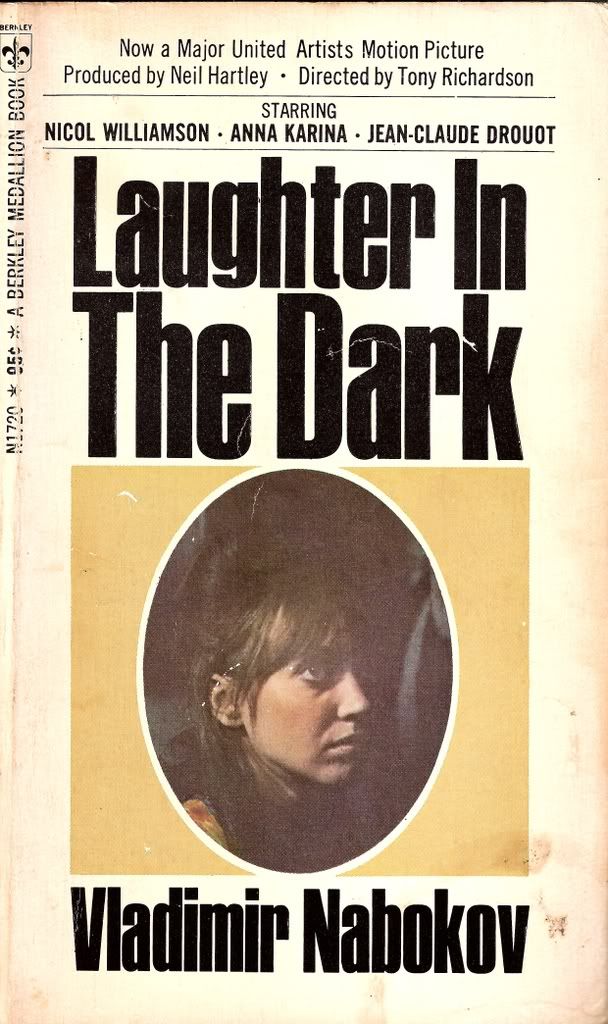
Review: Laughter in the Dark

An early Nabokov novel about a man named Albinus, a well-to-do German businessman who becomes infatuated with a callow younger woman. There are some similarities here with Pandora's Box or "Der Blaue Engel" (for fans of Weimar Cinema) in this story of a rather pompous individual brought low by his romantic entanglement with a younger woman.

Overall, it's a fairly tragic story, as Albinus loses first his marriage, then his daughter, then, in quick succession, his sight, dignity, fortune and life. It has its moments of humor and unique prose. Though hardly as brilliant or radical as Nabokov's later works, Laughter in the Dark is still a well-crafted narrative of one man's folly.