24 December 2008

999 Challenge

As stated previously, I'm going to be keeping track of my 999 challenge here. This is actually going to be my second year of doing the challenge, which was the 888 challenge last year. (The whole thread can be found here.)

I'm using fairly different categories this year. One priority I had when designing the categories was devoting more time to reading books in Spanish. I only had one explicit category for books in Spanish last year, so I ended up reading less than I could have. So, this year I have two categories that are going to be full of books in Spanish, though the categories have been defined loosely enough to allow for substitution if I run into something else I really want to read. I've also added some easier categories to balance out some of the heavier things I'll be reading.

Without further introduction, here are the categories:

I. Gauchos y Porteños
Books by Argentine authors and about Argentina, with a minor emphasis on gauchesco literature.

II. Orientales y Otros Americanos
Orientales is an antiquated term for Uruguayos. This will be a more general category for Latin American authors and books.

III. Eastern European Authors
Nabokov, Kafka, Schulz, Babel, and other Eastern European authors. The seed for this was a passage I read somewhere regarding Kafka, Schulz, and Babel as three important Jewish writers. Since I had books I wanted to read of all three, I figured I'd branch out. Since there are several other Eastern European authors I've been wanting to read, I went that direction. (As opposed to seeking out more Jewish authors.)

IV. Obscure Works
Any work in my LibraryThing library that is shared with 10 or less people. I'll leave this category open, so what will matter is how many people list it at the time I start it.

V. Straight (NBSO) Horror: All the King's Men
VI. Queer (NBSO) Horror: Goths and Weirdos

NBSO = Not By Sexual Orientation. By straight horror, I'm thinking of mainstream contemporary horror, the best example of which is Stephen King, though I'll be trying to read a pretty broad range of authors within this area. The other category is for fiction that has a more marginal claim on horror, such as modern gothics (i.e. Shirley Jackson) and weird fiction (i.e. Liggoti, Aickman).

VII. Audiobooks

Because the library has a good selection and they're great for a daily commute or listening to while working out and they take some pressure off having to read 81 entire books.

VIII. Thugs, Templars, Illuminati
More of a broad secret societies category, with an emphasis on Thuggee. I'll even be attempting to read the Ramaseeana, which is challenging not so much for length as for being a googlebook, which I'll have to read off a computer screen.

IX. Lighter Fare

I was originally going to call this one Humor, but I figured I'd throw in YA, graphic novels, comic strip books, etc.--anything to balance my reading material out a bit. :)

18 December 2008

Getting back on track in 2009

I've been pretty bad about updating the blog lately. This isn't so much for not writing anything as not writing anything that I'm posting here. So, in order to try to get back into the swing, I'm going to be keeping track of my progress on the 999 challenge on here. The 999 challenge is to read 9 books in each of nine categories. Each person picks the categories and books, so it's pretty much just a way of nudging oneself to read more and/or read a bit more selectively. The Librarything 999 Challenge Group is here. I'll post again shortly with my category choices.

16 November 2008

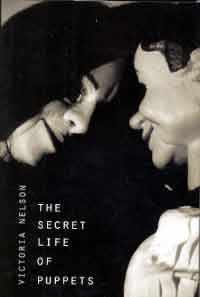
Victoria Nelson's "The Secret Life of Puppets"


Oh, blessed puppets, receive My prayer, and teach Me to make Myself in thy image.
-- Thomas Ligotti, "Mad Night of Atonement"


It feels wrong to me somehow that a book published in the year 2000 with the name "The Secret Life of Puppets" which deals with simulacra and demiurges, fantasy in European high art and American pulp fiction, and Bruno Schulz and H.P. Lovecraft doesn't once mention Ligotti, but perhaps it's just me.

Anyway, I found the book fascinating and thought-provoking, even though I found myself mostly skeptical of the author's conclusions. The argument here is that after the Enlightenment, Platonic thinking has been largely relegated to the background, a consequence of which is that Aristotelian, empirical philosophies have pretty much dominated ever since. However, Platonism and transcendental philosophies provide people with a sense of connection to the greater cosmos, which has been lost in our embrace of rational materialism. Platonic and neo-Platonic thought has found an outlet in culture, both high and low, and the recent conflation of neo-Platonism with technology (as exemplified in movies like "The Matrix") shows that we may be on the verge of a great return of Platonism or new religious reawakening.

As I said, it's an intriguing thesis, and I must admit I find myself mostly in agreement, at least with the way pop culture and art have adopted some of the roles/functions that used to be exclusive domains of religion. But I'm skeptical about the notion of the reawakening. The Matrix and its sequels have come and gone, and we've lost a large part of our obsession with virtual worlds. I'm almost tempted to bring out the old cliché of "9/11 changed everything," which like all clichés does have some element of truth. Anxiety and mystification of technology have been replaced by more conventional anxieties of violence by cultural outsiders. Of course, Nelson had no way of knowing that the western world would receive such a large shock, but at least for the moment the nature of cultural anxieties has shifted.

Another (lesser) criticism is the Lovecraft chapter, which I found interesting but pretty flawed. Nelson appears to be wanting to engage in a psychiatric reading of Lovecraft, which I could understand, but she relies too heavily on some broad generalizations. The impression I get is that Nelson is just trying to hard to find evidence of schizophrenia or syphillis trauma and is cherry-picking from Lovecraft's fiction to do so.

Those complaints aside, the book presents an intriguing look at philosophies of gnosticism and hermeticism, and their expression in popular culture and high art, as well as the way those have developed over the years. Nelson's approach has a certain playful ecclecticism, which is fun to read even when it's not entirely convincing.

25 June 2008

The Secret War: Betrayal

A little experiment in fiction:

Betrayal

That Summer, the Warlock entered into an alliance with Pedro Gutierrez. Nobody was surprised that this resulted in a complete break between him and the Astrolooger, but nobody expected it would happen so quickly.

The Warlock didn't know who he could trust, so his first impulse was to hole up with his few trusted cronies and get rid of everyone else. He had a long message, full of names and places, delivered to the Metropolitan Police, and he went to hole up in a hacienda outside San Luis with his crew. By then he was too well-connected to need worry about where the investigation would lead.

The Astrologer's betrayal was already underway when the police started breaking down doors. He had started organizing when the Warlock had made his first forays into going legit. The Astrologer had no illusions about where a Polack like him would fit into Gutierrez' operation.

He had already determined who was loyal and had began to arm them properly. Procuring so many weapons--knives, guns, explosives, artifacts--without the Warlock's knowledge had been easier than he had expected.

There had been one final item. He hadn't anticipated the depth of the Warlock's cowardice and was sure the battle would come down to a close-up fight between the two. He didn't particularly like the odds of this, as he knew that the Warlock was as skilled with the Nineveh Evocations as any man alive, nor could he hope to match the Warlock's mastery of Enochian.

He had met Guillermo Alberto only three weeks ago at Cafe Serrano on Calle Gallardo. He had first learned of the librarian from a friend of the Harlequin's, whose father had been in elementary school with the librarian. They had a good conversation at the cafe and had quickly struck a deal. The Astrologer was impressed by Guillermo's grasp on the mechanics of the criminal underworld.

It had cost him a lot, for the librarian had not been particularly interested in barter (save for some rare drugs and chemicals which would not have come cheap) but the paper now guarded in his jacket pocket had been worth it. The librarian had been too canny to reveal which book he had copied it out of. Though it was only three long lines of crabby script, it had taken intense study to decipher them, learn them, memorize them. The words had settled unsteadily in the Astrologer's thoughts. Sometimes he thought he could still feel the words taking form in his mouth, like a strong taste that lingered. It was the first time he had encountered Aklo. And he knew it would be the first time the Warlock did, as well.

Low-Fat Fiction: Tourism

I'm taking a class called low-fat fiction, mostly as an attempt to make myself try to write stuff. It's an interesting experience but a little intimidating. Anyway, here's the first piece I wrote for it.

Tourism

It was in the Cafe Jujuy that I first met Rodrigo, who was arguing with the clerk about some matter of politics or sports. Even though it delayed my own order, I didn't hold it against him. We weren't really introduced until a few minutes later when he came over and told me having my map splayed out over the table made me look like an idiot tourist.

"They're watching, you know, all the time," he explained.

He folded the map into a bowtie and handed it to me, flashing a yellowing smile. A short discussion on the literary merits of the city led to an invitation to be shown around the city.

We ventured out of the cafe, into the streets and sidewalks, filled with potholes and people.

The Libreria Sansabar was crammed into an L-shaped space and seemed to specialize in a particular kind of academic tome. A short perusal resulted in little of value.

It was a twenty minute walk to the Libraria Truco, past buildings abandoned then taken over, and Rodrigo seemed to watch for something. The steel door that guarded the shop gave it the feel of a hideout, and concealed the size of the interior.

The shadows had grown long by the time we stepped outside, my bag somewhat heavier.

There was one more, Rodrigo insisted, in the old part of the city, underneath an old mansion.

Twenty minutes later, he turned and asked, "Why'd you come here?"

I didn't see the blade, but something about that smile made me flinch. I fell back, trying to turn out of the way, and the pack struck him in the head.

It was seconds later that I realized I was running, what little sense of direction I had guiding my way back.

14 April 2008

Horror as Initiation: Lee Foust

I wanted to piggyback onto my blog from a few days ago to mention an alternative take on similar material. Lee Foust has a couple of brilliant essays on the h2so4 site.

The Horrific Experience of Countercultural Initiation

The Horrific Experience of Coming Face to Face with the Other 2

I find the distinction between female and male gothic modes rather interesting. Which I think gets back to what I find interesting with Lovecraft. It's common knowledge that Lovecraft projected a certain degree of his racism onto his monsters, often using similar terminology to describe both. Yet, I think Lovecraft also projected a certain amount of his own self image onto those monsters.

I'll mention one early story "Facts in the Case of Arthur Jermyn," which can be read as a neurotic phobia of miscegination. Yet, when HPL describes how the first Jermyn seemed to prefer being put in a madhouse to being around to see his son grow up, I find myself wondering about Lovecraft's own father who ended up in a madhouse and wasn't there to see his son grow up. Jermyn's son, as it becomes clear, is clearly monstrous, only half-human.

So, with respect to female and male gothics, where does Lovecraft fall? Except for a few pieces, his monsters aren't just entities to be beaten so order can be restored. I would argue several of his better regarded stories ("The Shadow Over Innsmouth", "At The Mountains of Madness", "The Outsider") present rather human monsters. But does Lovecraft really fall into the female gothic, where the monstrous ultimately comes to be accepted as good and beautiful? So, does Lovecraft present us with a male or a female gothic, or is it actually something weirder, some form of hermaphroditic gothic?

06 April 2008

The Ritual in the House: Horror Tale as Initiation


I wouldn't say I was a huge fan of horror when I was growing up. I was more into science fiction, which could certainly provide some chills, as in the ending of The First Men in the Moon and the feeding scene from The War of the Worlds. I also picked up a library book by somebody (not Ray) Bradbury about super intelligent animals who gone on a killing spree. (I was in the public library looking for Ray Bradbury but did not pay significant attention to the author's first name.) And I guess I did read the winners of the Miami Herald's Halloween scary story contest and the odd ghost story here or there. But I never really sought out the stuff. I remember when all my classmates were reading Stephen King and V.C. Andrews my reaction was the 80s equivalent of "meh."

It wasn't until I had graduated from college that I found myself interested in reading horror as a genre. The catalyst for this change in taste took place while I was hanging out with my friend Steve at his house. We were discussing books, and he said to me, "You really should check out Lovecraft. He's pretty good" (or something to that effect) and handed me The Best of H.P. Lovecraft: Bloodcurling Tales of Horror and the Macabre with its rather lurid cover:


By this point I'd heard of Lovecraft, from my college roommate Josh (who had attempted to get a CoC campaign going with amusingly disastrous results) and from Illuminatus Trilogy. I was not quite sure what to make of the book and still a little suspicious of the genre, I decided I'd just start with the shortest story. This turned out to be "The Picture in the House" which I read while Steve puttered about on the computer. The story hit me with a certain indefinable force. It didn't have quite the visceral shock of other horror I'd read, but the thing seemed to worm its way into my head in a way that had me hooked. After that, I read pretty much everything Lovecraft had ever written and continued on to many of the pastiche works that fall under the "Cthulhu Mythos" category.

At some point, I became rather bored with the Cthulhy Mythos stuff, most of which is pretty derivative and lacks much of the power of the original works. As I tried to read more broadly in the genre, I've encountered works of a much more visceral nature (Palahniuk's Haunted) as well as those of a much more cerebral sort (Ligotti, Borges). Last year, though, I decided to re-read "The Picture in the House," thinking I might find it tame or hackneyed. I was surprised by how powerful it seemed.

Part of my surprise was because on some level the story shouldn't work. It's about a man travelling around the back country of Massacussetts. He wanders into an old house to avoid the rain and there meets up with a (New England) redneck who happens to be fond of a book with a drawing of a cannibal who is cutting up victims. It turns out that the old man is himself a cannibal and the consumption of flesh has allowed him to live far beyond his years. He is, in fact, over 150 years old. Shortly after the traveller realizes this, a bolt of lightning obliterates the house and knocks him unconscious.

So, murderous rednecks, cannibalism, deus ex machina--all elements that in another story would have me scoffing or throwing up my hands. (Yes, that's you, Haunted. Except for the rednecks.) So, what is it about the story that manages to transcend such hackneyed conventions? I've come to the conclusion that what makes the story so powerful is that it is a story about reading horror and about being affected by it.

The picture that the old man is so fond of is in a book called Regnum Congo, and the drawing is associated with an entry on the Anzique cannibals. If a picture is worth a thousand words, than this picture can be thought of as a horror story. Having "read" this horror story, the old man finds himself developing a strange fascination. As he says: "Queer haow picters kin set a body thinkin'."

Having read and been affected this horror story, he then proceeds to create his own horror story. Namely that of a murderous redneck who consumes human flesh. Though he attempts to cover up this story, he ends up relating it to the traveller nonetheless, who is now involved in his own horror story, which he relates to the reader. The reader thus finds himself reading a horror story about a man hearing a horror story about a man seeing a horror story. It is no surprise that one suddenly finds oneself wondering, however subconsciously, "Am I in a horror story?"

But what really makes this story potent is the strange speech of the old man. (It helped that at the time I had an interest in magical traditions, in Crowley and Sanskrit and the whole lot.) Not only does he say, "Queer haow picters kin set a body thinkin'." He later goes on to add, "Queer haow a cravin' gits a holt on ye." Somehow, the product of these lines echoed in my head, eventually transmuting into "Funny how an idea gets hold of you," a thought which stuck with me long after I had finished the story.

When he was writing horror, Chuck Palahniuk described how one of the features of the horror story is its cyclical nature. This is not a bad insight but seems overly schematic to me. The cyclical nature of the story suggests that it bears some kinship with the practices of pre-modern, pre-Christian life, dominated by its rituals of agriculture, of death and rebirth. I would posit in a world more and more divorced from its own cycles, both those of growth and harvest and those of birth and burial, horror keeps some of those themes alive, hovering on the edge of the culture which has spurned them.

But not all rituals nor all horror stories are or need to be cyclical. One of the oldest, best known horror stories has to be the Book of Revelations, and its reader base certainly believes that's only going to happen once. On a much smaller scale, it can be said no man will ever have more than one Bar Mitzvah. Certainly a community would see many Bar Mitzvahs, but the person for whom it means most will only experience it once. It marks something, a change which is irreversible, like the flow of time itself. It says, "Childhood is over. You can't return. The person you were is no more." In this, it points to the arrow of time, which has only one destination.

It is this aspect which so haunted me about "The Picture in the House" and which I still recognize when I go back to it. "Funny how an idea gets a hold of you." It suggests psychosis, but it also suggested to me one Thug's comment about their initiation ritual: "The Gur of the Tuponee changes you. It would change the nature of a horse." It doesn't matter what you might have thought you were. That is no more. Welcome to the new reality, where feeding on people creates monstrous new realities--where you look over your shoulder to make sure you're not living in a horror story, soon to repeat it to someone else who will be irrevocably changed by it. Then you no longer think "meh" when you see those lurid covers but find yourself fascinated by these stories you believed beneath you.

It really is funny how an idea gets a hold of you.