Showing posts with label 999. Show all posts

24 December 2009

Review: The Keep by Jennifer Egan


The story begins with Danny's arrival at The Keep, an ancient European castle that has come into the possession of his cousin. Though Danny thrives on a busy social scene, he has left New York for the isolated confines of the Keep because he has angered too many people at home. Howie, the cousin, has been very successful in life and has bought the castle with the goal of creating a special sort of resort where people can escape from the modern and allow their sense of adventure and imagination free rein.

The story of Danny, Howie and the Keep alternates with that of its author or narrator, an inmate in a state penitentiary for unspecified crimes. He's taking part in a writing program, where he is creating or remembering the story of the Keep. With this story, he hopes to impress the leader of the writing group, a woman named Holly, but in prison, even writing a story can attract the animosity of a man's fellow inmates.

There's an interesting tension between the two narratives. Both stories are contemporary, but the story of the Keep, while mostly realistic, incorporates so many Gothic elements--not just the Keep itself, but an ancient baroness, a journey into the catacombs, a looming tower--as to push into the realm of fantasy or parody. The prison narrative, while not outwardly Gothic, still very much involves those Gothic elements such as isolation, confinement, the weight of the past, and forbidden longings.

Despite the use of Gothic and metafictional elements, the story is fairly restrained, which sometimes gives the novel a little bit of a truncated feeling. My initial response was to feel a little disappointed by the end of the novel, as if the unique setting and structure of the novel had promised much more than it had been able to deliver. On reflection, my affection for the novel has grown. The Keep is a story about the choices the people make and how those affect their lives and connections with others. It may not indulge the fan of the Gothic novel in the full-on outrageousness one may expect from that genre, but it does use those elements skillfully.

10 July 2009

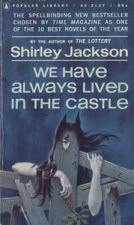
Review: We Have Always Lived in the Castle


The title of the novel is no accident, for it is as gothic a tale as any that was ever set in a crumbling castle on the banks of the Rhine. Its treatment of human evil, isolation and madness could easily qualify it as the pinnacle of 20th Century American Gothic.

A shadow has fallen across the house of Blackwood. Though once a prominent family, a possibly accidental poisoning has reduced their numbers to three (two sisters, an uncle) and made the townspeople suspicious of the survivors. The uncle, Julian, has been left physically crippled and one of the sisters, Constance, has developed a phobia about the world outside the house which does not prevent her from accepting visitors. It is left to the younger sister, Merikat (short for Mary Katherine), to venture into town on necessary errands.

Gothic literature often features singular characters, individuals who seem eerily plausible yet who are warped in a way that makes them unlike anyone else we've ever encountered. Merikat, who is the narrator and thus our guide through this story, is just such a character. It is clear that she views the townspeople with hostility, going so far as to craft charms--ordinary household items such as books or mirrors placed in odd locations or strange configurations--to keep the world at bay.

But soon it does intrude, in the figure of Charles, a cousin from an estranged branch of the family. His healthiness and level headedness seem to promise an opening up of the Blackwood home, a return to normality. But Merikat sees in him a representative of the crudity and selfishness of the outside world and seeks to drive him out through more and more powerful charms. The last of these results in a terrible reaction from the townspeople which sends the Blackwoods into greater isolation, leading to a hauntingly melancholy end to the story.

We Have Always Lived in the Castle is an incomparable achievement, a story that will equally charm and disturb in ways that sometimes can be almost intolerable. And you will probably never forget Merikat Blackwood.

09 July 2009

Review: Lamb; the Gospel According to Biff, Jesus' Childhood Pal


In The Last Temptation of Christ, Judas finds himself in a terrible situation. Jesus has told him that it will be necessary for Judas to betray him in order for mankind to be saved. As Christ acknowledges, God gave Judas the really hard task, that of betraying someone who he holds very dear. By comparison, all Christ has to do is die.

Though it's never acknowledged, the narrator of this book finds himself in a similar bind. As the lifelong friend of Joshua (aka Yeshua aka Jesus) and under the dictum that "dying is easy; comedy is hard," he has been left the harder path. All Joshua has to do is die. Biff has to make it funny.

Biff has been brought back to life by God so that he can write the definitive gospel since he was there from nearly the beginning. In order to ensure his cooperation, God has an angel chaperon Biff. Though it makes up very little of the story, the scenes of Biff and the angel in the hotel room are some of the funniest of the novel, especially in the angel's befuddlement at modern life.

Biff first met Joshua when they were both kids, and Joshua was bringing lizards back to life for the benefit of his younger, lizard-killing brother. From there they strike a lifelong friendship not impeded by the fact that Joshua knows he will one day be the Messiah. Biff is your quintessential underachiever, and his philosophical outlook, which has been derived from the teachings of Cynic, makes for a nice foil for Joshua's earnest desire to fulfill the task that has been set before him. When Joshua decides he will never learn how to be the Messiah if he does not seek out his origins, it is Biff who accompanies him on his travels.

They go in search of the Three Wise Men in order to learn the truth of Joshua's birthright. In their travels, this Hebraic Hope and Crosby encounter bandits, Taoist magicians, herbalist concubines, a hungry demon, a Buddhist monastery, the Tibetan Man of the Mountains, martial artists, a Kali ceremony, Tantra, untouchables and the Kama Sutra. After their travels, Joshua comes to learn what he has to do to become the Messiah, so they return to Palestine for the more familiar part of the story.

Christopher Moore here has a fine line to tread in attempting to make the story of Christ funny and believable yet keeping Joshua as the earnest Messiah figure we can all look up to. (No Last Temptation-style dream sequences of Christ experiencing the temptation of giving it all up here.) Having the story told by the underachieving and very sardonic Biff is a great way to thread that needle.

Moore makes the most of the sections where the gospels are silent, which give him a lot to work with. It yields great comic touches, like the time Joshua, Biff and Maggie decide to "circumcise" a well-endowed Greek statue, or the origins of the Jewish custom of Chinese food on Christmas. Though not every joke works, the passages overall maintain a high level of humor without robbing Joshua's quest of meaning.

The humor does begin to lost its impact near the end. Once Joshua and Biff return to Nazareth and Christ begins his ministry, Moore has less leeway with which to play. Once the ministry and the inevitable path to Golgotha have begun, the humor becomes more forced. As Joshua himself once said (though not in this book), a man cannot serve to masters, for he will honor one and neglect the other. The book has to choose between the earnestness of Joshua and the cynicism of Biff. It opts for the latter, for which one cannot entirely blame Moore. To have gone with the latter would have been to write a different, much edgier book. That Moore manages to make both elements work for as long as he does is testament to his talent and his great sense of humor.

25 June 2009

Review: La continuacíon y otras páginas


La continuacion is an anthology of stories and poems from Silvina Ocampo, who was friends with Borges, married to Adolfo Bioy Casares, and sister to Olivia Ocampo. In reading her short stories, I found it tempting to compare her to her contemporaries, Borges and also Julio Cortazar, which isn't entirely fair. Ocampo is certainly drawing from some of the same influences as those authors, but her perspective and style are clearly her own.

Among the themes are the blurring of identity (probably used most effectively in "La casa de azucar"), memories of childhood ("La siesta en el cedro"), and textual games ("Carta bajo la cama" and "El diario de la Porfiria Bernal"). Ocampo usually injects these themes with her own particular approach, as with the air of mystery and sadness that pervades the childhood stories. Of particular note is the sensuality of some of the stories, brining a certain liveliness to those elements. Admittedly, not all of the stories are great. (Of particular note is "El pecado mortal" for its oddly engaging take on the intersection of religion and sex.) Some of the later tales seem to have interesting concepts, though used in ways that struck me as less original.

Overall, a pretty nice collection presenting a sampling from the authors lifelong output.

07 June 2009

Review: In Defense of Food


In Defense of Food is the latest from Michael Pollan, whose previous The Omnivore's Dilemma examined the environmental impact of modern food production. In Defense, Pollan sets his sights on the modern Western diet, including some of the thinking that has gone into producing and justifying it. As Pollan lays it out, the modern diet has been shaped too much by the profit motives of large food producers and too little by the needs of human beings. While traditional diets were a product of a culture's trials and errors over centuries, the attempt to apply scientific methods to modern food production has resulted in food that is less healthy.

Pollan has a name for the allegedly scientific framework which has come to dominate the way that we think about food: nutritionism. Nutritionism, as distinct from nutrition, is a quasi-scientific set of ideologies about food which reflect little about the real impact of diet on health. Nutritionsim creates the illusion of being a scientific perspective on eating. And though it would seem that the scientific method, powerful as it is, should be able to determine what foods are or aren't healthy, it has failed for several reasons. In part, this is due to the sheer complexity of any diet, which renders it nearly impossible to look at x nutrient or y food item in isolation.

Additionally, the nutritionist impulse to view foods as collections of nutrients instead of whole units can result in bad conclusions. If a study finds that a diet high in red meat and low in fruit lead to higher rates of cancer and heart disease, what would be the logical conclusion? Through the nutritionist lens, that means that the goal should be to cut saturated fats (and cholesterol) and increase fiber (or antioxidant) intake. But switching to leaner meat and ramping up on oat muffins (and antioxidant supplements) does not appear to yield the same benefits as the high-fruit diet.

What then is the solution to the complicated thicket of competing health claims that present themselves in the marketplace? Pollan's recommendations are elegant in their simplicity: Eat food (as opposed to food-like stuffs). Not too much. Mostly plants. He also recommends a return to more traditional forms of eating, especially preparing food from scratch and eating with people instead of in isolation (and on the run).

It seems there is a growing number of people questioning the effect of the modern diet, a trend that Pollan has both helped fuel and benefited from. I would recommend the book to anyone considering a new look at the way we eat now and how much harm it might be doing. Pollan's non-dogmatic approach to the subject makes it an enjoyable read. His thesis about nutritionism may be stark, but his presentation and advice are not.

10 May 2009

Review: Suite Francaise

Ever since picking up my first work by Nemirovsky last year, I've admired her talent for observing the human condition. There's something about her observation of people and their actions that suggests a balance between optimistic humanism and world weariness. In Suite Francaise, she trains her fine eye on the way that people react, and then adjust, to war, specifically Germany's invasion of France in WWII.

The book is divided into two sections. The first section begins as the news spreads through France that the army has been unable to stop the Germans. With the Blitz heading towards Paris, panic spreads, and people begin to flee to the countryside. Nemirovsky quickly introduces several people, including one family, and the preparations they make to leave. At first, the sheer number of characters made it a bit confusing, but as the story progressed, I got to know the characters better and became able to distinguish them.

As the Parisians flee, they often find themselves in pretty harrowing circumstances. The invasion has thrown things into disorder, and people who've led lives of privilege and prestige suddenly find the charmed existence that they enjoyed has suddenly disappeared. At first the Germans appear only as news on the radio, but then there are bombings and aerial strafing, followed by pitched battles. The story reflects the horror and confusion of war. As the first section ends, the government has fallen, the fighting has ended and people are in the process of putting their lives back together.

The second section begins in the countryside, specifically in one of the villages to which one of the Parisians had fled. The Germans have gone from being an invading army to an occupying one, and in the process have gone from being an amorphous threat to having a very human face. In fact, the presence of all the young men in a village which has seen its own boys killed or taken prisoner gives rise to a strange dynamic of affection and resentment. This section felt even stronger, as Nemirovsky probes all the fault lines, allowing for a much slower boil of conflicting emotions and allegiances.

Because Nemirovsky was sent to the death camps, she never finished the novel, so the second section of the novel ends somewhat abruptly. Though not part of the novel, I couldn't help but contrast Nemirovsky's eye for day-to-day humanity with the sheer inhuman evil of the Holocaust. I also couldn't help wondering how this chronicle of the war, with all its fine detail and observations, would have continued had she lived.

30 April 2009

Review: El Túnel


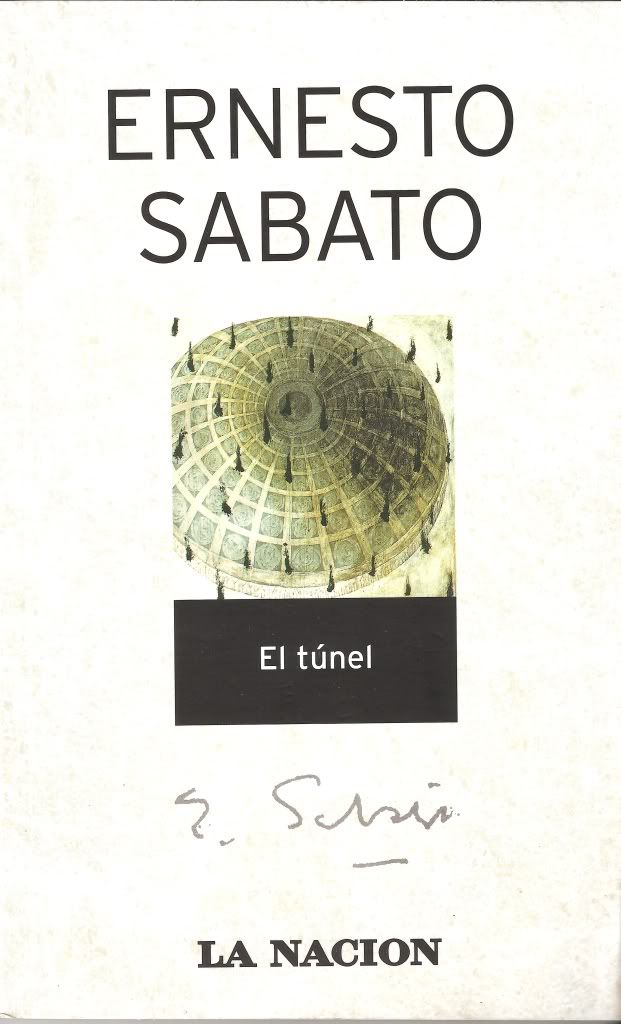
Ernesto Sabato's El Túnel is the first person account of an artist's murder of the one person who understood him best. At an exhibition, Juan Pablo Castel notices a woman captivated by the window that takes up a small section of one of his finished paintings. She is the only person who appears to have realized the importance of the window, which leads to him becoming to become slowly and utterly fixated on her.

He seeks her out in a somewhat roundabout matter, finally running into her seemingly by accident. He learns that she has been thinking about his painting all the time since that showing. They become romantically involved, but Castel feels she is not being completely honest with him. He begins to suspect she has other lovers, perhaps even that he´s just a plaything to her. He becomes increasingly obsessed with possessing her until his actions cross over into derangement.

This is a novel about obsession and man's futile struggle for meaning, and it is no surprise that Camus found it important enough to have translated into French. I must admit I was not entirely captivated by the story. Though I'm fond of eccentrics in literature (especially the obsessive kind), I often found Castel's obsessiveness more irritating than contagious. I also felt the metaphor of the tunnel as reflecting the essential loneliness of human existence was a bit on the literal side.

So, overall an interesting look at one man's obsession and how it reflects modern man's fruitless search for connection, but not entirely satisfying.

Review: Cola de Lagartija


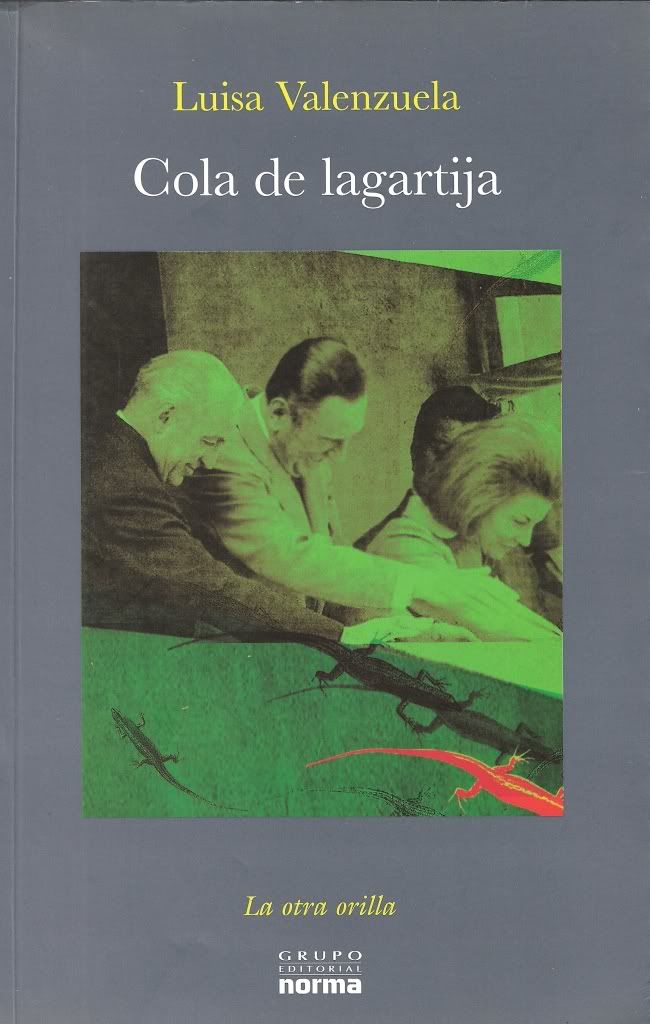
When Juan Peron returned to the Argentine presidency for the last time in 1974, he brought along two intimates who would go on to create some trouble. The first was his third wife Isabela, who would ascend to the presidency after his death. The second was Jose Lopez Rega, a character so odd it seems hard to believe he was not invented by Arlt or Borges. Rega was fascinated with occult and mystic arts, including Umbanda (like Santeria or Voodoo) and astrology. His interests earned him the nickname El Brujo, not inappropriate given the Rasputin-like hold he had on Peron and later Isabela. It was under Rega that Dirty War began, which was run out of the Office of Social Welfare under the auspices of the triple-A. (Argentine Anticommunist Alliance)

Cola de lagartija is based loosely on Lopez Rega, parting ways with the historical facts of Lopez Rega to create a surreal and disturbing meditation on violence and power. After the fall of Isabela's government, El Brujo heads to his childhood home of Laguna Negra in northern Argentina with his followers. Here he organizes new rituals of blood and sacrifice, and stages a very twisted orgy to which he invites prominent members of Argentine society.

Even in internal exile, he is dangerous enough to inspire enemies, among them the ruling junta, a revolutionary, and an author working on El Brujo's biography. The revolutionary and the author have a brief relationship, during which the revolutionary asks the author to finish her book by killing off El Brujo. But can she really pull it off in such a way as to kill the original?

El Brujo soon finds a new enemy in the mayor of the town of Capivari and its little newspaper. He takes over the town and the newspaper, changing the emphasis of the latter to occult themes. This inspires in him the plans for a new ritual, an immaculate conception which will cleanse Argentina in a river of blood.

I was expecting a touch of the strange, perhaps even some magic realism, when I started this book, as can only be expected from a story based on an already strange individual. But the story is strikingly surreal, often disturbing or funny, presenting an exaggerated look at the relationship between power and violence, and the role of the journalist or writer in responding to the terrible.

28 April 2009

Review: El Cantor de Tango

Bruno Cadogan is writing a dissertation on Borges' view of the tango--especially the older, less sentimental tangos Borges would have heard in his youth--when he hears that in Buenos Aires there is a man, Julio Martel, who sings the tango in this older style. Since no recordings exist of Martel's singing, Bruno heads to Buenos Aires to seek him out personally.

When he lands in Buenos Aires, he finds a room for rent in the very same building which housed Borges' Aleph in the story of the same name. From here he begins his quest for Martel, which turns into a labrynthine wandering through Buenos Aires in time and space. Martel, it turns out, has decided to forgo a career in order to use his tango singing to mark off places and events in the city that hold some particular meaning for him. He also becomes fascinated by the possibility of finding the Aleph in the house where he is staying.

This labrynthine wandering was the strongest aspect of the novel, and I really appreciated how Martinez explored and even celebrated the city of Buenos Aires and its lengthy and often tragic history. I cannot say if someone who has never visited the city would feel something similar, but I would certainly hope that the book would provide some motivation for planning a visit.

The novel did have a couple of flaws. Bruno Cadogan is meant to be an American, but he really thinks and acts more like an Argentine. While a minor flaw, it does cost the novel some verisimilitude. For me the larger flaw was that the novel was almost too Borgesian (never did I thought I would say that) in its use of allusions and homages to the point where it almost became distracting. (Bruno himself seems an obvious homage to Cortazar's "The Pursuer," also about a writer named Bruno fascinated with a troubled musician whose art allows him to experience time differently.)

Despite these flaws, I still found it a captivating read and greatly enjoyed its wanderings through the mazes of space and time which make up the reality of Buenos Aires.

Review: Plata Quemada


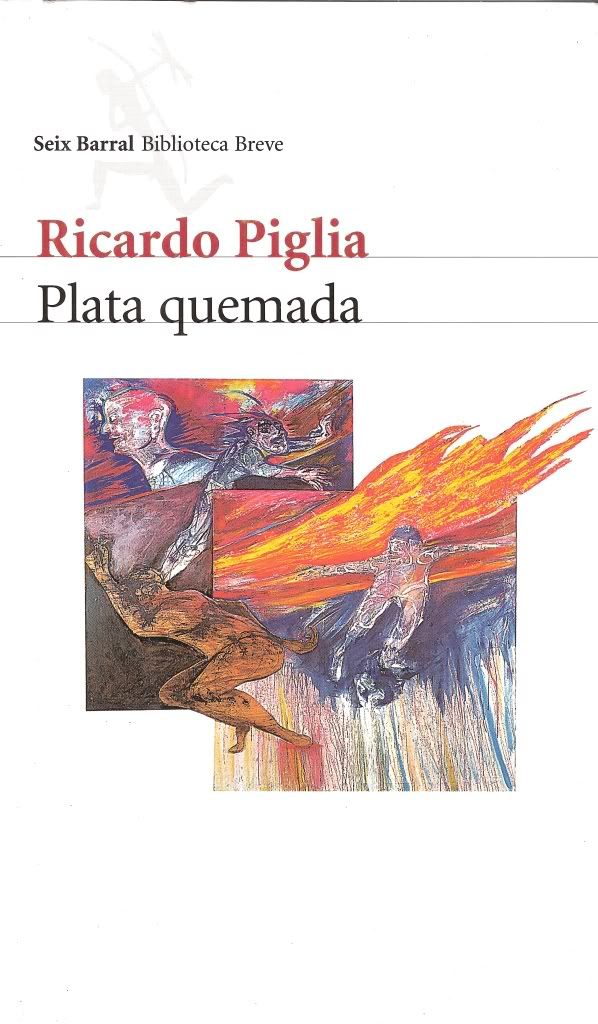
A group of Argentine criminals have got what could be a great heist planned out. They will grab the municipal payroll in a daring daytime robbery, then cross the river and slip into Uruguay until the heat dies down. The gang includes Gaucho Dorda and Nene Brignone, who are lovers; Cuervo Mereles, who swaggers with outlaw charisma; and Malito, a cold-blooded and calculating man and their defacto leader. The robbery goes off as planned, but they soon find themselves on the run, guns blazing as they drive their getaway car through the streets of Buenos Aires. Though the events related in Money to Burn seem outrageous enough to belong to a Tarantino film or a pulp crime novel, Ricardo Piglia as invented nothing in this hypnotizing tale of crime, loyalty and vengeance.

Piglia has a minor personal connection to the story, having met Mereles' ex-girlfriend in 1966 while on a train ride to Bolivia. During the trip, she told Piglia a confused and seemingly incredible story of the man she had been in a relationship with and the crimes he had been involved in. Though he never saw her again, he became fascinated by the story and began to research and attempt to write about it. It was a project that he ended up setting aside for the better part of two decades, only to return to and finish later.

Plata Quemada is a novelistic retelling of true events, with Piglia acknowledging where the historical record is ambiguous or incomplete. The only license taken is in the extent to which we get inside the heads of those involved, not just the criminals but also the police who are hunting them. What emerges is a fascinating portrayal of criminality and politics in Argentina and Uruguay of the 1960s, as well as an unforgettable portrayal of characters far outside the pale.

27 April 2009

Review: Toda Mafalda


Joaquín Salvador Lavado, aka Quino, is a cartoonist with a talent for observing the human condition and translating it into striking and darkly comic observations. Many of his works feature recognizable people in situations whose nightmarishness is made more painful by the truths so cleverly expressed. (It should come as no surprise that Quino's representations of bureaucracies at work bear some resemblance to Kafka's.) However, the comic strip Mafalda combines this dark comic sense with the more innocent realm of kids growing up in Argentina in the late 1960s.

If you are already familiar with Mafalda, Susanita, Manolito, Felipe and the rest of the gang, you probably need little convincing as to why Toda Mafalda, which features every Mafalda strip Quino ever created (including several for side projects or that were left out of previous collections) is a very good thing. (Sadly, the book is not in translation, though the individual collections have been published in English under the name Mafalda & Friends.)

Whenever I've tried to describe Mafalda to friends, I usually resort to describing it as "cross between Peanuts and Bloom County or Doonesbury." Like Peanuts, the principal characters are a group of kids with striking personality differences. (Though unlike Peanuts, the parents are also characters in the action.) But like Doonesbury and Bloom County, the comic deals with political and social topics of its time, including the Vietnam War and the crises affecting Argentina.

The appeal of Mafalda, though, is not in its topical commentary, much of which is dated or inaccessible to the non-Argentine. For one, as with Peanuts, the characters are quite memorable. There is, of course, Mafalda herself, a little girl more fixated on the problems of the world than adults around might find healthy. There is a certain poignancy to her, a sense that sometimes we feel a bit like children ourselves when faced with the complicated and seemingly unsolvable problems of the world. Mafalda has a perfect foil in Susanita, a superficial gossip girl who dreams of achieving status through marriage and motherhood. Her ambitions are something of a throwback, even for their time, but her fascination on the social realm and its secrets is still with us today.

I could go on, but I fear that my descriptions would not do the characters justice, nor Quino's often funny takes on politics, work, friendship, life and death. This is the kind of collection worth having on hand and revisiting quite often.

Review: El Juguete Rabioso

El Juguete Rabioso (usually translated as The Mad Toy), the debut novel of Roberto Arlt, was published with the help of Ricardo Güiraldes. It is arguably Arlt's most biographical work, chronicling the (mis)adventures of Silvio Drodman Astier as he attempts to find some way out of the poverty and alienation he has been born into.

Silvio is the parent of immigrants, an outsider in the world of early 20th Century Buenos Aires. He does not lack for ambition, though it often seems that the world works hard to thwart whatever minor dreams he may nurture. Because his father has abandoned the family, he finds himself having to quit school and seek work in order to support his mother and sister. At first he gets together with a couple of other neighborhood kids to engage in some theft, though their first crime--the break-in and robbery of a library--becomes their last after a close call with the police. Later, Silvio goes to work for a dishonest book seller, lands a job with the mechanic corps of the Air Force, and finally works as a paper salesman. The last of these turns out to be such drudgery, that he begins to consider returning to a life of crime.

Arlt expresses Silvio's drive, his hunger for success, in terms that must have been very familiar to him, as the changing circumstances move Silvio to alternate between hope and despair. The title is perhaps a little obvious in its metaphor: Silvio's overwhelming drives and passions combined with his inability to be enact them make him feel like some fierce frivolity. These different poles of existence are expressed in Arlt's unique prose, which combines lyricism with the street language of Buenos Aires.

El Juguete Rabioso, as with most of Arlt's works, is a bracing, sometimes almost painful, work with moments of dark humor or fascinating inventiveness. It pales a bit in relation to Arlt's later The Seven Madmen (arguably his best work), in comparison with which it seems somewhat conventional, but if you've never read Arlt and are interested in encountering his unique representation of the alienation of modern life (Argentine style), El Juguete Rabioso would be a good place to start.

23 April 2009

Review: Don Segundo Sombra

Don Segundo Sombra is the story of an orphaned boy named Fabio who has spent most of his early years in a small town living a somewhat rootless experience. One day he meets a gaucho named Don Segundo Sombra, the character who gives the novel its name, and is so impressed by the gaucho's quiet dignity that he decides to take him up as a mentor. He seeks out to the ranch of Sombra's current employer in order to obtain work alongside the gaucho. In the years that follow, he learns much from Sombra and travels widely around Argentina. The narrative details some of the adventures he encounters along the trail, including time spent among other gauchos.

Though there is some overlap, there is also a marked difference between the gaucho life as portrayed in Martin Fierro and that seen in this novel. Martin Fierro may have his honorable aspect, but he is basically an outlaw and a killer. While Sombra has its share of drawn knives, bloodshed is generally avoided. The one death that does result is portrayed as a tragedy and waste, without the outlaw romanticism of the older book.

What is most striking is the extent to which the gaucho is a civilizing influence. It is through Don Segundo that Fabio learns about courage, honesty and loyalty--values it is implied that he would not have picked up had he stayed with the distant relatives with whom he is staying at the beginning of the novel.

Like Martin Fierro, the novel's language draws heavily from Argentine, especially gaucho, manners of speaking, though written in a more natural and readable style. As with much gauchesque literature, the gaucho Sombra serves as symbolic of national character. Unlike those older works, Sombra was written when the real-life gauchos had begun to disappear and so reflects the shift of the gaucho from reality to myth, a lost emblem of the forging of personal and national adulthood.

22 April 2009

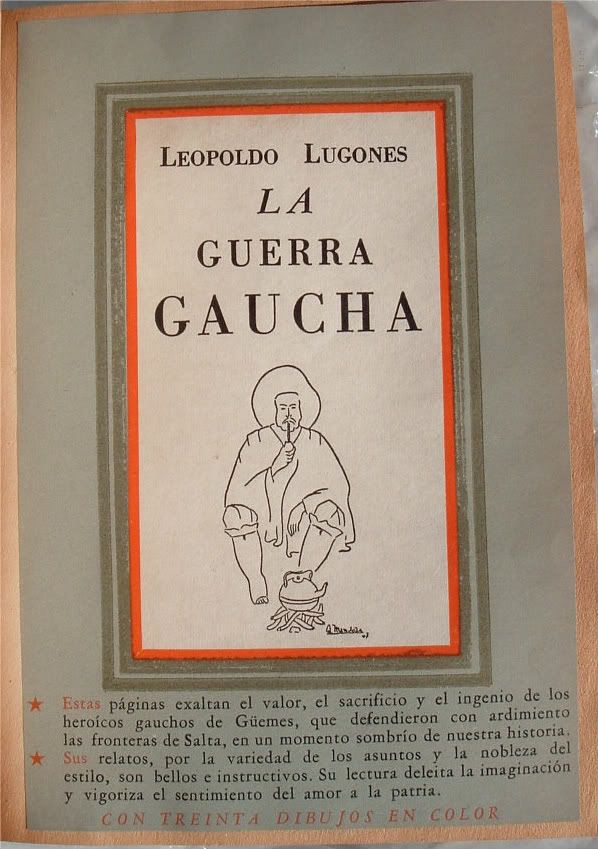
Review: La Guerra Gaucha


One dramatic footnote in the Argentine War of Independence took place in the northern provinces of Salta and Jujuy, where Spanish-led troops faced off with a guerrila force made up of local gauchos. Though not as strategically important as the campaigns of San Martín, Leopoldo Lugones found the confrontation between Spaniard and gaucho to be fertile ground for an exploration of courage, honor and patriotism. He travelled to the region to learn the oral traditions of the conflict and see the locations where the fighting had taken place.

Though he originally intended to write it as a novel, Lugones found that he could not work everything he wanted to say into one narrative, so La Guerra Gaucha became a collection of stories about the war. The short stories are to some extent disconnected: some feature skirmishes or battles while others feature the more day-to-day aspect of life during the war, and rarely does one get a sense of where each story fits into the larger strategic struggle.

The fighting, however, does serve as the binding force of the narrative. Even a simple local gathering can suddenly erupt into tense confrontation, and there are several stories in which the act of violence occurs suddenly, shockingly. The stories are also connected by several thematic elements, including the harshness of war, the desire for freedom, courage, sacrifice, fatalism.

The book does not want for fascinating characters--the friar who risks his life to signal the patriots, the gaucho who stages a suicide attack on a royalist fort, the young royalist lieutenant falling in love with a local widow--but Lugones' descriptive powers are effectively used to evocatively describe the land and its features. I never really considered Lugones a brilliant writer, as his other short story collections (Strange Forces, Fatal Stories) were longer on concept than linguistic fireworks. La Guerra Gaucha, on the other hand, reflects a sophisticated and striking command of language and imagery in service of the story he tells. Here he crafts a real sense of place to serve as powerful backdrop for the war being waged.

I will admit there were off moments, where Lugones shades off into a simplistic nationalism. Perhaps these struck me as terrible in part because I was aware of his later embrace of fascism, but luckily there were very few of those moments. Overall, I'd have to call it the strongest of Lugones' short story collections.

(Sadly, this book does not appear to have ever been translated.)

21 April 2009

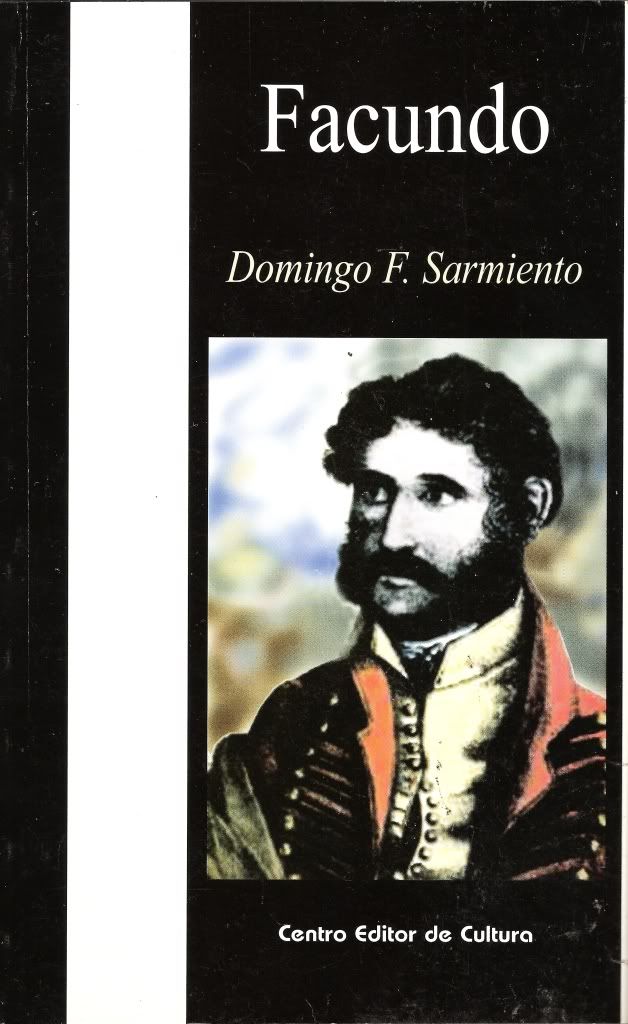
Review: Facundo

Domingo Sarmiento wrote Facundo while he was in exile in Chile, having had to flee Argentina due to Juan Manuel Rosas, the country's first dictator. Facundo can be read as his attempt to come to grips with the forces that brought his country under dictatorship and sent him to exile.

Facundo is presented as the biography of Facundo Quiroga, a gaucho and fighter in the War of Independence who would go on to serve as one of the most important generals in the civil war which would bring Rosas to power. Sarmiento uses the biography of Quiroga as a basis for a deeper exploration of Argentine politics and society. Even before Quiroga appears, Sarmiento gives a brief account of the geography of Argentina, and how its history led to a divergence between the city of Buenos Aires--cosmopolitan, cultured, with an interest in new political ideas--and the rural provinces, in which violence and corruption had come to dominate. In doing this, Sarmiento lays out the central struggle of Argentina as one between the Civilization of Buenos Aires and the Barbarism of the provincial caudillos, of which he sees Quiroga as an embodiment.

Quiroga makes for a larger than life figure, so there is a certain logic to his centrality (as opposed to Rosas) for Sarmiento. As a young man, Quiroga had a run in with a puma and killed it with a knife, earning the sobriquet "El Tigre de los Llanos" (The Tiger of the Plains). He dropped out of school while still young to pursue a gaucho existence buyt did not really make much of himself until becoming a leader of men during the civil war. Though not a great strategic thinker, his leadership of bands of gauchos turned out to be key in the victory of the Federalist forces under Rosas. Once Rosas is in power, Quiroga shows little interest in government, and ends up being violently assassinated. (Sarmiento alleges Rosas ordered the assassination, though the historical record is unclear.)

Quiroga can be thought of as many things: as novel, biography, history, and an exploration of the forces at work in Argentine history. Sarmiento sees the gaucho and his culture as expressions of the Barbarism which rejects the standards of Civilization. He advocates for the importance of education and the development of commerce in order to allow Argentina to rise to greatness. Though his theory of this struggle between Civilization and Barbarism tends at times towards simplification,(He seems to have a particular fetish for the use of European-style clothing as expression of political sophistication.) the difference between the European-influenced porteños and the insular world of the gauchos does bring insights into Argentina's history. Whatever its flaws, it's a fairly thorough and fascinating portrait of Argentina's internal struggle after independence and one very noteworthy figure in that struggle.

20 April 2009

Review: Martin Fierro


Martin Fierro is a two-part epic poem about a nineteenth century gaucho of the same name. It belongs stylistically to a tradition of gauchesque poetry, written not in traditional Spanish but in a Spanish filtered through the language, wordplay and lyrical traditions of the rural life of Argentina.

The first part of the poem, "The Gaucho Martin Fierro" introduces us to the character of Fierro, a poor and uneducated, but basically decent gaucho who lives with his common-law wife and children and eeks out a a basic existence. Trouble begins when he is pressed into military service by the authorities (a common occurrence at the time) and sent to serve on the frontier with the "unsettled" lands ruled over by fierce tribes of Pampas and Araucans. Here he is underpaid, underfed, poorly supplied, and generally mistreated. When he sees an opportunity, he flees back to the world he left behind. Later, the authorities catch up to him, and his resistance reveals such a depth of courage and nobility that he finds an unlikely ally in this struggle. Together, the two friends travel beyond the bounds of civilization.

"The Return of Martin Fierro" picks up several years later, with Fierro having found life in the wilderness much harsher than he expected. He returns to his home, where he meets up with the sons--all grown up now--whom he had to leave behind ten years prior. Together, they share stories of hardship and struggle, and of dealing with corrupt and callous authorities. While Fierro finds that the authorities have forgotten about his outlaw status, one act of violence from his past returns to haunt him and to leave the narrative with an ambiguous ending.

Martin Fierro is a sympathetic protagonist, though not without his flaws. He is not just an outlaw and a deserter, but also a brawler and a killer, though he is not without his sense of nobility. When contrasted to the authorities, which exert such power over him yet care little for his welfare, it becomes only natural to feel for the gaucho. I found the combination of the outlaw mystique and the realism of the gaucho's social marginalization to make for a moving tale.

To add to this, Fierro is not only a noble outlaw but also a musician, making his role as archetypal figure all the more noteworthy. The narrative is presented as one in which each of the main characters tell his own story in song, and the combination of musical performance with outlaw machismo struck me as just as deeply embedded in North American culture, whether you're talking of cowboys or gangstas. The climax of the second part involves a "payado," a sort of traditional gaucho song duel in which two guitar-players/singers trade off improvising songs on a theme.

The use of gauchesque style and language make for something of a double-edged sword, providing a unique feel while being potentially difficult to fully grasp. The edition I read was bilingual and thoroughly footnoted, which I found to be very helpful. I managed to understand it pretty well while reading the original, with only occasional glances to the translation. If your Spanish, like mine, is good but could be better, I recommend a bilingual edition. If you're more of a beginner, you're probably better off sticking to a translation, though much of the texture of the gauchesque language will be lost.

Marin Fierro is considered among the first classics of Argentine literature, and as with many a book that I'd heard much about, I approached it with a certain sense of wariness, fearing age would have dimmed its power. However, with its portrayal of a heroic criminal confronted by corrupt authority, and its beautiful and unique language, Martin Fierro certainly earns its classic status.

22 March 2009

Review: Something Wicked This Way Comes


Something Wicked This Way Comes is like a little segment of nightmare, a dream-like tale of innocence threatened by a malignant evil. When a carnival comes to town too late at night and out of season, it is the kind of curious omen that cannot help but draw in two boys on the edge of adolescence, such as Will Halloway and Jim Nightshade. Cougar and Dark's Pandemonium Carnival shows up mysteriously, appears to go up just as mysteriously, and promises secret delights somehow just a little more extravagant than those of the average carnival. So, it can hardly come as a surprise when it turns out that the Hall of Mirrors or the Carousel conceal darker secrets.

Jim and Will are first drawn to the marvelous carnival but soon find themselves the only ones aware of its intentions. As they take action to stop its plans, they make enemies of the strange characters who populate it, especially the sinister Illustrated Man, Mr. Dark. To resist the sinister forces moving against them, they will require some outside help, but who will possibly believe them?

Bradbury has crafted a fine little work of fantasy. Though it's not particularly scary, it succeeds at creating a rather childlike sense of dark enchantment. There's an almost mythic quality to his portrayal of not quite innocent childhood confronted with the wider world. His prose is mostly perfect for the sort of nightmare adventure described, although it did have moments where he seemed to so commit to inflating an already overinflated sentence or metaphor that you lost all sense of what he was actually talking about. But overall, it's the sort of book that makes you wish yourself could visit Cougar and Dark's Pandemonium Carnival, even if just once, no matter the consequences.

15 March 2009

Review: Memoria del fuego - Los Nacimientos

The Memory of Fire trilogy, of which book is the first part, recounts the history of the Americas (with special emphasis on Latin America) through the unique device of breaking it up into bite-sized pieces. The short anecdotes that make up the book are drawn from historical sources, each one noted carefully, though Galeano dramatizes or condenses them to some extent. The result, far from being disjointed, provides a good idea of the history of the Americas.

The book starts with First Voices, which includes creation myths from several different pre-Columbian traditions, including the Maya, Aztecs and Toltecs, Inca, Haida, Araucan, and several other. Though not history in a literal sense, its inclusion starts the book off with a strong sense of the people and land that is about to be changed. It also sets up themes and imagery which will continue to echo through the history of the continent.

The clock starts ticking in 1492, in the section called Old New World, with Columbus' fleet and its sailors anxious to reach a destination, any destination. The arrival of Columbus in Guanahani brings change not only to the Americas but also to Europe, where the religious and political orders need to cope with and make the best of the discoveries that come from the new land that has been discovered. Columbus' few voyages give way to more and larger explorations. The news and rumors of gold, even cities of gold, makes the Americas a desirable destination, both for soldiers of fortune from Europe and the governments who perceive the advantage such a source of wealth can bring them.

Galeano's breaking of the history up into smaller segments proves quite powerful at giving a sense of the dynamic at work in the history of the Americas and also of some of the unique characters involved in those events.

12 March 2009

Review: The Joy of Work


The Joy of Work is the latest in Scott Adams' non-comic strip Dilbert books. The format combines Adams' writing with a few Dilbert strips to illustrate the points that he makes. In this book, Adams suggests that if you are unable to squeeze any more money from the disfunctional sadist who calls himself your boss, your best bet is to increase your enjoyment of the time you have to spend at work. Adams suggests several ways to achieve that end, from the absurd (cubicle yoga, pretending to be psychic) to the surprisingly not impractible (managing creativity). He also describes some of his own experiences in handling criticism, including strips of his which received surprising negative response and even responding to some of the claims of Norman Solomon. Adams' long-form humor is similar to that of his strips, a mix of sarcastic and silly, so if you read Dilbert, you have a good idea of what the book is like.

Review: "El Pozo - Los Adioses"


This book combines two different novels by Onetti.

The first is "El Pozo," which is a first-hand account from a man who has just turned forty years of age. Having turned forty he decides to write about his life, since that is the sort of thing a man should do at forty, "especially if he's lived an interesting life." The narrator turns out to be something of an existentialist character. He recounts something terrible he did when he was young, though he seems unable to grasp the gravity of his actions. He also relates his alienated wanderings around his city of residence. He feels a connection to only two people, a poet and a prostitute, but his attempts to communicate openly with them don't turn out how he expected. It's a brief but interesting sketch of a certain alienated personality.

"Los Adioses," the second story, is somewhat more complicated. The town of Santa Maria is a destination for people needing to convalesce. As the owner of the only market/bar in town, the narrator observes the arrival of a former basketball player who checks into the local hotel. Most of the narrator's knowledge of the basketballer is second hand. Even though the ex-basketballer comes often to the store to pick up beer and his mail, conversation with the narrator is virtually nonexistent. The player's stay brings a series of mysteries, such as the correspondence the player receives (consisting mainly in letters from two different people), why he decides to rent a nearby house, and the visitors he receives. Though the narrator tells us pretty much everything he sees and hears and all the gossip he is told, the mysteries tend to persist in this work of subtle power.