Showing posts with label review. Show all posts

23 September 2010

Behind the Green (Room) Door

After a couple of stories that arguably fit with the horror theme, Palahniuk shifts gears. There's nothing vaguely terrifying, eerie or mysterious going on in this story. In it, Miss America and a "slick guy" sit in the green room of a television studio where some mid-sized town's local version of "Good Morning, America" is produced. They are there to sell products, she an exercise wheel, he a set of investment tapes.

The SG is the more experienced of the two, so a large part of the narrative is taken up with his advice/commentary on these TV shows and what it takes to succeed on them. We learn a little about Miss America's back story. She was once fat, but through diet and exercise thinned down to the point where she looked much better. She is also given to wearing pink. There's not really much else to her. As she herself says, "Losing all that blubber is the only really heroic thing I've ever done... If I gain it back, than it'll be like I never lived." I wonder if it's intentional for this character, so objectified and labeled by society that she has become shallow, to be portrayed in such a superficial way. Is it just poor writing, or does Palahniuk want us to know that he, too, is part of the problem?

As for Mr. SG, he's one of those typical Palahniuk creations who can rattle off facts about some chosen field. Here his obsession is broadcast media, especially television. One of the facts he sites is how cameras collapse three dimensions into two, rendering everything flatter. Because of this, faces with many angles look more interesting than those with less. Advances in image technology, however, tend to relatively bring out the details of faces, so those sharp angles might seem less attractive on current broadcasts than they used to. You could argue that Palahniuk's general point about the way the medium distorts reality is still true, but I wonder if his topicality means that some of his fiction will date rather quickly.

We learn that Mr. SG's parents were both product spokesmen who traveled from town to town to appear on morning shows. His mom is dead, but his dad, who didn't stick around for very long, is the old guy who is currently in the studio of the same station, his presentation delayed by some national catastrophe.

Overall, it's a pretty dull story. If Miss America weren't such a one-note character, seeing her back story might be interesting. Definitely no horror elements, save perhaps the horror of being around people lacking in personalities. There's some potentially interesting commentary about how mass media ends up altering what it portrays, though this hardly provides any deep insights.

16 September 2010

Foot Work

This story is told by Mother Nature, who is something of a hippie New Age type, with her long skirts, henna-painted skin and patchouli smell. She used to be a reflexologist, trained in treating medical conditions by massaging people's feet. It's not a lucrative career, but one day she meets a former classmate who now appears to be living an upper-class lifestyle. The classmate introduces MN to the world of "foot jobs," in which reflexologists use foot manipulation to give clients orgasms that leave them "to weak to walk for the next couple of days." In order to improve her financial situation, MN also gets into the business of foot jobs. At first, she earns a good amount of money, but she soon finds herself competing with too many other former idealists now turned high-priced call girls/guys and being in hock to the mafioso who acts as her pimp. Her friend introduces her to the next "dark side" application of reflexology, as an assassination technique. It is already too late for MN, who now has to go into hiding.

When Palahniuk is on his game, as he is here, he has a talent for coming up with amusingly twisted concepts that seem not entirely implausible. While not as horrific, claustrophobic or suspenseful as "Guts" the story still manages to create something of a paranoid vibe. It's world of reflexologist hit men, Reiki assassins, Feng Shui murder techniques, etc. suggests a darker, quasi-supernatural truth behind placid everyday reality. This story also continues the theme of people willing to employ rather odd means in order to better "get their rocks off."

One quick note: I'm leaving Post-Production, The Nightmare Box, Poster Child and Cassandra until the end. These four stories constitute their own, separate narrative, which can be thought of as the Cassandra Sequence.

15 September 2010

A Change of Direction/The Poetry of Chuck Palahniuk

I've been neglecting to continue with my review of Haunted for a variety of reasons. In part, because as I thought of the project, it became somewhat daunted. However, I've found inspiration to pick up the project again from two rather distinct sources. The first is Julio Cortázar's seminal novel, Hopscotch, written in 155 chapters which can be read in standard order or in a more convoluted "skipping around" manner. (Explained more fully in this Wikipedia entry.) A couple of days ago, while reading it, I found myself pondering whether the two different strategies represented two different ways of reading the novel or in fact represented two distinct novels. Is there an alternate order that would make the novel more powerful, more entertaining, more insightful than either of the two approaches offered by Cortázar?

The second is from Mr. Palahniuk himself in this interview where he describes his goal as the following:
In Haunted, I wanted to mimic the appearance of “Best of” collections. For example, The Collected Works of Poe. Those books alternate stories with novellas and poems.
When I first read that, I thought mainly of how it backed up my feeling that Haunted suffered from a certain lack of focus, that it was a fix-up novel in search of an identity. But in light of Hopscotch, I though I might follow Palahniuk's logic to its inevitable conclusion and treat it as a Collected Works of...

I've decided to reconstruct this "novel" along somewhat different lines, treating as some might treat an anthology. I've already read all of the poetry. Next, I plan to read and review the short stories (save "Guts," about which I've already written) as individual stories) and will finish off with a review of the novella/framing story.

I've already discussed the poetry a little in a previous entry, and reading all of it in a couple of sittings only serves to confirm that there isn't much here in traditional poetic terms of rhyme, meter, flow. There's a common visual element of the subject of the poem standing on a stage, while a thematically appropriate series of images is projected onto them. This element serves to express the way these characters are obscured by their own stories, a visual analogue of the way the character names, based on their backgrounds, crimes, etc., take the place of any sort of personal or family name. (The relationship between the story and the teller being one of the central themes of Haunted.)

One question I had hoped to resolve in rereading Haunted was, "Is this a horror novel?" On the one hand, there's the name, the cover, the fact that it would seem to be the third novel Palahniuk wrote after announcing he would write three novels "reinventing horror," and the Bram Stoker nomination it received. But there's still the question of the content of the book and to what degree it either uses horror elements and/or manages to be scary.

I'd have to say that the poetry falls by and large into the not horror. There's nothing particularly scary, atmospheric, moody. Some of them are amusing and/or transgressive, such as Mother Nature's tale of trying to enter a convent or The Matchmaker's account of his twisted, uh, matchmaking. Some, as with the matchmaker, try to fill in some of the details on these characters. Often, Palahniuk uses them to hit the themes and concepts that the novel also touches on elsewhere.

There's a degree of earnestness to some of these, such as "Evolution," which argues for life as a gift earned by other's sacrifice, and ends asking, "How will you show their birth and work and death were worthwhile?" Or, "Looking Back," in which a woman wistfully talks about raising a child. Sometimes this degree of earnestness can feel a bit heavy-handed as with the Earl of Slander's "Trade Secrets," which ends:
A journalist has a right...
...and a duty to destroy
those golden calves he helps create.
It might be an interesting thought if it were somewhat original.

Overall, the "poems" are a bit of a dud. They don't really hold up on their own, they don't contribute anything in terms of atmosphere, and they often touch on themes that are developed more in depth elsewhere. The poems mostly serve as something of a sideshow or distraction, helping to give the book the appearance of being more complex than it really is.

Next up, I'm going to pick up on the short stories. Since I've already covered "Guts," the next story will be "Foot Work."

28 July 2010

The Fall of the House of Wanker (Guts)

“Guts” is sort of (in)famous for being the story that caused people to faint at book signings. While it’s a dubious distinction for a story, it does capture a good sense of how potent the story is. Whatever problems I may have with the rest of the book, “Guts” is still a brilliant, if brutal, (or brilliantly brutal) tale, worthy of a modern day Poe, albeit one more interested in premature ejaculation than premature burial or in getting off than getting even. It’s a nearly perfect story, with the exception of a couple of moments when Palahniuk seems to overreach.

The story, of course, begins with a falsehood.
Inhale.
Take in as much air as you can.
This story should last about as long as you can hold your breath, and then just a little bit longer.

This story clocks in at somewhere in the 3000 word range, meaning that even at 2500 words, and read at the cheetah-like 600 words per minute, it would still take five minutes to get through the story. I'm not sure what the lung capacity for the average person is, but I imagine five minutes is pushing it. It's even worse if the story is out loud. Even John Moschitta, Jr. (who most in my generation will recognize as The Micro Machine Man) only clocks in at 586 words per minute, or slightly over five minutes. It's arguable that the narrator himself, who describes his lung capacity as "huge," may manage to hold his breath for that long, but it's not advisable for the rest of us.

"Guts" is essentially three stories about masturbation, each more gruesome and twisted than the one before it. The first is a kid of thirteen years old who was always "jonesing for a better way to get his rocks off." The kid hears about stimulating the prostate gland to induce orgasm and attempts it using a carrot and some Vaseline. When he gets called to dinner, he hides the carrot but comes back to see that it has disappeared along with is dirty laundry. From that day onward, a sense of shame and foreboding hangs over his relationship with is parents.

The second kid hears from his older brother that orgasm can be intesified through the insertion of a thin smooth tube into the urethra. One evening, while high he uses a thin tube of wax, which he's taken from a candle dripping, in order to try out this theory. Just as he's about to climax, he realizes that the tube has disappeared. A few hours later, his abdomen begins to hurt. After being taken to the hospital, an X-ray reveals that the tube has fallen into his bladder and is absorbing minerals, growing rough and damaging the inside of his bladder. His parents have to dip into his college fund to pay for the operation. "One stupid mistake, and how he'll never be a lawyer," the narrator tells us.

The last story is the narrator's own. He used to masturbate in the pool while sitting naked on the drain at the very bottom, which he called Pearl Diving due to his practice of snatching all the floating ejaculate from the water afterwards. As he finished one day and goes to kick off for air, he finds that he's stuck. Looking back, he sees "some kind of snake, blue-white and braided with veins" has come up from the pool drain and is latched on to his butt.

This is where the novel achieves something almost Poe-like. As the narrator realizes that the snake is actually his small intestine--pulled out by the suction of the drain--and begins to consider his actions and the consequences, the story achieves a degree of claustrophobia, compounded by the gruesome body horror, that makes it difficult to forget or dismiss. The kid eventually does what he has to in order to survive, telling us in a line that is perhaps a little too clever: "If I told you what it tasted like, you would never, ever again eat calamari." (Of course, "If I told you what it tasted like, you would never, ever again eat chitterlings" would be more accurate, but probably leave many confused.)

Afterwards, his family lives in denial, his dad attributing the mess to a dog that fell into the pool. It is just at the end that Palahniuk/the narrator seems to overreach, laying out the final horror wherein his sister misses her period, implying that she has become pregnant from the ejaculate in the pool. It is at this point that the story crosses over from extreme but plausible to simply ridiculous, for reasons I won't get into at this point. However, overall it's a brilliantly gruesome story, that manages to inject dark humor and a certain melancholy into its shocking proceedings.

26 July 2010

The First Second Poem (Landmarks)

Because my previous experience with Haunted was with the audiobook version, I had always assumed that "Landmarks," a poem about St. Gut-Free, was the first poem in the book. However, the index in the back indicates that "Landmarks" is the second poem. "Guinea Pigs," which I had previously identified as the cold open turns out to be the first poem, or perhaps I should say "poem." Due to the structure of the book, I had come to the conclusion that all off the poems are told from the point of view of a single character, who in the visual scheme of these poems stands on a stage, as if presenting at some odd open mic night. "Guinea Pigs" is from the collective perspective of the rest of the framing story, with no visual sense of being "spoken" by any particular character, so I'd always assumed it was just another section of the framing narrative.

The poems are sort of an interesting feature, though not so much for the poetry themselves. Even calling them poems is a bit of a stretch. Now, I confess I consider myself a pretty unsophisticated reader of poetry. My general approach is to read a poem out loud and judge it by how it feels being spoken. This doesn't give me much more than a general impression of whether I like a poem, but it beats poetry read silently, which usually feels a little flat to me. By that standard, these poems don't quite work. The language doesn't vary much from the style Palahniuk uses in the rest of the book.

What sets the poems apart is more their visual and structural elements. As I mentioned above, the poems all feature the visual of a character standing on a stage speaking. There's a short physical description of the character as well as a short introduction. Some of these are proper stories, others are more of a general rambling either about themselves or something of interest to them. The other common feature is of a movie playing over the characters, as a form of spotlight, which tends to echo whatever the character's theme is. This heightens the sense that these are archetypes of a sort.

In terms of the narrative structure, the poems are each told by the character whose story immediately follows. There are a couple of stories that are not preceded by poems, but I'll get into that later.

"Landmarks" brings St. Gut-Free who is so skinny that "his hands touch in the middle of his back." He tells a story of the job he used to have, where he drove a bus for tourists. One day, he takes the bus by his parents' house, and on spotting his father out front, dubs him "Saint Mel, the Patron Saint of Shame and Rage." He comes back the next days and adds, Saint Betty, "The Patron Saint of Public Humiliation." He later drives by his sister's condo and adds Saint Wendy, "The Patron Saint of Therapeutic Abortion." When he drives by his own apartment, he christens it the shrine of "The Patron Saint of Masturbation."

Overall, the poem is fairly amusing and interesting. If I praise it slightly at this point, it is because some of the impact should come from the discomfort of the combination of sainthood with these rather terrible things. This is pretty standard for Palahniuk, so seems a little less innovative now that I'm more accustomed to his shtick.

20 July 2010

The Wheels on the Bus (Chapter 1)

Chapter 1 begins with a bus picking up Comrade Snarky who is wearing "an army-surplus flak jacket--dark olive-green--and baggy camouflage pants, the cuffs rolled up to show infantry boots...a black beret pulled tight on her head, she could be anyone." I think those last four words are worth paying note to, since this is not that last time we'll see a character disappear behind a costume. I think it's fairly ambiguous whether this qualifies them as 2-D slasher flick victims or something more complicated, such as the archetypal lost souls I suggested previously.

The Matchmaker, introduced a little later in the chapter, not only comes in with cowboy boots and a straw cowboy hat, spitting brown tobacco juice out the window, but even (just in case you didn't get he's a hayseed) trailing horse shit. Before we move on with the characters, who we'll learn more about (or not) in future chapters, it's worth noting one last detail. Director Denial arrives with her cat, Cora Reynolds, and a tweed blazer, one of the lapels of which is swollen out from her chest. "A shoulder holster," says Comrade Snarky on seeing that.

These people are all being picked up in the dark hours of the morning, before the sun hasn't even come up. After this, they know they will be in their isolated writer's retreat, an experience likened to being on a desert island. They are each allowed one suitcase because "there will be a lot of [them], and the bus taking them to the desert island is only so big." (Here's hoping Palahniuk is aiming to mix up his metaphors, and just for the record, were I taking a bus to a desert island, my suitcase would contain scuba gear.)

As they get on the bus, they think about the people they are leaving behind.
Those people still in bed, they'd be asleep another hour, then washing their faces, under their arms, and between their legs, before going to the same work every day. Living the same life, every day.

These people would cry, but then they would go back to waiting tables, painting houses, programming computers.

It's a sentiment echoed by the organizer of the writer's retreat, Mr. Whittier, an old man with a "spotted shiny dome" of a scalp across which a few gray hairs have been combed. He tells them: "The people you're sneaking away from, they don't want you enlightened. They want to know what to expect."

I wonder if Palahniuk is still read in fifty years, whether he'll be considered largely an author you read when you're still young, preferably in high school or beginning college, like Jack Kerouac. It's possible that Mr. Whittier is not meant to be a mouthpiece for the author, but I doubt that since some variation on that sort of thinking seems to crop up often in the author's novels.

I confess it's a point of view I find myself having less patience with as I grow older. Yes, those people who have been left behind by their loved ones probably would get one with their lives, but I can't say I blame them, since the alternative would be to go chasing after those selfish pricks who abandoned them. Additionally, I wonder how Palahniuk's criticism fits in changing times.

In a time of increasing personal bankruptcies, of great economic risk being transferred from governments and business to families, is the desire for some sense of security--knowing you won't be homeless in retirement or that you'll be able to put your kids through college all that unreasonable--all that unreasonable? Or is Palahniuk prescient about how even the little security people had in 2006 would soon be destroyed by uncontrolled avarice?

Nonetheless, these would-be writers are not without their own economic dreams. They hope to write
...some maserpiece. A short story or poem or screenplay to make sense of [their lives]. A masterpiece that would buy [their] way out of slavery to a husband or parent or corporation. That would earn [their] freedom.

There's an interesting conflation of literary (masterpiece) and monetary (buy, earn) goals in that paragraph. Since this story of would-be writers began as a story of critics, I feel I must turn to Ricardo Piglia's commentary on the intersection of those realms (from his brilliant "Assumed Name"):
...as in every good detective story, what is at play is not the law, but money (or, more appropriately: the law of money). ...critics act like administrators of art and their function is to regulate the circulation and sale of books in the market: to be "criticized" (discovered) is to lose readers, that is, to be unable to earn money through literature. Once more, as with the counterfeiter who prints forged bills, to be discovered is not a moral (in this case: literary) problem but an economic one.

A couple of posts back, I mentioned how (like The Castle of Otranto) Haunted traffics in a little bit of misrepresentation. Haunted began life as a collection of short stories but was reworked into a novel because short story collections don't sell well. Haunted as a novel is a work of forgery motivated not by literary (moral) concerns but by monetary ones, interestingly paralleling the motives of his would-be writers. Interestingly, the would-be writers see money as necessary to buy their way "out of slavery." One wonders if the parallel between author and subject extends so far.

I want to move on from the novel's various crimes and ghosts for now, and let's get to the end of the chapter. Here, after an off-hand comment from Miss Sneezy, we learn that Comrade Snarky feels that Anne Frank had "life pretty good." As she explaines "Anne Frank ... never had to tour with her book..." Yes, this is offensive, but for Palahniuk pushing those kinds of buttons is sort of de rigueur, especially for Haunted. (I warn you now, if that seems bad, you may not want to go on.)

For now, let's look at the strange juxtaposition of Anne Frank's life with that of an author who "has to" tour with his or her book. Snarky seems to suggest that behind forced into hiding is preferable to being forced (or at least contractually obligated) to reveal oneself. As a would-be author, Snarky would appear to believe that she can create a masterpiece to earn her freedom, but she would prefer to remain in hiding than to be seen with her work. There's a suggestion here, perhaps one not unfamiliar to writers, of wanting the work to stand for the person. Instead of going out into the world him or herself, the writer would rather the work could function as their representative.

Ghosts, false identities, entrapment, hiding, the human replaced by its simulacrum--some themes already beginning to crop up--sign posts that we may be entering Gothic territory.

19 July 2010

The Cold Open (Guinea Pigs)

Books generally don’t have cold opens, which are a short teaser section before the titles roll. You could probably make a case for certain mass market genre novels that will throw a few paragraphs of suspenseful action from within the novel on the very first page of the book. (A practice that I recall from all of those cheesy AD&D novels I read when I was younger.) However, “Guinea Pigs,” the two-page chapter that follows the epigraph certainly feels like a teaser. It describes the basic premise of the novel, of a group of writers at an “isolated writers’ retreat” organized by an old man whose intentions end up being less than innocent, which makes for a nicely Gothic set-up.

Additionally, the narrator tells us that the writers gave each other pseudonyms, such as "The Matchmaker," "Lady Baglady" and "The Duke of Vandals." The narrator claims the nicknames are based on the sins or crimes or. It’s never clear exactly when, how or why these nicknames are determined, though perhaps there was a “Reservoir Dogs”-style meeting at some point. (“How come he gets to be a Duke but I’m stuck as an Earl?” “What are you talking about? An Earl is way higher than a Duke.” “No, you must be thinking of a Baron.”)

There are, of course, a couple of possible ways of reading this. If one were to take it at its most superficial level, it’s possible to see this as a twisted variation on the cast of characters of your typical slasher flick, which tends to feature characters easily identifiable as “The Jock, “The Nerd,” “The Rich Girl,” and so on. On another level, one keeping not only with the premise of “the opposite of superhero names” but also with the rest of Palahniuk’s oeuvre, these characters may be archetypes of a sort, the lost souls that haunt our contemporary world. The narrator describes them as:
Silly names for real people. As if you cut open a rag doll and found inside: Real intestines, real lungs, a beating heart, blood. A lot of hot, sticky blood.
It’s a brilliant description, and one that when I first read the book, gave me hope that the rest of the novel would manage a similar combination of the uncanny and the visceral. (The suggestion of the puppet as a stand-in for the human, in particular, recalls that modern master of the uncanny, Thomas Ligotti.)

One note on the narrator: This chapter and all subsequent chapters of the framing story are written from the first-person plural--that is the story is told by a “we.” It’s never spelled out who this “we” is but it’s pretty clear from the novel that it’s the collective voice of all (or almost all) of the writers. This is something of a departure for Palahniuk, whose previous novels, however experimental in some respects, were all narrated from the point of view of a single character.

I confess that even now, recollecting what I found frustrating or disappointing about the novel, I still find this opening quite effective. If nothing else, it's a crackerjack premise told with an economy that immediately leaves me wanting to read on.

15 July 2010

Every Story is a Ghost (The Epigraph)

Haunted kicks off with an epigraph from Poe’s “The Masque of the Red Death”: “There was much of the beautiful, much of the wanton, much of the bizarre, something of the terrible, and not a little of that which might have excited disgust.” I’ll probably delve more into the way that “Masque” informs the story, as well as Palahniuk’s take on Poe once we I get a little deeper into the book, but since we’re in Gothic territory, I want to delve into the past a little. Heck, let’s go all the way back to The Castle of Otranto, generally recognized as the first Gothic novel. Walpole incorporated all forms of supernatural elements which he figured might seem hokey to his then-modern audience, so he set the story in Italy of a couple of centuries back, believing this to be a time and place where such things might be more readily believed. The first edition of Otranto compounds this somewhat by including an introduction which states that the story is actually a translation of an old Italian manuscript written in the approximate era as that in which the story is set. I find it intriguing that the Gothic genre kicks off with this little bit of fraud, especially since it’s a mode of fiction that frequently makes use of hidden identities.

The full title of Haunted is Haunted: A Novel or Haunted: A Novel of Stories, either of which features a little bit of misrepresentation. Haunted did not begin as a novel, but as a collection of short stories. A framing narrative was added in order to take this disparate collection of stories, which do not appear to have been written around a central theme, and make a novel out of them. That narrative actually started out as a different story, a novella about critics isolating themselves from the world and then going slowly mad. It seems so very appropriate that a novel as concerned with stories as ghosts and vice versa features its own ghost of a story, one which actually lines up more closely with that epigraph. “The Masque of the Red Death” is the story of how in the midst of an epidemic of a very contagious and highly disease, Prince Prospero and his court lock themselves up in a palace and hold a masquerade ball. The masquerade features a collection of rooms, each designed around a color theme and with the goal of indulging the senses. All kind of outré and wild costumes and behavior are celebrated, but then someone walks in wearing a mask which reproduces the worst symptoms of the plague. This is too much for Prince Prospero who then (SPOILER WARNING) chases after the figure, only to find that it is the very plague itself in human form, and that he and his court have been trapped in with that which they had hoped to keep out. (Yes, that is a spoiler warning on a 150+ year old story, though if you haven’t already read “Masque,” I’m hoping this will serve as something of a wake-up call.)

In Palahniuk’s ghost of a story, the critics decide to isolate themselves from society because they have decided that they hate everything the culture that they review. They plan to set up their own community where they can create their own art, literature, etc. Yet because they are critics and not artists, they cannot create anything and so end up cannibalizing themselves and each other. (I’m tempted to stop here and ponder the irony of critics who dislike the very thing they center their careers around or question Palahniuk’s sharp dividing line between artists and critics. I think reading some reviews of Palahniuk’s Diary, especially that of Salon’s Laura Miller, will probably suffice to show what inspired Palahniuk to write that story.) As with “Masque,” a group of people hole themselves up hoping to escape something terrible in the outside and create their own idealized world only to find doom within that same enclosure they had believed would provide safety.

When discussing Haunted, Palahniuk sometimes talked about writing the sorts of "dark things Poe couldn't write about in his own time," which I confess I find a somewhat questionable notion. Though I'll have more to say on Poe later on, for now I wonder to what extent does a book itself serve as an author's escape from the threatening critics rampaging outside, and can a narrative trap itself by those strategies it had hoped would provide it with salvation?

Rereading Palahniuk's Haunted

Haunted was my first Palahniuk. I had been meaning to read Fight Club since after the movie came out, but hadn’t ever gotten around to it. In 2006, a coworker of mine offered to lend me a bootleg copy of the Haunted audiobook. I jumped at the chance because not only had I been intending to read Palahniuk for years, but what little I had read about Haunted intrigued me. Not so much the bit about people fainting as the fact that it was a work of horror from an author tagged as a nihilist, which made me hope I was in for the same sort of thrilling, revelatory experience I had as reading Thomas Ligotti’s Grimscribe. Also, though a novel, much of the book was made up short stories, which are generally a much better vehicle for horror.

What I read was both more and less than I expected. The first story (“Guts”) definitely left an impression, as well as some mild nausea. More horrors abounded, often through scenes of bodily destruction as well as some taboo defying behavior. Yet, overall, I was left with mixed feelings. There seemed to be a lot going on with the novel, yet it didn’t really hang together. The relationship between the short stories and the framing narrative seemed questionable, and neither did the social and philosophical commentary seem to mesh well with the events of the story. There was something of a Frankenstein quality to it, not because it was reminiscent of the classic tale from Mary Shelley, but because it felt stitched together. However, with so much going on, I considered the possibility that perhaps it was beyond me, too provocative for my middle class sensibilities while too subtle in its philosophy.

Looking back on it now, it strikes me as the sort of sentiment that must have been the product of a literary inferiority complex. I thought of myself as principally a reader of Lovecraft-type horror trying to branch out a little, so there must be some failure on my part. It couldn’t possibly be that an author as brilliant and respected as Palahniuk had flubbed something as low-brow as a horror story, could it? I confess that this conundrum inspired a certain degree of obsession with the book. I ended up seeking out all of the Palahniuk interviews related to the novel (Well, those available on the web) in the hopes of getting a better sense of the novel and later delved into Palahniuk’s other works. Since then, I’ve often considered revisiting Haunted, and I figured this is a good a time as any.

12 February 2010

Review: Mr. X


In Mr. X, Peter Straub writes about identity, family and the way the past influences our present. He also pays literary homage to weird writer H.P. Lovecraft. It was this last item which most got me interested in reading Mr. X and, sadly, the element I found most disappointing. Straub can write great literary horror, as seen in his Ghost Story, which pays homage to the ghost stories of Henry James and Nathaniel Hawthorne, but he seems to stumble here. This isn't entirely Straub's fault, as the Lovecraft homage or pastiche can be harder to pull off than it looks. Argentine author Jorge Luis Borges gave it a shot with "There Are More Things," and while it's a decent story, it's not one of Borges' best nor is it likely to make you forget "The Rats in the Walls." Writing a Lovecraft homage is a little like playing a Led Zeppelin cover song. Just because it's been done badly so often doesn't mean that doing it well is easy.

The premise is intriguing, and for the first of its six sections the book moves swiftly, drawing the reader into its sense of mystery. And the life of our protagonist, Ned Dunstan, is full of mystery. There is the strange premonition he gets of his mother's impending death; the question of his father, a man he has never met and about whom his mother has refused to talk; the feeling of missing something or someone in his life; and finally, the terrible attacks he has had every year on his birthday, starting when he was three years old. Only Ned knows, however, that what other people see as seizure-like episodes, he experiences as vividly real dreams. In these dreams, he witnesses terrible crimes committed by a strange figure dressed in a black coat and hat. He identifies this bogeyman by the name of Mr. X.

Interspersed with Ned's narrative are journal entries from Mr. X. Mr. X describes his own childhood, the discovery of certain supernatural powers and the revelation that he was descended from beings known as the Great Old Ones to help bring about their reign on earth. Later he discovers the work of H.P. Lovecraft and identifies his own story with that of the Providence author, going so far as to become obsessed with Lovecraft and his stories, believing them to be prophecies.

The premonition of his mother's death has brought Ned back to his hometown of Edgerton, where he spends time with his aunts and uncles as well as some of his mother's old friends. He also begins to search for the father he never knew and becomes embroiled in a local businessman's shady dealings. As you can see, there are a lot of elements here, and had Straub managed to blend them well, it would make for a real tour-de-force.

One central problem is Mr. X, who makes an effectively creepy villain for a little while but becomes less frightening the more journal entries we read. About a third of the way into the novel I came to the conclusion that Mr. X was easily the whiniest of the Bastard Spawn of the Great Old Ones I had ever encountered. (I imagine he avoids Old One family reunions lest he suffer Cyclopean wedgies at the hands of Wilbur Whateley.) There's something to be said for bogeymen willing to be quietly ominous, or if they're going to rant, it should reinforce the sense of menace, not undermine it. Mr. X's purple prose might be intended as a parody of Lovecraft's writing style but comes across as bad Lovecraft fanfic, especially when Mr. X is expressing such non-Lovecraftian sentiments such as:
I HATE ART. ART NEVER DID ANYONE A BIT OF GOOD. IT NEVER WON A WAR, PUT FOOD ON THE TABLE, SWEPT THE FLOOR, TOOK OUT THE GARBAGE, OR SLIPPED YOU A TWENTY WHEN YOU WERE DOWN AND OUT. ART DOESN'T ACT THAT WAY.

This may be a consequence of the weakness of the villain, but I found myself pretty bored with all of the characters. Ned is compelling as a confused young man beset by mystery but less so as a pulp detective figure hunting down the various threads of family and criminal intrigue. His aunts and uncles are a motley crew who are meant to be sort of charming in their twistedness, but every time one of them said some variation on "We are Dunstans" to reference the family's low standing in Edgerton, they crossed closer to self-parody. There have always been Dunstans in Cold Comfort Farm, after all. Ned also has a love interest, Laurie Hatch, who is tangentially connected to the criminal dealings. (She's the husband of a local, corrupt businessman.) She has a cute kid with musical talent and is quite sexy in a panther-like sort of way but sadly lacks much in the way of a personality.

The lack of engaging characters ends up undermining some of what should be the novel's strengths For example, Straub's prose has a nicely literary quality, such as when he describes Ned and Laurie's lovemaking:
Some of the women I had known may have been more passionate than Laurie, but none were more gracefully attuned to the capacity of each individual moment to spread its wings and glide into the next. She also had the gift of what some would call a dirty mind and others inventiveness. The more we explored our bodies and celebrated their abilities, the more unified we became until we seemed to pour into each other and become a single, profoundly interconnected thing.

It's nicely written and would be almost transcendent if I felt some connection to the characters, but since I don't it just seemed sort of purple to me, high-toned Harlequin romance.

This deleterious effect also extends to some of the novel's twists. We learn three different backstories for Laurie, and if she were a character I had cared about, I would have been struck with a feeling of suspense and wanted to know which was true. I didn't really care, though, and so felt that reading one backstory was punishment enough. Other twists were undermined by Straub's decision to riff off certain elements of Lovecraft's "The Dunwich Horror." This isn't bad on its own, but some twists that should have been surprising seemed obvious if you were familiar with the original.

Straub probably should have taken the advice offered up to Joseph Curwen about not calling up what you cannot put down, since I think the Lovecraft homage proves particularly damaging to the novel. Lovecraft had many weaknesses as a writer, but his portrayal of a universe where cosmic forces easily overwhelm a humanity to which they are indifferent was quite radical for its time and still retains the power to inspire dread. In discussing Ghost Story, Peter Straub says he realized that the "low key and restrained" horror story was self-defeating, and that "horror stories were best when they were big and gaudy, when the natural operatic quality in them was let loose." It's an effective strategy when riffing off of James or Hawthorne, but Straub doesn't adjust it for Lovecraft. In "The Dunwich Horror" Lovecraft gives us a monster that is like a big elephant, octopus thing with a huge face on one side of it's body. Mr. X has a guy who teleports around and stabs people. There's a bit of a scale problem there. Compared to Lovecraft's tales of horrors from beyond the borders of the known universe, the intrigue over trust funds and daddy issues come off as so much small potatoes, all those twists and turns just soap opera.

No scene illustrates Straub's failure to capitalize on the Lovecraft homage than the library scene. Yes, a library scene. If you've read many Lovecraft stories or even Lovecraft pastiches, you're familiar with it. When Ned discovers Mr. X's library he finds "multiple copies of every edition of Lovecraft's books... first editions, paperbacks, trade paperbacks, library editions." This is the Lovecraftian equivalent of leaving cash on the table. There's no texture there, none of the frisson between real and fictional works. By the time Mr. X was written, Lovecraft had become the subject of so many works, the pastiches of Arkham House, the periodical Lovecraft Studies, the Simon Necronomicon, the Hay Necronomicon, The Starry Wisdom. These last three all deal, to different extents, with the question of Lovecraft's fiction as cosmology, so they would be just the sort of thing you'd expect someone like Mr. X to own.

I realize that many of my criticisms wouldn't be shared by a reader who is less of a Lovecraft fan, and so I am hesitant to discourage anyone from reading the book. There are some good aspects. Straub's prose has its usual polished middlebrow quality. Edgerton--especially its seedier side--really comes alive sometimes. There also a certain audacity to all the twistiness, which I probably would have enjoyed if I had engaged more with the characters or didn't know what to expect. I almost wish I could read or at least review this book as someone who was not a Lovecraft fan, but it's not something that I'm able to do.

I think despite the homage, it's not really a book for Lovecraft fans. I'm not sure it would appeal to the reader who is wholly ignorant of Lovecraft's Mythos, either. That still leaves a good portion of horror readers, who tend to be ambivalent about Lovecraft and who would possibly really enjoy the novel. I hate to end a review on such a noncommittal note, but, seriously, your mileage may vary.

24 December 2009

Review: The Keep by Jennifer Egan


The story begins with Danny's arrival at The Keep, an ancient European castle that has come into the possession of his cousin. Though Danny thrives on a busy social scene, he has left New York for the isolated confines of the Keep because he has angered too many people at home. Howie, the cousin, has been very successful in life and has bought the castle with the goal of creating a special sort of resort where people can escape from the modern and allow their sense of adventure and imagination free rein.

The story of Danny, Howie and the Keep alternates with that of its author or narrator, an inmate in a state penitentiary for unspecified crimes. He's taking part in a writing program, where he is creating or remembering the story of the Keep. With this story, he hopes to impress the leader of the writing group, a woman named Holly, but in prison, even writing a story can attract the animosity of a man's fellow inmates.

There's an interesting tension between the two narratives. Both stories are contemporary, but the story of the Keep, while mostly realistic, incorporates so many Gothic elements--not just the Keep itself, but an ancient baroness, a journey into the catacombs, a looming tower--as to push into the realm of fantasy or parody. The prison narrative, while not outwardly Gothic, still very much involves those Gothic elements such as isolation, confinement, the weight of the past, and forbidden longings.

Despite the use of Gothic and metafictional elements, the story is fairly restrained, which sometimes gives the novel a little bit of a truncated feeling. My initial response was to feel a little disappointed by the end of the novel, as if the unique setting and structure of the novel had promised much more than it had been able to deliver. On reflection, my affection for the novel has grown. The Keep is a story about the choices the people make and how those affect their lives and connections with others. It may not indulge the fan of the Gothic novel in the full-on outrageousness one may expect from that genre, but it does use those elements skillfully.

10 July 2009

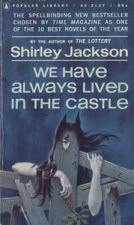
Review: We Have Always Lived in the Castle


The title of the novel is no accident, for it is as gothic a tale as any that was ever set in a crumbling castle on the banks of the Rhine. Its treatment of human evil, isolation and madness could easily qualify it as the pinnacle of 20th Century American Gothic.

A shadow has fallen across the house of Blackwood. Though once a prominent family, a possibly accidental poisoning has reduced their numbers to three (two sisters, an uncle) and made the townspeople suspicious of the survivors. The uncle, Julian, has been left physically crippled and one of the sisters, Constance, has developed a phobia about the world outside the house which does not prevent her from accepting visitors. It is left to the younger sister, Merikat (short for Mary Katherine), to venture into town on necessary errands.

Gothic literature often features singular characters, individuals who seem eerily plausible yet who are warped in a way that makes them unlike anyone else we've ever encountered. Merikat, who is the narrator and thus our guide through this story, is just such a character. It is clear that she views the townspeople with hostility, going so far as to craft charms--ordinary household items such as books or mirrors placed in odd locations or strange configurations--to keep the world at bay.

But soon it does intrude, in the figure of Charles, a cousin from an estranged branch of the family. His healthiness and level headedness seem to promise an opening up of the Blackwood home, a return to normality. But Merikat sees in him a representative of the crudity and selfishness of the outside world and seeks to drive him out through more and more powerful charms. The last of these results in a terrible reaction from the townspeople which sends the Blackwoods into greater isolation, leading to a hauntingly melancholy end to the story.

We Have Always Lived in the Castle is an incomparable achievement, a story that will equally charm and disturb in ways that sometimes can be almost intolerable. And you will probably never forget Merikat Blackwood.

09 July 2009

Review: Lamb; the Gospel According to Biff, Jesus' Childhood Pal


In The Last Temptation of Christ, Judas finds himself in a terrible situation. Jesus has told him that it will be necessary for Judas to betray him in order for mankind to be saved. As Christ acknowledges, God gave Judas the really hard task, that of betraying someone who he holds very dear. By comparison, all Christ has to do is die.

Though it's never acknowledged, the narrator of this book finds himself in a similar bind. As the lifelong friend of Joshua (aka Yeshua aka Jesus) and under the dictum that "dying is easy; comedy is hard," he has been left the harder path. All Joshua has to do is die. Biff has to make it funny.

Biff has been brought back to life by God so that he can write the definitive gospel since he was there from nearly the beginning. In order to ensure his cooperation, God has an angel chaperon Biff. Though it makes up very little of the story, the scenes of Biff and the angel in the hotel room are some of the funniest of the novel, especially in the angel's befuddlement at modern life.

Biff first met Joshua when they were both kids, and Joshua was bringing lizards back to life for the benefit of his younger, lizard-killing brother. From there they strike a lifelong friendship not impeded by the fact that Joshua knows he will one day be the Messiah. Biff is your quintessential underachiever, and his philosophical outlook, which has been derived from the teachings of Cynic, makes for a nice foil for Joshua's earnest desire to fulfill the task that has been set before him. When Joshua decides he will never learn how to be the Messiah if he does not seek out his origins, it is Biff who accompanies him on his travels.

They go in search of the Three Wise Men in order to learn the truth of Joshua's birthright. In their travels, this Hebraic Hope and Crosby encounter bandits, Taoist magicians, herbalist concubines, a hungry demon, a Buddhist monastery, the Tibetan Man of the Mountains, martial artists, a Kali ceremony, Tantra, untouchables and the Kama Sutra. After their travels, Joshua comes to learn what he has to do to become the Messiah, so they return to Palestine for the more familiar part of the story.

Christopher Moore here has a fine line to tread in attempting to make the story of Christ funny and believable yet keeping Joshua as the earnest Messiah figure we can all look up to. (No Last Temptation-style dream sequences of Christ experiencing the temptation of giving it all up here.) Having the story told by the underachieving and very sardonic Biff is a great way to thread that needle.

Moore makes the most of the sections where the gospels are silent, which give him a lot to work with. It yields great comic touches, like the time Joshua, Biff and Maggie decide to "circumcise" a well-endowed Greek statue, or the origins of the Jewish custom of Chinese food on Christmas. Though not every joke works, the passages overall maintain a high level of humor without robbing Joshua's quest of meaning.

The humor does begin to lost its impact near the end. Once Joshua and Biff return to Nazareth and Christ begins his ministry, Moore has less leeway with which to play. Once the ministry and the inevitable path to Golgotha have begun, the humor becomes more forced. As Joshua himself once said (though not in this book), a man cannot serve to masters, for he will honor one and neglect the other. The book has to choose between the earnestness of Joshua and the cynicism of Biff. It opts for the latter, for which one cannot entirely blame Moore. To have gone with the latter would have been to write a different, much edgier book. That Moore manages to make both elements work for as long as he does is testament to his talent and his great sense of humor.

25 June 2009

Review: La continuacíon y otras páginas


La continuacion is an anthology of stories and poems from Silvina Ocampo, who was friends with Borges, married to Adolfo Bioy Casares, and sister to Olivia Ocampo. In reading her short stories, I found it tempting to compare her to her contemporaries, Borges and also Julio Cortazar, which isn't entirely fair. Ocampo is certainly drawing from some of the same influences as those authors, but her perspective and style are clearly her own.

Among the themes are the blurring of identity (probably used most effectively in "La casa de azucar"), memories of childhood ("La siesta en el cedro"), and textual games ("Carta bajo la cama" and "El diario de la Porfiria Bernal"). Ocampo usually injects these themes with her own particular approach, as with the air of mystery and sadness that pervades the childhood stories. Of particular note is the sensuality of some of the stories, brining a certain liveliness to those elements. Admittedly, not all of the stories are great. (Of particular note is "El pecado mortal" for its oddly engaging take on the intersection of religion and sex.) Some of the later tales seem to have interesting concepts, though used in ways that struck me as less original.

Overall, a pretty nice collection presenting a sampling from the authors lifelong output.

25 May 2009

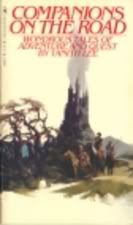
Review: Companions on the Road


This book features two short narratives--Companions on the Road and The Winter Players--set in undefined fantasy realms. Companions on the Road begins at the end of a long military campaign, the first, the warrior Havor has just finished a campaign, when through a series of events, he joins with Feluce the rogue and Kachil the brigand to seek out treasure hidden in the dungeons of Avillis. But instead of a lengthy dungeon hack, the three promptly find the treasure they are seeking. And that's when the story really gets going. The three soon learn that they are being followed by something all of their battle experience has not prepared them to face, something that stalks and kills as subtly as it does relentlessly. Lee combines heroic fantasy with horror elements in a tense race against time.

The second story, The Winter Players, features the priestess Oaive, who guards the Mysteries of the Shrine. One day a wolf-like stranger comes to town, offering to buy one of the objects, which Oaive refuses to do. When the stranger returns, a confrontation ensues in which she learns that the stranger is more than he appears to be. Difficult choices and a perilous chase ensue, as the stranger leads Oaive onward towards an even greater danger. While Companions wove horror elements into its fantasy tale, Players' fantasy incorporates questions of free will and destiny, endless cycles, and a feel for the folklore of lonely fishing villages.

While slightly different in theme, both or excellent works of fantasy, told with Lee's consummate skill for character, setting and pace.

10 May 2009

Review: Suite Francaise

Ever since picking up my first work by Nemirovsky last year, I've admired her talent for observing the human condition. There's something about her observation of people and their actions that suggests a balance between optimistic humanism and world weariness. In Suite Francaise, she trains her fine eye on the way that people react, and then adjust, to war, specifically Germany's invasion of France in WWII.

The book is divided into two sections. The first section begins as the news spreads through France that the army has been unable to stop the Germans. With the Blitz heading towards Paris, panic spreads, and people begin to flee to the countryside. Nemirovsky quickly introduces several people, including one family, and the preparations they make to leave. At first, the sheer number of characters made it a bit confusing, but as the story progressed, I got to know the characters better and became able to distinguish them.

As the Parisians flee, they often find themselves in pretty harrowing circumstances. The invasion has thrown things into disorder, and people who've led lives of privilege and prestige suddenly find the charmed existence that they enjoyed has suddenly disappeared. At first the Germans appear only as news on the radio, but then there are bombings and aerial strafing, followed by pitched battles. The story reflects the horror and confusion of war. As the first section ends, the government has fallen, the fighting has ended and people are in the process of putting their lives back together.

The second section begins in the countryside, specifically in one of the villages to which one of the Parisians had fled. The Germans have gone from being an invading army to an occupying one, and in the process have gone from being an amorphous threat to having a very human face. In fact, the presence of all the young men in a village which has seen its own boys killed or taken prisoner gives rise to a strange dynamic of affection and resentment. This section felt even stronger, as Nemirovsky probes all the fault lines, allowing for a much slower boil of conflicting emotions and allegiances.

Because Nemirovsky was sent to the death camps, she never finished the novel, so the second section of the novel ends somewhat abruptly. Though not part of the novel, I couldn't help but contrast Nemirovsky's eye for day-to-day humanity with the sheer inhuman evil of the Holocaust. I also couldn't help wondering how this chronicle of the war, with all its fine detail and observations, would have continued had she lived.

30 April 2009

Review: El Túnel


Ernesto Sabato's El Túnel is the first person account of an artist's murder of the one person who understood him best. At an exhibition, Juan Pablo Castel notices a woman captivated by the window that takes up a small section of one of his finished paintings. She is the only person who appears to have realized the importance of the window, which leads to him becoming to become slowly and utterly fixated on her.

He seeks her out in a somewhat roundabout matter, finally running into her seemingly by accident. He learns that she has been thinking about his painting all the time since that showing. They become romantically involved, but Castel feels she is not being completely honest with him. He begins to suspect she has other lovers, perhaps even that he´s just a plaything to her. He becomes increasingly obsessed with possessing her until his actions cross over into derangement.

This is a novel about obsession and man's futile struggle for meaning, and it is no surprise that Camus found it important enough to have translated into French. I must admit I was not entirely captivated by the story. Though I'm fond of eccentrics in literature (especially the obsessive kind), I often found Castel's obsessiveness more irritating than contagious. I also felt the metaphor of the tunnel as reflecting the essential loneliness of human existence was a bit on the literal side.

So, overall an interesting look at one man's obsession and how it reflects modern man's fruitless search for connection, but not entirely satisfying.

Review: Cola de Lagartija


When Juan Peron returned to the Argentine presidency for the last time in 1974, he brought along two intimates who would go on to create some trouble. The first was his third wife Isabela, who would ascend to the presidency after his death. The second was Jose Lopez Rega, a character so odd it seems hard to believe he was not invented by Arlt or Borges. Rega was fascinated with occult and mystic arts, including Umbanda (like Santeria or Voodoo) and astrology. His interests earned him the nickname El Brujo, not inappropriate given the Rasputin-like hold he had on Peron and later Isabela. It was under Rega that Dirty War began, which was run out of the Office of Social Welfare under the auspices of the triple-A. (Argentine Anticommunist Alliance)

Cola de lagartija is based loosely on Lopez Rega, parting ways with the historical facts of Lopez Rega to create a surreal and disturbing meditation on violence and power. After the fall of Isabela's government, El Brujo heads to his childhood home of Laguna Negra in northern Argentina with his followers. Here he organizes new rituals of blood and sacrifice, and stages a very twisted orgy to which he invites prominent members of Argentine society.

Even in internal exile, he is dangerous enough to inspire enemies, among them the ruling junta, a revolutionary, and an author working on El Brujo's biography. The revolutionary and the author have a brief relationship, during which the revolutionary asks the author to finish her book by killing off El Brujo. But can she really pull it off in such a way as to kill the original?

El Brujo soon finds a new enemy in the mayor of the town of Capivari and its little newspaper. He takes over the town and the newspaper, changing the emphasis of the latter to occult themes. This inspires in him the plans for a new ritual, an immaculate conception which will cleanse Argentina in a river of blood.

I was expecting a touch of the strange, perhaps even some magic realism, when I started this book, as can only be expected from a story based on an already strange individual. But the story is strikingly surreal, often disturbing or funny, presenting an exaggerated look at the relationship between power and violence, and the role of the journalist or writer in responding to the terrible.

28 April 2009

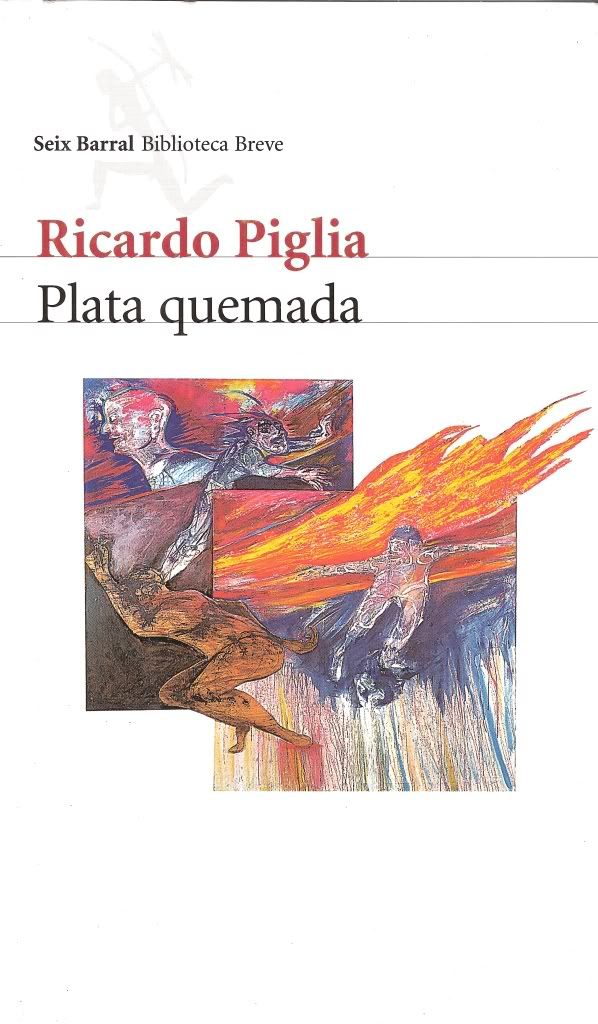
Review: Plata Quemada


A group of Argentine criminals have got what could be a great heist planned out. They will grab the municipal payroll in a daring daytime robbery, then cross the river and slip into Uruguay until the heat dies down. The gang includes Gaucho Dorda and Nene Brignone, who are lovers; Cuervo Mereles, who swaggers with outlaw charisma; and Malito, a cold-blooded and calculating man and their defacto leader. The robbery goes off as planned, but they soon find themselves on the run, guns blazing as they drive their getaway car through the streets of Buenos Aires. Though the events related in Money to Burn seem outrageous enough to belong to a Tarantino film or a pulp crime novel, Ricardo Piglia as invented nothing in this hypnotizing tale of crime, loyalty and vengeance.

Piglia has a minor personal connection to the story, having met Mereles' ex-girlfriend in 1966 while on a train ride to Bolivia. During the trip, she told Piglia a confused and seemingly incredible story of the man she had been in a relationship with and the crimes he had been involved in. Though he never saw her again, he became fascinated by the story and began to research and attempt to write about it. It was a project that he ended up setting aside for the better part of two decades, only to return to and finish later.

Plata Quemada is a novelistic retelling of true events, with Piglia acknowledging where the historical record is ambiguous or incomplete. The only license taken is in the extent to which we get inside the heads of those involved, not just the criminals but also the police who are hunting them. What emerges is a fascinating portrayal of criminality and politics in Argentina and Uruguay of the 1960s, as well as an unforgettable portrayal of characters far outside the pale.

27 April 2009

Review: Toda Mafalda


Joaquín Salvador Lavado, aka Quino, is a cartoonist with a talent for observing the human condition and translating it into striking and darkly comic observations. Many of his works feature recognizable people in situations whose nightmarishness is made more painful by the truths so cleverly expressed. (It should come as no surprise that Quino's representations of bureaucracies at work bear some resemblance to Kafka's.) However, the comic strip Mafalda combines this dark comic sense with the more innocent realm of kids growing up in Argentina in the late 1960s.

If you are already familiar with Mafalda, Susanita, Manolito, Felipe and the rest of the gang, you probably need little convincing as to why Toda Mafalda, which features every Mafalda strip Quino ever created (including several for side projects or that were left out of previous collections) is a very good thing. (Sadly, the book is not in translation, though the individual collections have been published in English under the name Mafalda & Friends.)

Whenever I've tried to describe Mafalda to friends, I usually resort to describing it as "cross between Peanuts and Bloom County or Doonesbury." Like Peanuts, the principal characters are a group of kids with striking personality differences. (Though unlike Peanuts, the parents are also characters in the action.) But like Doonesbury and Bloom County, the comic deals with political and social topics of its time, including the Vietnam War and the crises affecting Argentina.

The appeal of Mafalda, though, is not in its topical commentary, much of which is dated or inaccessible to the non-Argentine. For one, as with Peanuts, the characters are quite memorable. There is, of course, Mafalda herself, a little girl more fixated on the problems of the world than adults around might find healthy. There is a certain poignancy to her, a sense that sometimes we feel a bit like children ourselves when faced with the complicated and seemingly unsolvable problems of the world. Mafalda has a perfect foil in Susanita, a superficial gossip girl who dreams of achieving status through marriage and motherhood. Her ambitions are something of a throwback, even for their time, but her fascination on the social realm and its secrets is still with us today.

I could go on, but I fear that my descriptions would not do the characters justice, nor Quino's often funny takes on politics, work, friendship, life and death. This is the kind of collection worth having on hand and revisiting quite often.