Showing posts with label Thomas Ligotti. Show all posts

16 November 2008

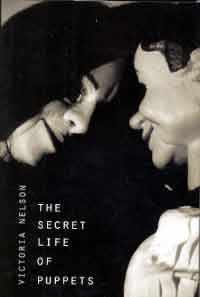
Victoria Nelson's "The Secret Life of Puppets"


Oh, blessed puppets, receive My prayer, and teach Me to make Myself in thy image.
-- Thomas Ligotti, "Mad Night of Atonement"


It feels wrong to me somehow that a book published in the year 2000 with the name "The Secret Life of Puppets" which deals with simulacra and demiurges, fantasy in European high art and American pulp fiction, and Bruno Schulz and H.P. Lovecraft doesn't once mention Ligotti, but perhaps it's just me.

Anyway, I found the book fascinating and thought-provoking, even though I found myself mostly skeptical of the author's conclusions. The argument here is that after the Enlightenment, Platonic thinking has been largely relegated to the background, a consequence of which is that Aristotelian, empirical philosophies have pretty much dominated ever since. However, Platonism and transcendental philosophies provide people with a sense of connection to the greater cosmos, which has been lost in our embrace of rational materialism. Platonic and neo-Platonic thought has found an outlet in culture, both high and low, and the recent conflation of neo-Platonism with technology (as exemplified in movies like "The Matrix") shows that we may be on the verge of a great return of Platonism or new religious reawakening.

As I said, it's an intriguing thesis, and I must admit I find myself mostly in agreement, at least with the way pop culture and art have adopted some of the roles/functions that used to be exclusive domains of religion. But I'm skeptical about the notion of the reawakening. The Matrix and its sequels have come and gone, and we've lost a large part of our obsession with virtual worlds. I'm almost tempted to bring out the old cliché of "9/11 changed everything," which like all clichés does have some element of truth. Anxiety and mystification of technology have been replaced by more conventional anxieties of violence by cultural outsiders. Of course, Nelson had no way of knowing that the western world would receive such a large shock, but at least for the moment the nature of cultural anxieties has shifted.

Another (lesser) criticism is the Lovecraft chapter, which I found interesting but pretty flawed. Nelson appears to be wanting to engage in a psychiatric reading of Lovecraft, which I could understand, but she relies too heavily on some broad generalizations. The impression I get is that Nelson is just trying to hard to find evidence of schizophrenia or syphillis trauma and is cherry-picking from Lovecraft's fiction to do so.

Those complaints aside, the book presents an intriguing look at philosophies of gnosticism and hermeticism, and their expression in popular culture and high art, as well as the way those have developed over the years. Nelson's approach has a certain playful ecclecticism, which is fun to read even when it's not entirely convincing.

13 November 2007

The Outside Poet and Trash Surfing

Some authors have a way of infiltrating your head, working their way into your dreams. My second night of reading My Work is Not Yet Done inspired the following dream:

My consciousness appears semi-detached. There is a man and his girlfriend in the room. I am the man and I am also watching the couple--a strange bifurcation of consciousness that makes the dream sort of difficult to describe. The apartment is a curious blend of decadence and desolation. The walls were once covered with mirrors, and every surface appears to have been shiny, recalling a "futuristic" setting in a '60s sci-fi movie. The mirrors are in various states of destruction, some only cracked, others reduced to mere shards in their frames; the floor is littered with reflective detrius.

Somewhere outside of this room, lingering on the edge of our consciousness is the Poet, whose words create this world. I feel it when he is about to write, a sudden tension filling the apartment. At his whim, time moves forwards or backwards, the room degenerates or improves, the relations between the man and his girlfriend sweeten or deteriorate. There seems to be a randomness to these whims which destroys all sense of continuity. Ultimately, the Poet grows bored with writing this domestic situation. I am allowed an escape from the apartment.

And I find myself outside, atop a large garbage heap, looking down what must be four or five stories to a dumpster the size of a parking lot. I am among a small group of people. The garbage heap begins to slide forward, than plunge down, taking us with it. I try to stay on top of the shifting debris, seeing the ground come up at me, falling with that sense of exhilaration you get in dreams, where you know it won't hurt to hit the ground.

The landing isn't hard, but the garbage partially liquifies, becoming an opaque, turgid fluid in which float unidentifiable scraps. We struggle to get out, finally managing to cooperate to get a rope over the side of the dumpster so we can climb out.

09 November 2007

Books Compared: Lullaby/My Work is Not Yet Done

Only a cynic can create horror. For behind every masterpiece of the sort
must reside a driving daemonic force that despises the human race and its
illusions, and longs to pull them to pieces and mock them.

-Howard Philips Lovecraft


I think I've been mentally comparing the works of Thomas Ligotti and Chuck Palahniuk since the first time I read Haunted.* Both are cult authors with reputations as nihilists, and both write with distinctive styles and thematic concerns. 2002 turned out to be an interesting publication year for both. (Pardon the familiarity of using first names; but both have rather long surnames.) Chuck published his first foray into horror with the novel Lullaby; Thom published his longest work, a novella by the name of My Work is Not Yet Done in a collection of the same name. (I won't get into the other two, much shorter stories included in that book.)

The similarities extend beyond publication date. Both feature disaffected narrators who find themselves acquiring supernatural powers of a questionable nature, but more importantly both are intensely dark, funny and philosophical works. There's even overlapping themes, such as concerns over mortality, criticisms of modern capitalism, and some apocalyptic musings.The main contrast is the characteristic style. Chuck's minimalism is descended from Hemingway by way of Amy Hempel and Raymond Carver. It emphasizes the use of verbs over adjectives, and he prefers short sentences that mirror the way people speak. Thom's style, on the other hand, reflects the baroque and surreal influences of authors such as H.P. Lovecraft (adjectivitis!) and Bruno Schulz.

I imagine most people will find Chuck's style a little more accessible. MWINYD is actually among the lower end of the baroque for Thom, but overall I find his style more effective, especially at evoking the requisite atmosphere of a horror story, than Chuck's.

Lullaby is easily Chuck's best work, but as a work of horror fiction it has some flaws. As I've already stated, his minimalism is less effective at creating atmosphere than Thom's subtle surrealism. Horror fiction revolves around the emotion of fear and its various permutations, and Lullaby is not particularly scary.

My other criticism of Lullaby as a work of horror is Chuck's handling of the supernatural element. Supernatural elements can be tricky to handle effectively in fiction, especially horror. When handled skillfully, they serve to effectively bind the story together, giving substance to submerged or displaced issues. (i.e., the way Cthulhu embodies Lovecraft's pessimism or Dracula lurks in the shadows of Victorian sexuality) When handled poorly, they come off as plot contrivances with little rhyme or reason.

Lullaby falls somewhere in between. I liked its haunted houses and visions of sonic plague, but I thought the culling song hadn't really been though through properly and its grimoire was a little silly. MWINYD's supernatural elements, however, seemed a much more natural fit for the narrator/author's philosophy and his concern with the meaninglessness of existence.

Both books, in fact, struggle with the question of the meaningless of existence, which is approached from a perspective of profound skepticism bordering on nihilism. Though both authors are considered nihilists, there is actually a fair amount of difference with Chuck's sunny nihilism an interesting counterpoint to Thom's bleak nihilism. As Tyler Durden says in an earlier Chuck book: "It's only after we've lost everything that we're free to do anything." I suspect the Frank Dominio, the protagonist of MWINYD, learns we're never free completely free to do anything and losing everything is its own reward.

As with writing styles, I think Chuck's work is probably the more accessible. Behind the bleakness and the dark humor lurks a heart in search of redemption as sincere as that of a Dr. Phil fan. Thom's philosophy is bleaker, like a shadow version of Zen, where we are only free when we lose all illusions, but to do that you must accept freedom itself as an illusion.** (Again, personal preference here leans towards Thom's more absolute darkness.) Ironically, these different outlooks reflect to an extent their literary influences; contrast Hemingway's humanism with Lovecraft's cosmicism.

* Haunted's prologue invokes the conceptual slipperiness between human beings and their simulacra (puppets, mannikins, etc.); while this concept was certainly not invented by Ligotti, he has evoked it more uniquely and effectively than any author since Bruno Schulz.

** Or to contrast two interesting quotes, one from Haunted, one from "The Nightmare Network" (the third story in MWINYD):
Chuck: "Each of us striving to be the camera behind the camera behind the camera"
Thom: "The camera pulls back on the entire universe. There is no one behind the camera."