Showing posts with label 999-IV. Show all posts

25 June 2009

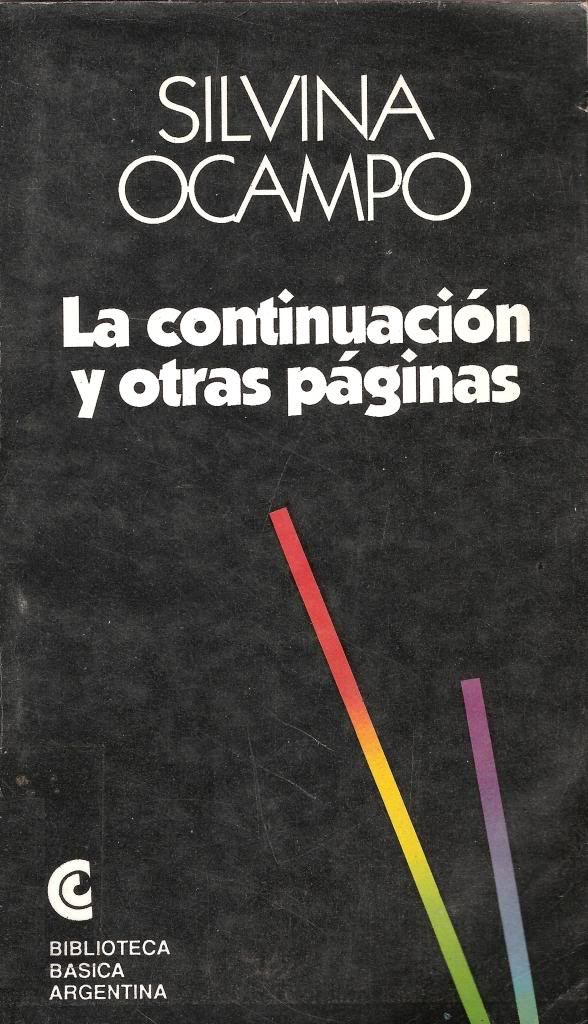
Review: La continuacíon y otras páginas


La continuacion is an anthology of stories and poems from Silvina Ocampo, who was friends with Borges, married to Adolfo Bioy Casares, and sister to Olivia Ocampo. In reading her short stories, I found it tempting to compare her to her contemporaries, Borges and also Julio Cortazar, which isn't entirely fair. Ocampo is certainly drawing from some of the same influences as those authors, but her perspective and style are clearly her own.

Among the themes are the blurring of identity (probably used most effectively in "La casa de azucar"), memories of childhood ("La siesta en el cedro"), and textual games ("Carta bajo la cama" and "El diario de la Porfiria Bernal"). Ocampo usually injects these themes with her own particular approach, as with the air of mystery and sadness that pervades the childhood stories. Of particular note is the sensuality of some of the stories, brining a certain liveliness to those elements. Admittedly, not all of the stories are great. (Of particular note is "El pecado mortal" for its oddly engaging take on the intersection of religion and sex.) Some of the later tales seem to have interesting concepts, though used in ways that struck me as less original.

Overall, a pretty nice collection presenting a sampling from the authors lifelong output.

08 March 2009

Review - Astor Piazzolla: A Memoir


Astor Piazzolla holds an important spot in the history of twentieth century musicians. His nuevo tango, which incorporated jazz and classical elements into the traditional tango of Argentina, not only revitalized the tango, but but also gave it a new international resonance, inspiring such artists as Yo-Yo Ma and Daniel Barenboim. What sort of person could create music so beautiful, poignant without being sentimental, modern yet with such depth? Wondering this, I had read Le Grand Tango, a very thorough account of Astor's life, and from what I've heard one of the better biographies written about him. But while Azzi and Collier do a good job of telling you what Piazzolla was up to throughout his life, they are somewhat less successful at giving you a sense of who he was.

That is one thing that made Astor Piazzolla: A Memoir such an enjoyable read. Piazzolla was apparently something of a difficult interview subject; Gorin compares him to Borges for his tendency to answer more in the spirit of provocation than information. However, Gorin seems to have managed to get Astor to open up about himself, partially because they were friends, and also one suspects due to some degree of doggedness or cleverness on Gorin's part.

The book is not a traditional biography, and it focuses mainly on certain times and themes of particular importance to Piazzolla. Quite a bit of time is spent on his musical inspirations, from growing up in New York, meeting Carlos Gardel, studying with Naudia Boulanger, and playing in the Orquesta Tipica of Anibal Troilo. So, too time is spent talking about Piazzolla's drive for innovation and his impulsive, sometimes tempestuous, personality which together led to his making enemies within the Argentine tango community. (And also to some short-lived experiments, such as Tango-Jazz and the Electronic Octet.) Piazzolla also talks about his private life, musicians he's played with, and his observations on the cultural milieu of which his music was a part. One gets a good sense of the intelligence of the man, his emotional turmoil, his devotion to tango.

It's a rich and fascinating portrait, one that I think any fan of Piazzolla would find interesting. That said, for the really interested, it is probably best to read a more traditional biography, such as Le Grand Tango, as well as Memoir in order to get the full picture.

25 February 2009

Review: Black Magic - 13 Chilling Tales

Black Magic is an anthology of short stories ostensibly all dealing with the theme of black magic, forbidden sorceries and texts, voodoo and diabolism. It does fall somewhat short of that, with one story about a mad scientist and another about a vampire. (By Nathaniel Hawthorne and Ray Bradbury, respectively.) However, those are both quite striking stories, so perhaps it's not so bad to break a little from the premise of the collection.

The other stories are grouped into five sections: Devil Worship, Witchcraft, Curses, Magic Writing and Incantation, and Voodoo. As well as the Hawthorne and Bradbury, there's entries from Algernon Blackwood, H. G. Wells, M. R. James, Avram Davidson, and Theodore Sturgeon. Of particular note are James' "Casting the Runes," a nicely atmospheric tale of supernatural vengance, and Davidson's "Where do you live, Queen Esther?," which reflects that author's talent for mixing the fantastic and everyday to stunning effect.

I also quite liked Margaret Irwin's "The Book," a tale of a cursed object leading to a man's doom; the story uses a rather novel approach towards the first symptoms of the curse. Blackwood's "Ancient Sorceries" was nicely atmospheric, though the end explained the strange phenomena in a way that felt a little too pat. (I would have prefered it a little more ambiguous.)

As with all collections, some stories are stronger than others, and if I had to pick a low point, it'd be "Cheese" by A. E. Coppard, which seemed like it should either be funny or scary, but didn't manage to do either quite right.

I wouldn't recommend seeking out the collection, as most of these stories could be found elsewhere. But if you ever run across this little bit of pulp in a used book store, it's definitely worth a look.