Showing posts with label Argentina. Show all posts

23 June 2009

Denevi: La última Navidad del primo Vegelio

The story is told in flashback by a narrator who remembers when he was a young boy and his cousin Vegelio came to his family's house for Christmas. Vegelio is something of a sad sack, showing up in crummy clothes and always bringing the same flavored almonds every Christmas, which nobody in the family cares for. The narrator, however, has a certain fondness for Vegelio. That night, as Vegelio leaves he tells the narrator a certain secret, which would devastate the narrator's family if were to be revealed. It was interesting overall, but not one of the stronger stories so far.

22 June 2009

Denevi: Viaje a Puerto Aventura

There seems to be a bit of porteño-satire going on in this tale of an ill-fated road trip. The story begins with the narrator's wife telling the narrator how she also hates to see people driving around in cars, because she knows that they enjoy making her jealous, what with the way they flaunt their travel to some exciting/relaxing location with all their cool friends. She works herself up into a bit of a state, so the narrator agrees to take her for a drive.

He borrows a friends old Lincoln, and they dress up a bit and go for a drive. Between the narrator's struggles to deal with Buenos Aires traffic and his wife's forced attempts to look as if they're having the times of their lives, the scene quickly grows rather grotesque. It is at this point that the wife decides that it is all those people staying at home and showing off what a fun time they're having at that that really make her sick.

It's a bit broad to make for an emotionally resonant portrayal, but as a poke at the porteño obsession with being seen and envied, it works pretty well. There is also one final surprise in store for the couple, which I thought worked pretty well.

Ocampo: Paradela & Keif

So, we come to the last two stories in the anthology, both of which incorporate fantasy elements. Paradela is the name of a furniture salesman who helps the narrator's cousin with furnishing a house she has bought. There is a fair amount of humor in the interaction between Paradela, who seems like something of a Porteño-type, and the cousin, who is something more of a humorless society woman. The odd events take place when Paradela comes into contact with furniture, although this is only revealed with two different pieces. One is an antique bed where a Russian prince died. When Paradela lies down on it, he begins to get weaker and appears to be dying himself. The other is a simple-looking piano bench which was once owned by Gardel, and which allows Paradela to sing like Gardel when he is sitting or kneeling on it. It's overall an amusing story, though lacking much in the way of punch.

The second story, Keif, is a little subtler in its use of fantastic elements, and more somber. Keif is the name of a tiger, which is the pet of a woman whom the narrator becomes friends with. Beyond having a tiger as a pet, the woman is rather eccentric in other ways. She decides that she has become tired of life and decides to walk into the sea to do away with herself, leaving the narrator to take care of Keif. The supernatural element doesn't really come until the final twist, which takes some of the melancholy off what should be a fairly depressing story.

And with that, I have read and blogged on all the short stories in La continuación y otras páginas. It was a fun experience, and I'm only sorry that it's taken me so long to finish. Although I don't think Ocampo will anyone forget Borges or Cortazar, she writes some pretty interesting stories. I'll be looking to read more of her works in the future. (And I'll try to spend some time with her poetry in the near-future.)

21 June 2009

Ocampo: Ulises & Los grifos

For some reason "Ulises" appears to end abruptly. Considering that there is no break in the page numbers, I'd guess that only a few lines are lost. If so, this story ends on a rather abrupt or fatalistic tone. This story incorporates Ocampo's frequent theme of childhood, though with fantasy elements incorporated. The story concerns the narrators' childhood and her friendship with a strange classmate named Ulises. Ulises has a reputation for telling outlandish stories, as well as a face that strikes most people as being that of an old man. He is also an orphan, living with three elderly and rather eccentric aunts. He and the narrator sneak out one day to visit a fortune teller, who offers Ulises his youth. That's when things take a decidedly supernatural turn, which is quickly reversed and at which point the story cut off. Intriguing, though I'm not really sure where it was going.

"Los grifos" is a pretty Borgesian, not least of all because Borges himself makes a few appearances. Grifos are faucets, and the story concerns a set of faucets which drip onto a basin and create a musical, almost mystical sound. Ocampo seeks out the wider meaning of faucets, suggesting a bizarre mythology of faucets. The story climaxes with a mysterious story of how the basin came into her hands. Interesting, but as can be expected from a Borgesian story, there's not much in the way of conventional plot.

12 June 2009

Ocampo: Amada en el Amado

"Amada en el Amado" begins much like "El lecho," with a couple that appears to be almost obsessively in love, though this story develops less disturbingly. Every day, the husband tells the wife his dreams of the previous nights. The wife wishes she could take part in these dreams, as she never has any dreams of her own. In an odd twist, the woman develops the ability to pull things out of the man's dreams. It takes another twist into odder territory after the wife manages to pull a certain phylactery from the man's dreams.

10 June 2009

Ocampo: El diario de Porfiria Bernal

"El diario" bears some similarities to Henry James' "The Turn of the Screw": an English governess in isolating circumstances, watching over a girl and a boy. One of the characters even makes reference to Henry James, although she is unsure whether the name is Henry or Francis James. Despite the obvious homage, the story is not another retelling of James' classic. Instead, it goes off into its own curious direction of lycanthropy, predestination and the text that mediates between them.

True to its title, the story does feature the diary of Porfiria Bernal, the young girl of the family. We are introduced to the diary by Helen Fielding, the English governess taking care of her. In a "Dagon"-like touch, Miss Fielding assures us that she is writing her introduction shortly before the end. We are never given specifics on why Miss Fielding has come to be in Argentina, the circumstances which have led her to her current position, but it appears she has something of an interesting family history. She describes how she came to work for the family and her experiences and affection for Porfiria. It was Helen's suggestion that inspired Porfiria to keep a diary. Miss Fielding is taken aback a bit when Porfiria asks her whether everything you put into a diary has to have really happened or not. She doesn't think much about the question until she has managed to read the diary. It is then the narrative shifts from Miss Fielding to Porfiria's diary.

What follows appears to be a normal account of a somewhat different girl, her family and governess. The Bernal's are upper middle class and travel a fair amount during the year, spending summers on the beach. There are suggestions that more may be going on. Miss Fielding gets along well with the family, but Porfiria doesn't really trust her. Miss Fielding also appears to have a strange reaction to cats.

After several months of entries, the diary is interrupted by Miss Fielding's writing. She claims that the diary is making things happen. She has had it away from Porfiria for several days, but still the events of the last several days have taken place just as described in the entries for those days. From here the entries grow stranger. Miss Fielding becomes more violent with Porfiria, until it culminates in a near fatal accident and a surreal transformation.

It's an interesting combination of elements, one that definitely plays with your expectations. I have to admit, it came as a bit of a surprise when the diary was interrupted by MIss Fielding--sort of equivalent to realizing someone has been reading over your shoulder. There is a pretty interesting ambiguity as to what is going on, whether the diary is causing things to happen or if Miss Fielding is having a nervous breakdown. (But if she is, so it would seem is Porfiria.) In the end, though I enjoyed the story, it struck me as perhaps more comical than haunting, which may or may not have been the intended result.

Denevi: ­¡Miss Maggie, Happy Birthday!

Miss Maggie Sills, who has often been told that she looks and sounds very much like the Queen Mother, has been invited by her friends to join them for dinner at a nice restaurant. She doesn't show up, which worries her friends very muhc. They wiat until late, and then end up going home.

The next day, she meets up with one of her friends, who tells them about how worried they were. Maggie tells the story of why she never made it to the restaurant, of how she took a taxicab with a very nice driver--how he got lost, stopped to get directions, directions which took him in the wrong direction, thus requiring new directions, they always appeared to be only a block or two away but found their way blocked by a one-way street, until after driving around for hours, the driver stops to let her use the restroom at a pizza parlor, but with the rain, they decide to eat right there, and since it's her birthday also celebrate with a bottle of champagne.

So, not much happens overall, but it is an engaging story and reflects nicely some of the social dynamics of Argentine society. It also has kind of a nicely ironic ending.

BDT: Conversa & El diecinueve

Though I've decided to try to look at at least two stories a day, today's entry works out nicely in that the two stories have a common element. Both of these stories are told principally through dialogue. "Conversa," appropriately enough, is told entirely through dialogue, while "El diecinueve" has a smattering of non-dialogue description.

"Conversa" pure and simple is the conversation of a man and a woman in a coffee shop. It's well written, capturing this sort of interaction quite realistically. The man here is the more assertive, and the woman's response--not hostile, but wary--seems pretty dead on. As well done as it is, I must admit if there was any deeper meaning or current there, it sort of passed me by.

"El diecinueve" (The Nineteenth) begins with a man greeting Captain Farías. The captain doesn't recognize his interlocutor, but soon learns that it is someone from his past, specifically his role in Argentina's Dirty War. There's a curious ambiguity to the 19th and his end of the dialogue. Is he a ghost or did he in fact survive? And what has he come back for? Nothing is really resolved, which makes the story either sort of frustrating or intriguing. (I opt for the latter, personally.)

09 June 2009

Ocampo: El pecado mortal y La pluma magica

I have to quote (via rough translation) the opening to the "El pecado mortal," since I thought it was such a great hook.

The symbols of purity and mysticism are sometimes more of an aphrodisiac than pornographic stories or pictures, and it is because of this--what sacrilege!--that the days before your first communion, with the promise of the white dress, lace gloves, and pearl rosary were perhaps the only truly impure ones of your life.

I can't say the story that follows quite lives up to the opening, but somehow I'm not sure I mind so much.

"La pluma magica" reminded me a great deal of Ramsey Campbell's horror story "Next Time You'll Know Me," in that these are both stories of artistic anxiety narrated by the artist himself. In fact, both stories involve the artist writing to the person(s) who he believes has robbed him. Campbell's story is unsurprisingly the darker of the two, while "pluma" is sadder. The narrator of "pluma" is an author who has had to give up writing because everything he writes turns out to have already been written. The narrator finds a solution in a magical quill which allows him to write absolutely original material. The narrator is then betrayed by a protege (possible lover?) who steals the quill. When certain books begin to be published in a style the narrator recognizes as the quill's, he considers it a confirmation of his suspicion.

Denevi: Gaspar de la noche

"Gaspar de la noche" is one of Denevi's "epiphanies" and concerns a piano instructor who is auditioning a potential student. There's an intriguing mix of elements here, which make the term epiphany seem particularly appropraite.

There's a touch of the strange in the young boy sitting on the couch, looking to all the world like a miniature adult down to the horrible suit, the boy who has been brought in by his parents in order to nurture his gift. The parents are too poor to pay for a proper teacher but recognize the child's gift. The teacher's reluctance is compounded by the strangeness, especially when the child offers to play "Gaspar de la nuit," a difficult piece which happens to be the teacher's favorite.

I didn't quite get into this story so much, with its mix of realistically sad and sort of kilter elements, but it probably hazards a reread.

07 June 2009

Ocampo: La cara en la palma & Los amantes

At this point, I'm trying to double up when I can in order to get through the remaining stories quickly. I would not normally link these two stories, though now that I have done so, I can say that they both serve as parables of romantic passion.

"La cara en la palma" translates to "The hand in the palm," and if you're mind immediately flits to Vampire Hunter D, you're on the right track. The writer of the letter always wears a glove on her left hand while in public, because she says she has a face on the palm of that hand. The hand often whispers dark things to the narrator, undermining her relationship with other people, especially her lover. (It is him that the letter that makes up this narrative is addressed.) They have broken up, but she may return to him. He'll know if she's decided to come back to him if the next time he sees her, she's happy but with her left hand gone before the elbow. Sort of a morbid reflection on relationships and psychic self-mutilation. It's left somewhat ambiguous. Would cutting off the hand be a good thing?

"Los amantes" is a more upbeat but perhaps more demented parable about relationships. A couple go out to a picnic and consume several delectable desserts. What stands out for this story is the sensual power with which Ocampo describes the consumption of the tasty treats in question, leaving little doubt as to what the feasting is a stand in for. Intimate, sensual, a little perverted even--what an odd little story.

20 May 2009

Ocampo: Visiones & El lecho

It's unclear if these two stories are meant to be linked. They have very little thematically in common, except for a certain morbid quality, though the one element that seems to link them is significant enough that the latter (El lecho) may be intended as a febrile vision from the former (Visiones).

Visiones is the story of a woman who wakes up in a hospital bed. It's unclear why she's in the hospital or how long she has been there. Her consciousness is fractured, she believes she has awoken in her own bedroom, and so she is confused by the fixtures and objects in the hospital room. The interactions with the nurse are strange, but the nurse reassures her she will get better. As the story reaches it's conclusion, the narrator begins to think of beds (lechos), their relationship to birth, sex, life, and death.

The story that follows, "El lecho" ("The Bed") is a brief story of a couple, whose relationship has its troubles but who find an escape from their problems when sharing a bed. One day in bed, the woman smells smoke and suggests a fire. The man says it is an olfactory illusion. The woman says she hears the fire, which sounds like a flowing river. The man says it is auditory illusion. When they both see that the room is brightly lit by the blaze, the woman says that if they hold each other tight, the fire will only burn their backs. The man says they will be burned throughout. And so ends the brief and creepy fever dream.

18 May 2009

Ocampo: Carta bajo la cama

There's a horror trope (named the Apocalyptic Log) in which a narrator continues to write an account of what is happening to them right up to the minute of their own demise. And "Carta bajo la cama," whose title recalls Poe's "MS Found in a Bottle," is one such account. The story is the letter which an unnamed narrator is writing to a friend. She is staying in an isolated house in the English countryside. The other residents of the house have left for the weekend. The narrator begins by discussing the feeling of fear, how it can be enjoyable, but how she prefers to be able to share it. A strange man approaches the house, seemingly a gardener. She then hears a news report about a man who murders women and buries them next to the gardens of their houses. As other signs of the mysterious man's identity as the murderer turn up, the narrator resigns herself to her fate and places the letter under the bed. Overall, it seems like a pretty straightforward execution of a trope, albeit with some odd touches, and the narrator's own interest in their enjoyment of fear almost takes it into a meta direction.

11 May 2009

Ocampo: Magush

The story of a man who meets a youth with the gift for prophecy. The story is plotless and conceptual in a way that could bring up a certain adjective or proper name. (But there's a word that should never be mentioned in riddles about chess.) The youth reads fortunes not in tea leaves or in crystal balls, but in the windows of a building across the street from the shop where he works.

The prophecies that the youth reveals are of a generally negative cast--romantic betrayals, failed business ventures, disloyal friends--and as some of them begin to come true, he seeks out more and more of the boy's predictions. Eventually, the boy reveals to him pretty much all that is in store for him, which leaves the man paralyzed with despair. The boy suggests that in order to have his life, he must let all the things prophesied come to pass. The man does not want to face them, so the youth suggests if he could only get someone else to endure them in his place, he would be free.

The man offers to trade destinies with the boy, and the boy agrees. Yet they both find themselves paralyzed, watching the windows that reveal the prophecy, neither really eager to take up the destiny of the other. It's a pretty interesting spin on the question of whether knowing your own future would be a blessing or a curse, written with a certain haunting quality

07 May 2009

Ocampo: La continuacion

La continuacion takes the form of a letter, one which initially seems to be a Dear John letter. As the letter progresses, we learn that the letter writer also happens to write fiction, and that part of the reason that she is leaving is a disconnect between the writer's fiction and their life. It turns out that the writer has created a fictionalized version of her own relationship in which the genders are reversed. Several times, she refers to this fictional relationship to describe her own feelings. There's a certain ambiguity as to whether she is just using the fiction to express her own feelings, or to whether she is getting lost in the fictional world she's creating to the extent that it seems more real than her own life. As the letter reaches its conclusion, the possibility that the letter might be a suicide note, not a Dear John letter, comes into play. The writer's intent is left ambiguous, which contributes to the haunting quality of the ending.

05 May 2009

Ocampo: Extraña visita & La siesta en el cedro

The first two stories in La continuación y otras páginas are childhood stories.

The first is "Extraña visita," in which a little girl named Leonor goes with her father to visit her father's friend, who has a daughter her own age. There's some neat descriptions in this short story, such as the friend being "so tall that he seems isolated from the world by his height" and of Elena, the daughter, having black hair but a face "so transparent that it seemed as if it had been erased." While playing, the girls spy on their fathers talking in the study. (Their sight is distorted by a white curtain drawn across the window.) Leonor gets the impression that her father is crying, but afterwards his demeanor convinces her that she must have been mistaken. They don't go back to Elena's house, and Leonor finds that Elena's face has been erased from her memory. Not much happens, so this story is largely about its use of language and imagery, which it admittedly does pretty well.

"La siesta en el cedro" centers on Elena, who may or may not be the same girl from the previous story. Elena is friends with the gardener's daughters, Cecilia and Esther. Cecilia comes down with an illness which has apparently already killed three other people. Elena doesn't really care--she even drinks from a glass that Cecilia has drunk from--but her parents make sure to keep Cecilia away. Cecilia dies, and Elena goes to vist the family but is disgusted as to the extent that they seem to be getting on with their lives.

There's a certain sadness to both stories, stronger in the second, as well as a sense of mystery. The mystery isn't supernatural so much as a product of the interaction between children and adults. In a way, I'm reminded of Julio Cortazar who also wrote short stories about childhood with their fair share of mystery and sadness.

03 May 2009

Story a Day: Silvina Ocampo anthology

My next Story a Day treatment will deal with Silvina Ocampo's La continuacion y otras paginas, which is a brief anthology of her works, beginning with some stories from Viaje Olvidado.

30 April 2009

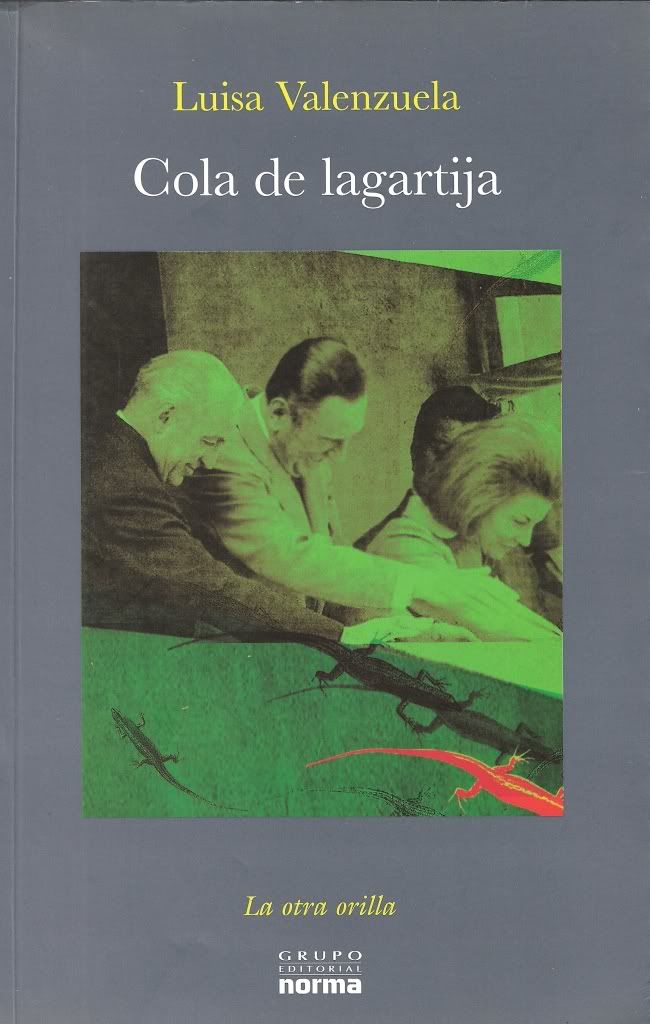
Review: Cola de Lagartija


When Juan Peron returned to the Argentine presidency for the last time in 1974, he brought along two intimates who would go on to create some trouble. The first was his third wife Isabela, who would ascend to the presidency after his death. The second was Jose Lopez Rega, a character so odd it seems hard to believe he was not invented by Arlt or Borges. Rega was fascinated with occult and mystic arts, including Umbanda (like Santeria or Voodoo) and astrology. His interests earned him the nickname El Brujo, not inappropriate given the Rasputin-like hold he had on Peron and later Isabela. It was under Rega that Dirty War began, which was run out of the Office of Social Welfare under the auspices of the triple-A. (Argentine Anticommunist Alliance)

Cola de lagartija is based loosely on Lopez Rega, parting ways with the historical facts of Lopez Rega to create a surreal and disturbing meditation on violence and power. After the fall of Isabela's government, El Brujo heads to his childhood home of Laguna Negra in northern Argentina with his followers. Here he organizes new rituals of blood and sacrifice, and stages a very twisted orgy to which he invites prominent members of Argentine society.

Even in internal exile, he is dangerous enough to inspire enemies, among them the ruling junta, a revolutionary, and an author working on El Brujo's biography. The revolutionary and the author have a brief relationship, during which the revolutionary asks the author to finish her book by killing off El Brujo. But can she really pull it off in such a way as to kill the original?

El Brujo soon finds a new enemy in the mayor of the town of Capivari and its little newspaper. He takes over the town and the newspaper, changing the emphasis of the latter to occult themes. This inspires in him the plans for a new ritual, an immaculate conception which will cleanse Argentina in a river of blood.

I was expecting a touch of the strange, perhaps even some magic realism, when I started this book, as can only be expected from a story based on an already strange individual. But the story is strikingly surreal, often disturbing or funny, presenting an exaggerated look at the relationship between power and violence, and the role of the journalist or writer in responding to the terrible.

28 April 2009

Review: El Cantor de Tango

Bruno Cadogan is writing a dissertation on Borges' view of the tango--especially the older, less sentimental tangos Borges would have heard in his youth--when he hears that in Buenos Aires there is a man, Julio Martel, who sings the tango in this older style. Since no recordings exist of Martel's singing, Bruno heads to Buenos Aires to seek him out personally.

When he lands in Buenos Aires, he finds a room for rent in the very same building which housed Borges' Aleph in the story of the same name. From here he begins his quest for Martel, which turns into a labrynthine wandering through Buenos Aires in time and space. Martel, it turns out, has decided to forgo a career in order to use his tango singing to mark off places and events in the city that hold some particular meaning for him. He also becomes fascinated by the possibility of finding the Aleph in the house where he is staying.

This labrynthine wandering was the strongest aspect of the novel, and I really appreciated how Martinez explored and even celebrated the city of Buenos Aires and its lengthy and often tragic history. I cannot say if someone who has never visited the city would feel something similar, but I would certainly hope that the book would provide some motivation for planning a visit.

The novel did have a couple of flaws. Bruno Cadogan is meant to be an American, but he really thinks and acts more like an Argentine. While a minor flaw, it does cost the novel some verisimilitude. For me the larger flaw was that the novel was almost too Borgesian (never did I thought I would say that) in its use of allusions and homages to the point where it almost became distracting. (Bruno himself seems an obvious homage to Cortazar's "The Pursuer," also about a writer named Bruno fascinated with a troubled musician whose art allows him to experience time differently.)

Despite these flaws, I still found it a captivating read and greatly enjoyed its wanderings through the mazes of space and time which make up the reality of Buenos Aires.

Review: Plata Quemada


A group of Argentine criminals have got what could be a great heist planned out. They will grab the municipal payroll in a daring daytime robbery, then cross the river and slip into Uruguay until the heat dies down. The gang includes Gaucho Dorda and Nene Brignone, who are lovers; Cuervo Mereles, who swaggers with outlaw charisma; and Malito, a cold-blooded and calculating man and their defacto leader. The robbery goes off as planned, but they soon find themselves on the run, guns blazing as they drive their getaway car through the streets of Buenos Aires. Though the events related in Money to Burn seem outrageous enough to belong to a Tarantino film or a pulp crime novel, Ricardo Piglia as invented nothing in this hypnotizing tale of crime, loyalty and vengeance.

Piglia has a minor personal connection to the story, having met Mereles' ex-girlfriend in 1966 while on a train ride to Bolivia. During the trip, she told Piglia a confused and seemingly incredible story of the man she had been in a relationship with and the crimes he had been involved in. Though he never saw her again, he became fascinated by the story and began to research and attempt to write about it. It was a project that he ended up setting aside for the better part of two decades, only to return to and finish later.

Plata Quemada is a novelistic retelling of true events, with Piglia acknowledging where the historical record is ambiguous or incomplete. The only license taken is in the extent to which we get inside the heads of those involved, not just the criminals but also the police who are hunting them. What emerges is a fascinating portrayal of criminality and politics in Argentina and Uruguay of the 1960s, as well as an unforgettable portrayal of characters far outside the pale.