Showing posts with label Lovecraft. Show all posts

03 August 2011

Tea Party Outsiders

Having let this blog go dormant for the better part of a year, due largely to the fact that I felt like it lacked any sense of purpose, I have to admit to a certain embarrassment to posting now just for the sake of getting something out of my system. (And perhaps insomnia and sleep deprivation play a role in this) But, oh well, the inspiration is there and better to write about it than to leave it turning over in my head.

I was motivated to write by today's Maureen Dowd column in the New York Times, Washington Chainsaw Massacre, in which Dowd draws parallels between our current political situation and the plots of some major horror works in literature and film and references Lovecraft. Now, don't get me wrong, I mostly agree with Dowd. There's certainly plenty of Fear and Loathing to go around in our current political climate, and it's not difficult to imagine the Capitol--currently occupied by one overly sensitive party and one that has fallen into somnambulance--splitting apart like the House of Usher.

And it's kind of cool to see Lovecraft referenced in the New York Times, but as sometimes happens, I can't help feel it's done in a way which reinforces the image of Lovecraft as a writer who mostly just called things "indescribable" and then threw a lot of adjectives around. The passage in particular is:

In the short story “The Outsider,” Lovecraft’s narrator offers a description that matches how some alarmed Democrats view Tea Partiers: “I cannot even hint what it was like, for it was a compound of all that is unclean, uncanny, unwelcome, abnormal and detestable. It was the ghoulish shade of decay, antiquity and desolation; the putrid, dripping eidolon of unwholesome revelation; the awful baring of that which the merciful earth should always hide. God knows it was not of this world.”

There's something about the choice of this quote that feels, well, like Dowd just skimmed a Lovecraft Best of... until she found the first sentence that seemed purple and horrific enough. Where to start? How about the fact that the narrator in this case is describing his own reflection, which actually seems like an interesting commentary though not one that Dowd seems be to trying to make. Or how about the fact that both the Tea Parties and Lovecraft have a soft spot for the 18th century? Or how the past in Lovecraft's fiction often takes on a dual role of both idyllic refuge and source of menace? Not to mention that some of these descriptors just seem off. (Do Democrats really think of the Tea Party as a "shade of decay" or an "unwholesome revelation"? Isn't it the Republicans who are more likely to think in terms of moral disgust?)

To tell the truth, as a Lovecraft nerd, as someone who has read more than a couple of biographies about him, as someone who thinks it's kind of cool how he went from being a cult writer to having a Library of America printing, I feel a certain degree of affection for Lovecraft and an almost protective reaction when I see him portrayed in a reductive way, especially by people who perhaps should know better (*cough*StephenKing*cough*). And I don't really feel like the Lovecraft quote Dowd chose adds a whole lot to her argument. It's just a series of pejoratives, taken out of context in a way that deprives them of much of their meaning. It seems like, had she read a little more deeply into Lovecraft, she might have turned up something more appropriate or interesting. And I guess that's what I find most disappointing.

12 February 2010

Review: Mr. X


In Mr. X, Peter Straub writes about identity, family and the way the past influences our present. He also pays literary homage to weird writer H.P. Lovecraft. It was this last item which most got me interested in reading Mr. X and, sadly, the element I found most disappointing. Straub can write great literary horror, as seen in his Ghost Story, which pays homage to the ghost stories of Henry James and Nathaniel Hawthorne, but he seems to stumble here. This isn't entirely Straub's fault, as the Lovecraft homage or pastiche can be harder to pull off than it looks. Argentine author Jorge Luis Borges gave it a shot with "There Are More Things," and while it's a decent story, it's not one of Borges' best nor is it likely to make you forget "The Rats in the Walls." Writing a Lovecraft homage is a little like playing a Led Zeppelin cover song. Just because it's been done badly so often doesn't mean that doing it well is easy.

The premise is intriguing, and for the first of its six sections the book moves swiftly, drawing the reader into its sense of mystery. And the life of our protagonist, Ned Dunstan, is full of mystery. There is the strange premonition he gets of his mother's impending death; the question of his father, a man he has never met and about whom his mother has refused to talk; the feeling of missing something or someone in his life; and finally, the terrible attacks he has had every year on his birthday, starting when he was three years old. Only Ned knows, however, that what other people see as seizure-like episodes, he experiences as vividly real dreams. In these dreams, he witnesses terrible crimes committed by a strange figure dressed in a black coat and hat. He identifies this bogeyman by the name of Mr. X.

Interspersed with Ned's narrative are journal entries from Mr. X. Mr. X describes his own childhood, the discovery of certain supernatural powers and the revelation that he was descended from beings known as the Great Old Ones to help bring about their reign on earth. Later he discovers the work of H.P. Lovecraft and identifies his own story with that of the Providence author, going so far as to become obsessed with Lovecraft and his stories, believing them to be prophecies.

The premonition of his mother's death has brought Ned back to his hometown of Edgerton, where he spends time with his aunts and uncles as well as some of his mother's old friends. He also begins to search for the father he never knew and becomes embroiled in a local businessman's shady dealings. As you can see, there are a lot of elements here, and had Straub managed to blend them well, it would make for a real tour-de-force.

One central problem is Mr. X, who makes an effectively creepy villain for a little while but becomes less frightening the more journal entries we read. About a third of the way into the novel I came to the conclusion that Mr. X was easily the whiniest of the Bastard Spawn of the Great Old Ones I had ever encountered. (I imagine he avoids Old One family reunions lest he suffer Cyclopean wedgies at the hands of Wilbur Whateley.) There's something to be said for bogeymen willing to be quietly ominous, or if they're going to rant, it should reinforce the sense of menace, not undermine it. Mr. X's purple prose might be intended as a parody of Lovecraft's writing style but comes across as bad Lovecraft fanfic, especially when Mr. X is expressing such non-Lovecraftian sentiments such as:
I HATE ART. ART NEVER DID ANYONE A BIT OF GOOD. IT NEVER WON A WAR, PUT FOOD ON THE TABLE, SWEPT THE FLOOR, TOOK OUT THE GARBAGE, OR SLIPPED YOU A TWENTY WHEN YOU WERE DOWN AND OUT. ART DOESN'T ACT THAT WAY.

This may be a consequence of the weakness of the villain, but I found myself pretty bored with all of the characters. Ned is compelling as a confused young man beset by mystery but less so as a pulp detective figure hunting down the various threads of family and criminal intrigue. His aunts and uncles are a motley crew who are meant to be sort of charming in their twistedness, but every time one of them said some variation on "We are Dunstans" to reference the family's low standing in Edgerton, they crossed closer to self-parody. There have always been Dunstans in Cold Comfort Farm, after all. Ned also has a love interest, Laurie Hatch, who is tangentially connected to the criminal dealings. (She's the husband of a local, corrupt businessman.) She has a cute kid with musical talent and is quite sexy in a panther-like sort of way but sadly lacks much in the way of a personality.

The lack of engaging characters ends up undermining some of what should be the novel's strengths For example, Straub's prose has a nicely literary quality, such as when he describes Ned and Laurie's lovemaking:
Some of the women I had known may have been more passionate than Laurie, but none were more gracefully attuned to the capacity of each individual moment to spread its wings and glide into the next. She also had the gift of what some would call a dirty mind and others inventiveness. The more we explored our bodies and celebrated their abilities, the more unified we became until we seemed to pour into each other and become a single, profoundly interconnected thing.

It's nicely written and would be almost transcendent if I felt some connection to the characters, but since I don't it just seemed sort of purple to me, high-toned Harlequin romance.

This deleterious effect also extends to some of the novel's twists. We learn three different backstories for Laurie, and if she were a character I had cared about, I would have been struck with a feeling of suspense and wanted to know which was true. I didn't really care, though, and so felt that reading one backstory was punishment enough. Other twists were undermined by Straub's decision to riff off certain elements of Lovecraft's "The Dunwich Horror." This isn't bad on its own, but some twists that should have been surprising seemed obvious if you were familiar with the original.

Straub probably should have taken the advice offered up to Joseph Curwen about not calling up what you cannot put down, since I think the Lovecraft homage proves particularly damaging to the novel. Lovecraft had many weaknesses as a writer, but his portrayal of a universe where cosmic forces easily overwhelm a humanity to which they are indifferent was quite radical for its time and still retains the power to inspire dread. In discussing Ghost Story, Peter Straub says he realized that the "low key and restrained" horror story was self-defeating, and that "horror stories were best when they were big and gaudy, when the natural operatic quality in them was let loose." It's an effective strategy when riffing off of James or Hawthorne, but Straub doesn't adjust it for Lovecraft. In "The Dunwich Horror" Lovecraft gives us a monster that is like a big elephant, octopus thing with a huge face on one side of it's body. Mr. X has a guy who teleports around and stabs people. There's a bit of a scale problem there. Compared to Lovecraft's tales of horrors from beyond the borders of the known universe, the intrigue over trust funds and daddy issues come off as so much small potatoes, all those twists and turns just soap opera.

No scene illustrates Straub's failure to capitalize on the Lovecraft homage than the library scene. Yes, a library scene. If you've read many Lovecraft stories or even Lovecraft pastiches, you're familiar with it. When Ned discovers Mr. X's library he finds "multiple copies of every edition of Lovecraft's books... first editions, paperbacks, trade paperbacks, library editions." This is the Lovecraftian equivalent of leaving cash on the table. There's no texture there, none of the frisson between real and fictional works. By the time Mr. X was written, Lovecraft had become the subject of so many works, the pastiches of Arkham House, the periodical Lovecraft Studies, the Simon Necronomicon, the Hay Necronomicon, The Starry Wisdom. These last three all deal, to different extents, with the question of Lovecraft's fiction as cosmology, so they would be just the sort of thing you'd expect someone like Mr. X to own.

I realize that many of my criticisms wouldn't be shared by a reader who is less of a Lovecraft fan, and so I am hesitant to discourage anyone from reading the book. There are some good aspects. Straub's prose has its usual polished middlebrow quality. Edgerton--especially its seedier side--really comes alive sometimes. There also a certain audacity to all the twistiness, which I probably would have enjoyed if I had engaged more with the characters or didn't know what to expect. I almost wish I could read or at least review this book as someone who was not a Lovecraft fan, but it's not something that I'm able to do.

I think despite the homage, it's not really a book for Lovecraft fans. I'm not sure it would appeal to the reader who is wholly ignorant of Lovecraft's Mythos, either. That still leaves a good portion of horror readers, who tend to be ambivalent about Lovecraft and who would possibly really enjoy the novel. I hate to end a review on such a noncommittal note, but, seriously, your mileage may vary.

12 February 2009

Kali, Lovecraft, and Simmons (not Richard or Gene)


For a more straightforward review of Song of Kali, check the 999 Challenge Blog.

As I mentioned before, my first encounter with Kali came when I was learning about Thuggee to write a roleplaying campaign. Since the Illuminatus! Trilogy (which I was drawing on) featured Satanism, I figured I had found my perfect devil stand-in. I knew that drawing an equivalence between Kali and Satan was rather silly, but I figured 90% of 19th century Europeans wouldn't sweat the difference, so if the Satanists turned out to be Kali worshippers, it would make some degree of sense. (At least within the sort of paranoid, over-determined world of conspiracy theories.)

So, the concept that portrayals of Kali and Kali worshippers in the Western media have been a little on the unfair side has never been surprising to me. I'm not faulting Indiana Jones and the Temple of Doom here, whatever its shortcomings as a movie. Since Indiana Jones is an homage to 1930s adventure serials, it seems fair that it relies on some rather archaic or incoherent portrayals of India and Hinduism.

In my review of Song of Kali, I mentioned Dan Simmons verging on racism (or Eurocentrism or Orientalism or whatever you want to call it) and felt that deserved a little more explanation. I am, however, going to veer off a little into some thoughts regarding the horror/spiritual nature of the Goddess Kali.

Because what surprised me on my recent read of the novel was that despite the amount of research that Simmons put into the novel (judging by the collection of facts and quotes) he seems to stick with a one-sided, dated portrayal of Kali. Kali is a fairly rich figure, one whose appearance and attributes vary quite a bit depending on the nature of the devotee. (I recommend David Kinsley's work, such as this essay.)

Not that this makes Kali unsuitable as the bogeyman in a horror story. In fact, I rather think there's some similarities between the sort of spiritual reality that Kali implies and some of Lovecraft's fiction. Quoting Kinsley in Tantric Visions of the Divine Feminine:

There is an insistence in Hinduism that the world as it appears to us is a show, that there remains hidden from our normal view an aspect of reality that is... shockingly different from our ego-centered way of apprehending it.

The Mahavidyas... are awakeners, visions of the divine that challenge comfortable and comforting fantasies about the way things are in the world.


Based on that quote, I'd say the biggest distinction between the above and the sort of truth presented in Lovecraft's fiction is that the Tantrica believes that it's ultimately positive to see reality as it is, whereas nothing good ever comes in an HPL story from learning the truth. But ultimately, whether you're gazing on Kali or Cthulhu, I would argue, you're going to get a big batch of truth that is going to unsettle you.

Simmons opts for a simpler portrayal, where Kali alone embodies "the dark underside of an essentially benign universe" (emphasis mine) and "the focus and residue of all the atavistic urges and actions which ten thousand years of conscious strivings had hoped to put behind." Kali here doesn't represent uncomfortable but necessary truths (as in Tantra) or even terrifying but unavoidable truths (as she would if she were a Cthulhvian figure) but a straightforward adversary, the personification of everything we would be better off without but sadly can't entirely eradicate. (Towards the end of the novel, the protagonist begins referring to her as "that bitch," which pretty much sums up the reductionist view presented.)

Of course, if it was only the portrayal of Kali, it might be a missed opportunity but hardly racist. However, Simmons seems to use Kali as a stand-in for Indianness, its primitiveness and barbarity. In its horror aspect, the novel sometimes channels Lovecraft, both for its atmospheric settings and in its notion of non-Euclidean spaces. Unfortunately, it also seems to channel Lovecraft's distaste towards teeming hordes of brown people. In setting up the battle lines between good and evil, Simmons makes it clear that Indian culture stands on the wrong side.

Early on, the protagonist contrasts his wife Amrita's memories of India as a place of "cluttered cheapness of everything" with their current home, which is "as clean and open as a Scandinavian designer's dreams, all gleaming bare wood, comfortable modular seating, immaculately white walls, and works of art illuminated by recessed lighting."*

This contrast of the Western, orderly and good with the Indian, chaotic and bad reaches its peak intellectually about halfway through the novel. The protagonist is sitting down for tea with an Indian writer, who browbeats him into accepting that his horror at the poverty and squalor of Calcutta are do to his own Western prejudices. Then, Amrita, who is Indian-born but Western-educated, interrupts by arguing that Indian culture is utterly dysfunctional. Hers is the last argument. The Indian author has no further arguments, at least none that are shown.

One other detail is worth mentioning in why I think the novel presents an unfair picture of India. Simmons starts each chapter with a short epigraph. Most of these are from Indian sources, often describing the horror of Calcutta. But once the worst tragedy takes place and the survivors must move on and find redemption, the epigraphs switch over to Yeats. This coincides with the image of a terrible and degrading India which can only be escaped in the safe and orderly ways of the civilized West.

Alone, one of these elements--the reduction of Kali to bogeyman, the portrayal of Calcutta as fundamentally horrifying, the arguments about Indian culture, the shift of poetic sources--wouldn't make me think that Simmons is working from his own prejudices. But they consistently create an impression of India and Indian culture as backwards and brutal, something to be avoided, as contrasted with the humanistic, orderly ways of the West.

I'm not really looking to castigate Simmons for his politics, just elaborate on an aspect of the novel that made me uncomfortable. I'd be curious to hear from anyone with any thoughts, even if it's just to call me a PC thug.


*I was surprised at the extent to which reading this description of their house brought out my inner Tyler Durden. Was this image of smug first-world wealth meant to make the principals sympathetic, and if so, why did it so make me want to see them taken down a notch?

09 January 2009

Book Review: Graphic Classics - H.P. Lovecraft

(This review covers the first edition of Graphic Classics: H. P. Lovecraft, the one featuring HPL as a seafood vendor on the cover.)


As Gahan Wilson points out in his introduction, Lovecraft is one of the most illustrator-friendly authors of fantastic fiction. Not only do his works feature countless atmospheric settings and outre monstrosities, but he can also be quite detailed in his description of said places and things. So, he's a pretty natural choice for a collection of illustrated adaptations.

As if to underline this fact, the first thing after the introduction is a one-page excerpt of John Coulhart's "The Dunwich Horror" showing the death of Wilbur Whateley. It's a great scene, and Coulhart really brings out the full morbid ickiness of it. Sadly, it's all we see of that work, which underlines some of the weaknesses of this collection.

While it has some great, fun adaptations (though more on that below), it often feels a bit of a scattershot effort which seems to flirt with being a better work. Along with the single page of Dunwich, there is a selection of six beautiful pages from Tom Sutton's adaptation of "The Dream Quest of Unknown Kaddath."

Other items are somewhat amusing but flawed. One of the first items is a brief HPL biography, which leans a bit too closely on the de Camp image of Lovecraft as sexually neurotic. (Although I was amused by George Kuchar's fascination with breasts; even one of Lovecraft's aunts has serious cleavage on display.) Another piece, called "The Chaos Rapant" features a rapping, tenticular Nyarlathotep awakening a cranky Cthulhu. It's funny, but seems like it be better off in a compilation of silly Cthulhu parodies.

And though I was happy to see the Fungi From Yuggoth featured--HPL's poetry isn't generally great, but I think Fungi is an exception--the adaptation left a lot to be desired. Every other poem in the cycle features an illustration, each done by a different artist. Some of the illustrations are quite striking, but too many see to bear little connection to the corresponding poem and opt instead for a sort of general surrealism.

As for the good illustrations, the first story after the bio is an adaptation of "Herbert West - Reanimator." The story has been trimmed down to four parts from six, with each part given a different illustrator. My favorite was the third section, done by J.B. Bonivert, which really plays up the twisted humor of the original; all of the chapters were quite good, though.

I also really enjoyed the adaptation of "The Cats of Ulthar," by Lisa Weber who's done good work in other volumes of the Graphics Classics series. Her art here really captures the sense of dark fable from the original story.

There are several other good pieces, including the adaptations of "The Shadow Out of Time" and "The Terrible Old Man." Luckily, it appears these were retained in the second edition, along with Cats and Herbert West, so I'd more strongly recommend checking out the second edition, which features Cthulhu on the cover.

16 November 2008

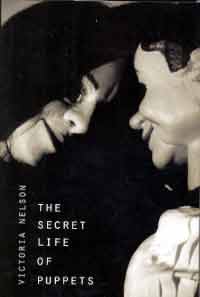
Victoria Nelson's "The Secret Life of Puppets"


Oh, blessed puppets, receive My prayer, and teach Me to make Myself in thy image.
-- Thomas Ligotti, "Mad Night of Atonement"


It feels wrong to me somehow that a book published in the year 2000 with the name "The Secret Life of Puppets" which deals with simulacra and demiurges, fantasy in European high art and American pulp fiction, and Bruno Schulz and H.P. Lovecraft doesn't once mention Ligotti, but perhaps it's just me.

Anyway, I found the book fascinating and thought-provoking, even though I found myself mostly skeptical of the author's conclusions. The argument here is that after the Enlightenment, Platonic thinking has been largely relegated to the background, a consequence of which is that Aristotelian, empirical philosophies have pretty much dominated ever since. However, Platonism and transcendental philosophies provide people with a sense of connection to the greater cosmos, which has been lost in our embrace of rational materialism. Platonic and neo-Platonic thought has found an outlet in culture, both high and low, and the recent conflation of neo-Platonism with technology (as exemplified in movies like "The Matrix") shows that we may be on the verge of a great return of Platonism or new religious reawakening.

As I said, it's an intriguing thesis, and I must admit I find myself mostly in agreement, at least with the way pop culture and art have adopted some of the roles/functions that used to be exclusive domains of religion. But I'm skeptical about the notion of the reawakening. The Matrix and its sequels have come and gone, and we've lost a large part of our obsession with virtual worlds. I'm almost tempted to bring out the old cliché of "9/11 changed everything," which like all clichés does have some element of truth. Anxiety and mystification of technology have been replaced by more conventional anxieties of violence by cultural outsiders. Of course, Nelson had no way of knowing that the western world would receive such a large shock, but at least for the moment the nature of cultural anxieties has shifted.

Another (lesser) criticism is the Lovecraft chapter, which I found interesting but pretty flawed. Nelson appears to be wanting to engage in a psychiatric reading of Lovecraft, which I could understand, but she relies too heavily on some broad generalizations. The impression I get is that Nelson is just trying to hard to find evidence of schizophrenia or syphillis trauma and is cherry-picking from Lovecraft's fiction to do so.

Those complaints aside, the book presents an intriguing look at philosophies of gnosticism and hermeticism, and their expression in popular culture and high art, as well as the way those have developed over the years. Nelson's approach has a certain playful ecclecticism, which is fun to read even when it's not entirely convincing.

14 April 2008

Horror as Initiation: Lee Foust

I wanted to piggyback onto my blog from a few days ago to mention an alternative take on similar material. Lee Foust has a couple of brilliant essays on the h2so4 site.

The Horrific Experience of Countercultural Initiation

The Horrific Experience of Coming Face to Face with the Other 2

I find the distinction between female and male gothic modes rather interesting. Which I think gets back to what I find interesting with Lovecraft. It's common knowledge that Lovecraft projected a certain degree of his racism onto his monsters, often using similar terminology to describe both. Yet, I think Lovecraft also projected a certain amount of his own self image onto those monsters.

I'll mention one early story "Facts in the Case of Arthur Jermyn," which can be read as a neurotic phobia of miscegination. Yet, when HPL describes how the first Jermyn seemed to prefer being put in a madhouse to being around to see his son grow up, I find myself wondering about Lovecraft's own father who ended up in a madhouse and wasn't there to see his son grow up. Jermyn's son, as it becomes clear, is clearly monstrous, only half-human.

So, with respect to female and male gothics, where does Lovecraft fall? Except for a few pieces, his monsters aren't just entities to be beaten so order can be restored. I would argue several of his better regarded stories ("The Shadow Over Innsmouth", "At The Mountains of Madness", "The Outsider") present rather human monsters. But does Lovecraft really fall into the female gothic, where the monstrous ultimately comes to be accepted as good and beautiful? So, does Lovecraft present us with a male or a female gothic, or is it actually something weirder, some form of hermaphroditic gothic?

06 April 2008

The Ritual in the House: Horror Tale as Initiation


I wouldn't say I was a huge fan of horror when I was growing up. I was more into science fiction, which could certainly provide some chills, as in the ending of The First Men in the Moon and the feeding scene from The War of the Worlds. I also picked up a library book by somebody (not Ray) Bradbury about super intelligent animals who gone on a killing spree. (I was in the public library looking for Ray Bradbury but did not pay significant attention to the author's first name.) And I guess I did read the winners of the Miami Herald's Halloween scary story contest and the odd ghost story here or there. But I never really sought out the stuff. I remember when all my classmates were reading Stephen King and V.C. Andrews my reaction was the 80s equivalent of "meh."

It wasn't until I had graduated from college that I found myself interested in reading horror as a genre. The catalyst for this change in taste took place while I was hanging out with my friend Steve at his house. We were discussing books, and he said to me, "You really should check out Lovecraft. He's pretty good" (or something to that effect) and handed me The Best of H.P. Lovecraft: Bloodcurling Tales of Horror and the Macabre with its rather lurid cover:


By this point I'd heard of Lovecraft, from my college roommate Josh (who had attempted to get a CoC campaign going with amusingly disastrous results) and from Illuminatus Trilogy. I was not quite sure what to make of the book and still a little suspicious of the genre, I decided I'd just start with the shortest story. This turned out to be "The Picture in the House" which I read while Steve puttered about on the computer. The story hit me with a certain indefinable force. It didn't have quite the visceral shock of other horror I'd read, but the thing seemed to worm its way into my head in a way that had me hooked. After that, I read pretty much everything Lovecraft had ever written and continued on to many of the pastiche works that fall under the "Cthulhu Mythos" category.

At some point, I became rather bored with the Cthulhy Mythos stuff, most of which is pretty derivative and lacks much of the power of the original works. As I tried to read more broadly in the genre, I've encountered works of a much more visceral nature (Palahniuk's Haunted) as well as those of a much more cerebral sort (Ligotti, Borges). Last year, though, I decided to re-read "The Picture in the House," thinking I might find it tame or hackneyed. I was surprised by how powerful it seemed.

Part of my surprise was because on some level the story shouldn't work. It's about a man travelling around the back country of Massacussetts. He wanders into an old house to avoid the rain and there meets up with a (New England) redneck who happens to be fond of a book with a drawing of a cannibal who is cutting up victims. It turns out that the old man is himself a cannibal and the consumption of flesh has allowed him to live far beyond his years. He is, in fact, over 150 years old. Shortly after the traveller realizes this, a bolt of lightning obliterates the house and knocks him unconscious.

So, murderous rednecks, cannibalism, deus ex machina--all elements that in another story would have me scoffing or throwing up my hands. (Yes, that's you, Haunted. Except for the rednecks.) So, what is it about the story that manages to transcend such hackneyed conventions? I've come to the conclusion that what makes the story so powerful is that it is a story about reading horror and about being affected by it.

The picture that the old man is so fond of is in a book called Regnum Congo, and the drawing is associated with an entry on the Anzique cannibals. If a picture is worth a thousand words, than this picture can be thought of as a horror story. Having "read" this horror story, the old man finds himself developing a strange fascination. As he says: "Queer haow picters kin set a body thinkin'."

Having read and been affected this horror story, he then proceeds to create his own horror story. Namely that of a murderous redneck who consumes human flesh. Though he attempts to cover up this story, he ends up relating it to the traveller nonetheless, who is now involved in his own horror story, which he relates to the reader. The reader thus finds himself reading a horror story about a man hearing a horror story about a man seeing a horror story. It is no surprise that one suddenly finds oneself wondering, however subconsciously, "Am I in a horror story?"

But what really makes this story potent is the strange speech of the old man. (It helped that at the time I had an interest in magical traditions, in Crowley and Sanskrit and the whole lot.) Not only does he say, "Queer haow picters kin set a body thinkin'." He later goes on to add, "Queer haow a cravin' gits a holt on ye." Somehow, the product of these lines echoed in my head, eventually transmuting into "Funny how an idea gets hold of you," a thought which stuck with me long after I had finished the story.

When he was writing horror, Chuck Palahniuk described how one of the features of the horror story is its cyclical nature. This is not a bad insight but seems overly schematic to me. The cyclical nature of the story suggests that it bears some kinship with the practices of pre-modern, pre-Christian life, dominated by its rituals of agriculture, of death and rebirth. I would posit in a world more and more divorced from its own cycles, both those of growth and harvest and those of birth and burial, horror keeps some of those themes alive, hovering on the edge of the culture which has spurned them.

But not all rituals nor all horror stories are or need to be cyclical. One of the oldest, best known horror stories has to be the Book of Revelations, and its reader base certainly believes that's only going to happen once. On a much smaller scale, it can be said no man will ever have more than one Bar Mitzvah. Certainly a community would see many Bar Mitzvahs, but the person for whom it means most will only experience it once. It marks something, a change which is irreversible, like the flow of time itself. It says, "Childhood is over. You can't return. The person you were is no more." In this, it points to the arrow of time, which has only one destination.

It is this aspect which so haunted me about "The Picture in the House" and which I still recognize when I go back to it. "Funny how an idea gets a hold of you." It suggests psychosis, but it also suggested to me one Thug's comment about their initiation ritual: "The Gur of the Tuponee changes you. It would change the nature of a horse." It doesn't matter what you might have thought you were. That is no more. Welcome to the new reality, where feeding on people creates monstrous new realities--where you look over your shoulder to make sure you're not living in a horror story, soon to repeat it to someone else who will be irrevocably changed by it. Then you no longer think "meh" when you see those lurid covers but find yourself fascinated by these stories you believed beneath you.

It really is funny how an idea gets a hold of you.

16 March 2008

Books Compared:Diary/Rosemary's Baby/"The Shadow Over Innsmouth"

Diary is the second of the three books put out by Chuck Palahniuk in which he sought to reinvent the horror genre. It is also written as an homage to the work of Ira Levin, particularly Rosemary's Baby. At the time I read Diary, I was not directly familiar with the work of Levin and the comparison that first came to mind was with an older, shorter story: H.P. Lovecraft's "The Shadow Over Innsmouth." (I was indirectly familiar with the work of Levin in that Baby and The Stepford Wives, particularly in their film adaptations, are so well known as to be part of the lexicon.)

Diary is told as a series of entries in a coma diary, kept by a middle-aged woman (Misty Marie Wilmot) for her husband, a contractor who is in a coma after an unsuccessful suicide attempt. As a young woman she aspired to be an artist and live in a big, beautiful house. In art school, she met a young man whose family lived in a big, beautiful house on an the rather exclusive (and very isolated) Waytansea island. She became pregnant, and they got married and moved back to the island. Both her and the island have fallen on hard times by the time the husband attempts suicide. As the story progresses, the "island people" push Misty into painting again (which she hasn't done in years) and messages start to turn up in the houses that Peter had worked on. These messages warn hysterically about some doom that is to come upon the "summer people" who have begun to rent from the island people.

Rosemary's Baby is the story of a woman who moves into a large gothic building in New York with her husband. Shortly before she gets pregnant, strange things begin to happen around her, beginning with the suicide of a young woman she met in the basement of the building. As the story (and her pregnancy) progresses it becomes clearer that the people around her (especially the other inhabitants of the building) have some ulterior motives regarding the child growing in her womb.

"The Shadow Over Innsmouth" is the first-hand account of a young man following an antiquarian tour of New England in which he found himself taking a detour into an old dilapidated town by the name of Innsmouth. It was an old trading port which was decimated by some sort of plague and became isolated, its inhabitants developing odd deformities, perhaps as a result of inbreeding or miscegination. While there, he sought out on old drunk named Ezekiel who told him some very strange things about the history of the town. Then the bus out of town broke down, and he was forced to spend the night in the local hotel.

And from here on out There be spoilers!

Not surprisingly, things turn out to be far stranger and sinister than the hapless protagonists expected.

The young antiquarian whose name is never given soon learns that the town has been taken over by hybrid fish-men who worship a strange, ancient deity and seek to interbreed with humans. After a night of frightening close calls, he manages to escape. Not long after his escape, however, he comes to learn that he is himself descended from the strange fish-men and is slowly transforming into one. He sinks into despair, considers suicide, then finally chnages his mind and heads to the sea to start his new life as a monster.

Rosemary finally stumbles upon some clues that the friendly old people in the building are, in fact, witches. Fearing for the safety of her child, she attempts to flee. But she is turned in by the doctor she confides in and taken back to the apartment, where she gives birth. She is told that the baby is born dead, but doesn't believe it and sneaks into the apartment of the head witches. It turns out that the child is the offspring of Satan, whom the witches summoned up to rape her. Though she considers killing the child, she changes her mind and decides that even the Son of Satan deserves a mother's love.

Misty eventually learns that her painting and the diary are both part of a larger scheme. Every hundred years, a woman who was not born on the island will paint a series of pictures which render people catatonic (via Stendahl syndrome). This will allow the "island people" to enact a major tragedy on the "summer people" (and quite a few of themselves, as well) which will make them rich again. It has been done twice before, after which the island people enjoyed 90+ years of prosperity before going nearly bankrupt and having to enact another massacre. The diary is key because the two former artists also kept diaries, and it is important to reproduce the events in the life of the artist for the plot to unfold. Misty attempts to stop the tragedy but is stopped by the police, and the massacre unfolds. She ends her story by mailing a copy of her diary to Palahniuk so he can write a book to, I guess, stop the pattern a hundred years hence.

Of the three, Diary is the one that tries hardest to be readable as allegory. As par for the course for Palahniuk, it is meant to be a statement on the plight of the artist, the nature of capitalism, and gentrification and immigration (ie. Portland property values). Baby appears to have been inspired by a certain 60s era anxiety over the increased secularization of the American populace. One character mentions that the death of God is not just a line from Nietzchie but an actual event taking time at that place. (Palahniuk himself interprets Baby as presenting a strongly pro-choice argument, but I suspect he hasn't read the novel.*) Shadow reflects some of Lovecraft's phobias--of foreigners and the ocean, in particular--but ends is powerfully ambiguous note, calling into question its own assumptions about monstrosity.

Curiously enough, though Lovecraft tends to be a far more verbose writer in terms of style, Shadow probably has the strongest, most disciplined finale of all three works. After Rosemary decides she wants to nurture her Satan Spawn, she has an argument with the head satanist about whether the baby is to be named Adrian or Andrew. Meanwhile, a Japanese satanist who shouts "Hair Satan!" (difficulty with "l"s) takes pictures of everyone. I'm not sure if Levin had campiness in mind when he wrote that scene, but there sure is a lot of it and it undercuts whatever eerieness the final revelation is supposed to bring.** Misty, in her attempt to foil the final step of the plot, ends up running around in front of a crowd, yelling, "You're all going to die! I'm Leonard da Vinci! I'm Lord Byron." It's hard not to sympathise with the crowd for thinking she's nuts. By contrast, the slow realization of the narrator of Shadow that he's becoming a monster and his wrestling with what to do about it are written as a slow accumulation of details. By the time he writes "I cannot be made to kill myself," it has an almost existentialist courage to it.

One of the things that struck me about Diary was the extent to which Palahniuk's attempt at allegory conflicts with the power of the story. There's an unresolved question at the heart of the plot: who or what is really behind the plot in question. The book implies that the first time it happened was by accident, and the second was only discovered when it was already taking place. It would appear that the island people stumble onto some pattern of human sacrifice older than them. In fact, the paintings that Misty paints are photo quality reproductions of scenes of the island itself, which again reinforces the idea that it is the island itself that seeks the massacre with the island people secondary beneficiaries. This appears to take human agency largely out of the equation, which makes it less convincing as social allegory regarding the evils of gentrification. And frankly a time scale of 100 years suggests that it is not the island which sets the plot in motion but an author looking for a nice round number.***

Curiously enough, Waytansea island is fish-shaped and it is described as a place where "even the dogs are inbred" which connects it strangely to Lovecraft's Innsmouth. It's an odd parallel, but one that makes me wonder: Was Palahniuk aware of this parallel when he sought to reinvent the horror novel? And if not, has he ever considered that he might himself be a "summer person" on this particular genre/island, just another interloper whose read a few guidebooks but doesn't know the territory or understand the history?

* This may be an unfair charge, but his interpretation seems a case of wishful thinking more than anything else. Rosemary starts out wanting a baby, and once she realizes something is up ends up fearing for the life of her child against those who would see it as less than a person. It might represent a certain degree of pregnancy anxiety but is a pretty insubstantial argument for legalized abortion.


** And seriously, satanists? I know it was written 40 years ago, but does anyone really find satanists scary? Perhaps it's just me, but I find them two-dimensional and dated. In Shadow, someone says the Innsmouth people were accused of being devil worshippers but that it's a pretty silly charge. Then it turns out the "devils" they worship (and are) don't really care about Christian theology.


*** I can't help but wonder what Borges would have done with a story about an artist whose act of writing reproduces a tragedy 100 years old. Although I think a nice touch would be to rewrite Diary with Sonia Greene as the practical aspiring artist finding herself forced to work to support the family and Lovecraft himself as the creepy artist of ambiguous sexuality with the weird family.

20 February 2008

Richard's "Tunga Tuggo, Lingua Dingua"

This is the story of two brothers out looking for the remains of their father, who has disappeared and is believed dead. One thing I really like about Richard's style is his skill at creating a feeling of place, one he has in common with my some of my favorite horror authors. Just as Lovecraft has his haunted New England and Ligotti's stories often seem to take place in a rust belt where decay has infested everything, Richard's vision of southern oceanside towns captures a sense of decadance that is both realistic and mythic. Ironically enough, though not a horror story, the brothers' adventure does end on a somewhat Lovecraftian note.

24 January 2008

Does the Dagon Church need a masturbation saint?

If you'll pardon the stream-of-consciousness intro, I'm dredging up a tongue-in-cheek theory I dreamed up a couple of years ago with regards to a character from Chuck Palahniuk's Haunted.

Yesterday, I picked up Mark Richard's Charity from the library. I first encountered Richard when a friend gave me Fishboy as a birthday gift in high school. I actually didn't really care for Fishboy the first time I read it, but I pulled it out last year and re-read it. Much to my (pleasant) surprise, it turned out to be a great read. (In fact, it sort of inspired me to give Moby Dick a try, but that's a different story.)

Richard seems to get grouped together with Palahniuk, probably because they have similar literary influences. (Amy Hempel, Gordon Lish, Raymond Carver) And Fishboy shares some superficial similarities with Haunted. Both aim for dark, gruesome humor and both feature stories within the main narrative. The books are otherwise very different, much to Richard's benefit.

Charity is a collection of Richard's short stories, and I've decided that I'm going to be reading it and giving it the "story a day" treatment I gave Lugones' Strange Forces. I thought the approach worked really well with Lugones, allowing me to organize and get a better feel for the authors style and themes.

That prompted me to think it might be worth treating Haunted like a short-story collection and giving it the story a day treatment. Some people might say this is unfair, since Haunted is a novel, not a short story collection. To which I call bullshit, since it was conceived as a short-story collection and Frankensteined up into a novel. (The zippers still show.) That's something down the road as I debate whether to re-read the accursed thing or just review the stories from memory, but in the meantime I thought I'd dredge up my Deep One explanation for St. Gut-Free's curious biological properties. Previously I had tried to lay it out in a somewhat convoluted, rambling style, but since I've already been pretty rambling about getting to the theory itself, I'm just going to bullet-point it for ease of read. Anyway, without further ado...

Evidence that St. Gut-Free is actually a Deep One

  • Despite having no body fat, no surplus muscle mass, and a poor ability to absorb nutrients through his digestive system he manages to survive a period of starvation that incapacitates normal people.
  • His sperm is able to survive for prolonged periods in chlorinated water. Once it detects an ovulating female, it instinctively swims up her cervix to fertilize available eggs.
  • He masturbates underwater. Obviously the water-womb association has a particular significance for him, what with his who mother who hides herself away. (What could be more humiliating than the Innsmouth look?)
  • He hooks up with Mother Nature. (The dude's quite the Oedipal mess, see above.) Out of all the women, he picks the one who represents a primal, pre-human state of existence.
  • His intestines taste like squid tentacles.

07 November 2007

Open Circle Theater: "The Dreams in the Witch House"

Every year Seattle's Open Circle Theater puts on an adaptation of Lovecraft, usually several pieces grouped together. This year's performance followed the same pattern, adapting four Lovecraft short stories into ~90 minutes of theater.

The works in question were "The Picture in the House," "Nyarlathotep," "The Cats of Ulthar," and "The Dreams in the Witch House." Lovecraft doesn't seem a natural to adapt to theater since some of the horrors he describes seem as if they would be indescribable even with CGI, but the limitations of the stage make for some interesting approaches.

Last year's adaptation involved interlinked stories, one of which ("Strange Magicks") was original. This one was structured differently, with Nyarlathotep and Cats of Ulthar nested in Picture, and Dreams as a separate piece.

"The Picture in the House" was a relatively faithful adaptation, with only a few minor changes. The unnamed narrator still seeks shelter in an aged structure to avoid a rainstorm while out visiting the Arkham countryside. However, the events take place in the modern day, so that the narrator speaks his observations into a voice recorder. (A clever device for allowing for narration.) Inside the house, he discovers a series of books and meets a strange old man who asks him to read from the book. The stories he reads are "Nyarlathotep" and "The Cats of Ulthar." The core effect of the story is kept, though the writers felt the need to make explicit what Lovecraft never really stated. (Understandable, since the slow accumulation of little details is a little more difficult in theater than in writing.)

"Nyarlathotep," on the other hand, required quite a bit of adaptation to bring to the stage. The original story is a rather surreal prose poem of a travelling showman who appears to bring the world to ruin. (The story very dreamlike and provides for a certain ambiguity as to whether the destruction is real or hallucinated.) The piece is presented through the eyes of two men, Robert Chambers and Ludwig (or is it Edward?) Prinn, who are investigating the travelling showman. Like "Strange Magicks" the action ends with Lovecraftian revelations in a darkened theater. That can be a hard thing to make convincing and not goofy, but John McKenna manages to deliver it with the right degree of dramatic flair.

"The Cats of Ulthar" is also a tricky story to adapt. Written by Lovecraft when he was most under the influence of Lord Dunsany, it's set in a mythical dreamland and told almost as a fable. As with Picture, the adaptation makes explicit something that Lovecraft only points at. (Though in such a way that there is only one obvious conclusion.) It ended up capturing some of the fable-like feeling of the original, though still seemed a bit shortened.

Of all four performances, "The Dreams of the Witch House" was probably the weakest. The source material certainly presents its own sets of challenges, but even taking that into account, a lot of material seems to have been cut out, in contrast to the other adaptations where material was added in to provide coherency. The creature effects on Brown Jenkin were pretty cool, though.

Overall a good show, though not quite as good as last years. They had changed venues to a smaller space, and I wonder if that did not affect the kind of show they could put on. The OCT web site states that they recently moved to a new location, so I hope the space next year lends itself better to interdimensional horrors.

22 October 2007

The Starry Wisdom

The Starry Wisdom is one of the more unique collections of Lovecraft-inspired fiction that I've come across. Instead of simply new variations on the seeker running into monstrous entities with unpronouncable names or even a collection of stories trying to bring Yog-Sothothery into the 20th (or 21st) century (a la The Children of Cthulhu), The Starry Wisdom's goal is to view the Lovecraftian mythos through the eyes of the sort of late 20th Century occultism which has itself been much inspired by the Old Gent. Or as editor D.M. Mitchell states:

My aim is to dig deeper and access the subterranean channels of archetype and
inspiration with which Lovecraft was connected... the current of semi-occult
symbolism and shamanic imagery.

While a worthy goal, the collection fails to consistently live up to it. As with a lot of collections, it's hard to avoid the feeling that some of it is filler. Far too much space is devoted to unengaging prose poems more interested in the connection between sado-masochistic impulses and Crowleyian notions of magick and the new aeon than to anything more Lovecraftian than the usual name dropping (Cthulhu, Yog-Sothoth, Old Ones, etc.) Additionally, there are several stories of fairly good quality which seem almost wholly unconnected to Lovecraftian themes at all, further contributing to the sense of padding. That leaves about half the collection, which thankfully has some pretty strong pieces. Among the standouts were stories by Grant Morrison, Robert M. Price, Alan Moore, D F Lewis, Brian Lumley (although he seems much too convential considering the goals of this collection), Don Webb, and D.M. Mitchell's own "Ward 23". Additionally, there are three illustrated/comic book-style stories. John Coulthart's adaptation of "The Call of Cthulhu" is "worth the price of admission alone." The other two "Third Eye Butterfly" and "Pills for Miss Betsy" are less overtly Lovecraftian while still evoking a certain Lovecraftian dread. The book concludes with a collection of three essays concerning the relationship of Lovecraft's fiction to modern occultism, which will likely be of more interest to the student of ceremonial magick than to the casual Lovecraft fan.

One of the failings of the collection is a rather superficial handling of "the current of semi-occult symbolism and shamanic imagery" in Lovecraft's fiction. The stronger works, such as Morrison's "Lovecraft in Heaven," Moore's "The Courtyard," or Lewis' "Meltdown" approach HPL's imagery with a knowledge of the tradition of weird fiction which he was working in. The prose poems, on the other hand, seem to take Lovecraftian themes as an entry for dwelling on their authors' own "semi-occult symbolism" which could be interesting for someone interested in the psychosexual baggage of modern occultism, but is much less so for anyone interested in the Lovecraftian tradition.

13 August 2007

Terror in Old Ægypt: "Nyarlatophis"

I have to admit I'm actually a bit torn about reviewing "Nyarlathopis," for two reasons.

  1. Sargent has an obvious affection for the source material.
  2. Whatever else I can accuse "Nyarlathopis" of, it definitely was not lazily written.

The concept for the story certainly has a lot of promise: Nyarlathotep (Nyarlathopis being the more accurately Egyptian version of his name) tries to conquer Egypt in the 13th century BC but does not succeed. The story is based on the first-hand account of the Pharaoh's lead adviser at the time. Considering that Nyarlathotep is a vaguely Egyptian figure, putting him into an Egyptian milieu should generate some interesting results. And Sargent provides a lot of historical detail, covering everything from Egyptian mythology to its governance structure.

Despite all this potential, the story never really transcends the level of mere pastiche at which most Cthulhu mythos fiction seems to aim.The story is beset by anachronisms which serve to undermine whatever sense of suspense or weirdness the plot should generate. Sargent writes in a straightforward descriptive style which whatever its merits is completely wrong for this story, for it fails to capture the feel of an ancient text documenting an epic struggle against an unimaginable evil. Certainly a style more in keeping with that associated with ancient texts (the Bible, Hammurabi legend, Beowulf, etc.) would have been more appropriate. It would not even have had to be particularly authentic to provide the requisite atmosphere of weirdness. (And being a weird tale, however derivative, a sense of the weird is always a plus.)

The stylistic problems are compounded when more outlandish concepts are introduced. (And this being a Cthulhu mythos tale, outlandish concepts are kind of a prerequisite.) Concepts such as "the other side of the universe" or the primal chaos at the center of creation are handled as if they were fairly straightforward concepts, despite the fact that they are being presented by a narrator who thought the sun was a chariot and had never seen a body of water larger than the Nile. (Or perhaps the Mediterranean.)

A few other factors serve to dull the atmosphere, among them the muddling of the mythos and the author's info dumping. Sargent sets up a religious war between the Egyptian gods and the Cthulhu Mythos, a somewhat Derlethian approach which reduces Nyarlathotep to a cartoon villain. As for the info dumping, because the author has placed the story in a setting with which his audience is likely unfamiliar, he has to provide quite a bit of background information. At first, this is provided by the framing story of the translated papyrus, but a lot of information is still provided by the narrative itself which leads to inauthentic digressions while the narrator explains things that his expected audience should be familiar with. While some people may consider the use of footnotes in fiction distracting or (even worse!) postmodern, when you're tale is framed as a historical document it is an effective way to bridge the gap between the fictional audience and the real audience. After all, what is the point of all those details to add veracity to the tale if they are introduced in a way which completely undermines that veracity.

I am perhaps being a bit harsh; as I said before, most of this kind of writing is written at the level of pastiche. The story certainly ranks above average in comparison with the majority of mythos fiction, lifted a bit by the detailed historical setting. If you're a fan of Lumley's Titus Crow or August Derleth's various works, you would probably enjoy this story. If you're, like me, a bit jaded regarding Cthulhu Mythos fiction, you'll probably find it sadly lackluster.

Next up is my final entry regarding "The Taint of Lovecraft"

09 August 2007

Mythos Inversion: "Live Bait" and "The Black Brat of Dunwich"

Though each of these two stories is substantial enough to merit its own review, they share enough similarities that I should comment on them together. Both stories take place in a world where Lovecraft was a sort of reclusive Truman Capote, writing non-fiction using the tools of fiction. Both stories also attempt an inversion of the good/evil spectrum present in the original Lovecraft stories to which they refer.

To expand a bit on the first point, "Live Bait" features a businessman making a visit to the town at the center of "The Shadow Over Innsmouth," a story based largely on the nameless narrator's first hand narration to HPL. "The Black Brat of Dunwich" is the story of two researchers who meet someone with a rather different account of the events that took place in "The Dunwich Horror," which was based on a combination of newspaper coverage and HPL's interviews with Henry Armitage.

[I've always found Lovecraftian stories featuring Lovecraft as non-fiction author to be something of a cheat, though "Black Brat" manages to use this tired concept in an interesting way.]

And just to cut to the chase, since it will become obvious soon enough, of the two stories "Black Brat" was certainly the strongest. "Live Bait" starts strong and has moments of suspense and a few good ideas, but its attempt to cast the Deep Ones as victims fails to "humanize" them to the extent that the author may have intended. (It doesn't help that Lovecraft's original story ends with the human/monster dichotomy already shredded. Had "Shadow" ended right after the narrator's escape, the inversion would seem much fresher.) The Innsmouth locals are little better than caricatures, more like copies of Deliverance hillbillies than truly sinister individuals. (Though Sargent does a fairly good job of copying Lovecraft's odd Innsmouth dialect.)

By way of contrast, "Black Brat" is a pretty successful "humanization" of Wilbur Whateley. It falters a bit at the end; Sargent seems to be straining to wrap everything up a little too neatly. By contrast, the middle section dealing with Wilbur and the inconsistencies in Lovecraft's tale is fairly thought provoking. There is an interesting tone of homoeroticism brought to the material which surprised me on my first reading, but on a second reading it seemed very appropriate, resonating with Lovecraft's theme of alienation and body horror. Sargent handles the theme well, pushing it enough to get you thinking without letting it become heavy-handed.

Next: "Nyarlatophis"

08 August 2007

Sargent's Taint: "Their Love of Craft"

Stanley Sargent's The Taint of Lovecraft kicks off with the science fiction/horror hybrid "Their Love of Craft." Having read a fair share of Lovecraft-inspired short fiction, I've developed something of a loose hierarchy or classification scheme. At the top are stories which manage to echo Lovecraft's work yet bring an author's individual approach to it. (i.e. Ligotti, T.E.D. Klein, Karl Wagner) At the bottom are works which attempt to slavishly copy Lovecraft without managing a whit of suspense or mystery. (Authors to remain nameless.) And while "Their Love of Craft" doesn't quite rise to the heights of the former, it certainly doesn't sink to the depths of the latter.

The story is a cross between At the Mountains of Madness and The Forbidden Planet. Though somewhat derivative, the unlikelihood of the pairing (and the unexpected resonances between the two sources) make for an entertaining story. Sargent does pile on a bit with Lovecraftian in-jokes, which almost border on being too clever, yet he still gives the story an atmosphere of subtle dread or mystery as one would expect from the Old Gent himself. Well, somewhat more subtle than HPL, but its presence is always welcome even in a story with it's tongue halfway in its cheek. (Somewhat reminiscent of Kim Newman's "Big Fish" in this department.) The ending, italicized in the style of HPLs older stories, is darkly (or grossly) funny in a way that felt a bit anticlimactic, but the story otherwise balances its horror and humor elements pretty well.

Next up is Mythos Inversion: "Live Bait" and "The Black Brat of Dunwich"

07 August 2007

Reviewing Sargent's The Taint of Lovecraft - Preamble

I find it tricky to review collections of short stories. Even when they come from the same author, there tends to be a certain degree of variety in the stories even if all from the same author. (Sargent's book being no exception.) I'm not fond of oversimplification, so attempting to sum up a collection of stories feels somewhat wrong or at least beyond my current ability to achieve successfully. My tendency would be to review each story individually, but I imagine this would make for an unnecessarily long-winded review, one perhaps itself lacking in cohesion.

So, in approaching Stanley Sargent's The Taint of Lovecraft I've decided that the most reasonable thing to do might be to split the difference. I will review several stories individually, followed by a review of several of the lesser stories, then I will attempt to conclude with a summary of some sort. In all likelihood, I will skip over the poetry (for which I have no ear), though I may comment on the essays.

My first entry: "Their Love of Craft"