10 July 2009

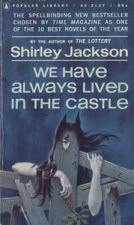
Review: We Have Always Lived in the Castle


The title of the novel is no accident, for it is as gothic a tale as any that was ever set in a crumbling castle on the banks of the Rhine. Its treatment of human evil, isolation and madness could easily qualify it as the pinnacle of 20th Century American Gothic.

A shadow has fallen across the house of Blackwood. Though once a prominent family, a possibly accidental poisoning has reduced their numbers to three (two sisters, an uncle) and made the townspeople suspicious of the survivors. The uncle, Julian, has been left physically crippled and one of the sisters, Constance, has developed a phobia about the world outside the house which does not prevent her from accepting visitors. It is left to the younger sister, Merikat (short for Mary Katherine), to venture into town on necessary errands.

Gothic literature often features singular characters, individuals who seem eerily plausible yet who are warped in a way that makes them unlike anyone else we've ever encountered. Merikat, who is the narrator and thus our guide through this story, is just such a character. It is clear that she views the townspeople with hostility, going so far as to craft charms--ordinary household items such as books or mirrors placed in odd locations or strange configurations--to keep the world at bay.

But soon it does intrude, in the figure of Charles, a cousin from an estranged branch of the family. His healthiness and level headedness seem to promise an opening up of the Blackwood home, a return to normality. But Merikat sees in him a representative of the crudity and selfishness of the outside world and seeks to drive him out through more and more powerful charms. The last of these results in a terrible reaction from the townspeople which sends the Blackwoods into greater isolation, leading to a hauntingly melancholy end to the story.

We Have Always Lived in the Castle is an incomparable achievement, a story that will equally charm and disturb in ways that sometimes can be almost intolerable. And you will probably never forget Merikat Blackwood.

09 July 2009

Review: Lamb; the Gospel According to Biff, Jesus' Childhood Pal


In The Last Temptation of Christ, Judas finds himself in a terrible situation. Jesus has told him that it will be necessary for Judas to betray him in order for mankind to be saved. As Christ acknowledges, God gave Judas the really hard task, that of betraying someone who he holds very dear. By comparison, all Christ has to do is die.

Though it's never acknowledged, the narrator of this book finds himself in a similar bind. As the lifelong friend of Joshua (aka Yeshua aka Jesus) and under the dictum that "dying is easy; comedy is hard," he has been left the harder path. All Joshua has to do is die. Biff has to make it funny.

Biff has been brought back to life by God so that he can write the definitive gospel since he was there from nearly the beginning. In order to ensure his cooperation, God has an angel chaperon Biff. Though it makes up very little of the story, the scenes of Biff and the angel in the hotel room are some of the funniest of the novel, especially in the angel's befuddlement at modern life.

Biff first met Joshua when they were both kids, and Joshua was bringing lizards back to life for the benefit of his younger, lizard-killing brother. From there they strike a lifelong friendship not impeded by the fact that Joshua knows he will one day be the Messiah. Biff is your quintessential underachiever, and his philosophical outlook, which has been derived from the teachings of Cynic, makes for a nice foil for Joshua's earnest desire to fulfill the task that has been set before him. When Joshua decides he will never learn how to be the Messiah if he does not seek out his origins, it is Biff who accompanies him on his travels.

They go in search of the Three Wise Men in order to learn the truth of Joshua's birthright. In their travels, this Hebraic Hope and Crosby encounter bandits, Taoist magicians, herbalist concubines, a hungry demon, a Buddhist monastery, the Tibetan Man of the Mountains, martial artists, a Kali ceremony, Tantra, untouchables and the Kama Sutra. After their travels, Joshua comes to learn what he has to do to become the Messiah, so they return to Palestine for the more familiar part of the story.

Christopher Moore here has a fine line to tread in attempting to make the story of Christ funny and believable yet keeping Joshua as the earnest Messiah figure we can all look up to. (No Last Temptation-style dream sequences of Christ experiencing the temptation of giving it all up here.) Having the story told by the underachieving and very sardonic Biff is a great way to thread that needle.

Moore makes the most of the sections where the gospels are silent, which give him a lot to work with. It yields great comic touches, like the time Joshua, Biff and Maggie decide to "circumcise" a well-endowed Greek statue, or the origins of the Jewish custom of Chinese food on Christmas. Though not every joke works, the passages overall maintain a high level of humor without robbing Joshua's quest of meaning.

The humor does begin to lost its impact near the end. Once Joshua and Biff return to Nazareth and Christ begins his ministry, Moore has less leeway with which to play. Once the ministry and the inevitable path to Golgotha have begun, the humor becomes more forced. As Joshua himself once said (though not in this book), a man cannot serve to masters, for he will honor one and neglect the other. The book has to choose between the earnestness of Joshua and the cynicism of Biff. It opts for the latter, for which one cannot entirely blame Moore. To have gone with the latter would have been to write a different, much edgier book. That Moore manages to make both elements work for as long as he does is testament to his talent and his great sense of humor.

30 June 2009

Denevi: La cola del perro

"La cola del perro" is that last of the stories in this collection, this one in the fable mode. A farmer is trying to maximize efficiency at his farm by making sure his animals are not goofing off. Since he doesn't have a good sense of how to judge their output, he decides to prohibit the dog from wagging his tail, under the theory that if the dog is wagging his tail he must not be working. The farmer goes so far as to threaten the dog with death if he will not stop wagging his tail.

The dog finds this very unnatural, but does learn that if he concentrates, grits his teeth and squeezes the right muscles, he can keep from wagging his tail. But he finds it very frustrating and stressful. As he becomes more stressed, his behavior becomes more hostile and threatening. Although the other inhabitants, including the farmer's wife, begin to think the policy has cost the dog his sanity. The farmer, though, thinks it is great, especially since a hostile dog makes for a much better guard dog.

Interesting story, which struck me either as a satire on workplaces that fixate on productivity or a commentary on communism. (They may seem like pretty divergent possibilities, but the Soviets were pretty fixated on productivity numbers in their days.)

29 June 2009

Denevi: Eine Kleine Nachtmusik

"Eine Kleine Nachtmusik" is the last of Denevi's character-based pieces, and like some of the others has an element of confrontation between a certain porteño snobbery and the wider world. Two spinster sisters spend their nights listening to records of classical music in their apartment, which is in a building which is largely empty. One day the hear that a young musician has moved into an apartment in the floor below theirs. That night they hear him playing tangos in the apartment below.

The younger sister finds his tangos moving and becomes fascinated with him. She begins to think about running into him, seeing him as a potential escape for the lonely existence she is living with her sister. Though her sister acts horrified about the sort of music he plays, she also has an interest in meeting him.

In the end, things do not work out quite as either planned in a melancholy ending.

IPA: Snowmen

And here the book swings back into weird/fantasy/magical realism mode with a great story about a few days in winter. There's admittedly not much in the way of a plot here. Snow falls one day in the hometown of the narrator, who is a young boy. He heads out with his friends to play in the snow. Soon they encounter some very intricate snowmen. They wander around some more, and then go back outside day after day to see the new variations in snowmen. The snow figures become ever more fanciful: people in complicated scenes, animals, plants, mythical beasties. Of course, these are all pretty much figures it is impossible to make with snow, but I found it only added to the sense of the wondrous that Millhauser is after in the story.

CHM: The Same Dog

A tricky story to discuss, because it actually hinges on a little bit of a twist that I'd rather not give away. The story features two periods in time, the first when he was a young boy and the second having grown up and visiting the house he grew up in. As a boy he was a little bit of an outcast, but there was a little girl he was good friends with. They would go out exploring the English countryside together, roaming as far as they could get away with. One day they discover a strange house, guarded by a very frightening dog. As they leave, the boy thinks he sees something which creeps him out, but he catches only a vague glimpse.

Soon thereafter, the boy becomes sick and spends many days in bed. After he recovers he learns that his friend has died, but nobody will tell him what happened. He grows up never having known what happened to her. He returns to his childhood home from the army with a fellow soldier along. They go out exploring and discover the strange house that he had found as a child.

And to reveal anymore would be to give too much away. This again is Aickman at his most mysterious, with a sense of the strange but providing no ability to really puzzle out what has happened.

28 June 2009

BDT: Revelación de otoño & El invierno propio

These last two stories round out the seasonal section of Buzon de tiempo. "Revelación de otoño" is about an academic couple, who decided somewhat late in life to adopt a daughter. It's an interesting sketch of their lives, their friends and interests. The conflict arises at the end, when the daughter decides that she wants to know about her biological mother. As with the spring story, the seasonal connection doesn't seem as integral as it could be.

"El invierno propio" (One's own winter) is, unsurprisingly, about death. An old professor thinks about life and death as he sits in his library, looking at all the books. There's a certain elegance to the simplicity of the piece, and any bibliophile can appreciate the feelings of nostalgia of looking at books that have accompanied one through life.