04 April 2010

Review: The Brontës Went to Woolworths by Rachel Ferguson


"How I loathe that kind of novel which is about a lot of sisters." So begins The Brontës Went to Woolworths with a touch of playful irony, as this happens to be a novel very much about sisters. The oldest (who also happens to be the narrator) is Deirdre Carne, who works as a journalist and has been attempting to get a novel published. Katherine, who is a little younger, is an actress still trying to achieve success in her career. The youngest of the three is Sheil. She is still young enough to have a governess present to guide her education. All three live together with their widowed mother in a London house in the 1930s.

The family members are drawn together by a very playful imaginative life. A large part of it revolves around humorous anecdotes regarding "family friends" which can be anything from childhood toys to prominent strangers. Among them is Judge Toddington, who Deirdre first saw when she had to serve jury duty. Deirdre describes these "friendships" in a such a matter-of-fact manner that I sometimes felt a little lost early in the novel, unsure as to what was real and what was not.

The family appears to have built up this world in part as protection for the challenges they face. Katherine gets kicked out of her acting class and has to decide whether to join a travelling show. Deirdre agonizes over whether her novel will find a publisher. Even the fantasy realm provides some degree of discomfort. Sheil's governess considers it foolish and grows increasingly frustrated with the sisters' talk about their "friends." While on holiday, the family attends a séance, where they appear to draw some attention from a couple of mysterious phantoms.

The major development comes when Deirdre gets a chance to know the real Lady Toddington during a charity bazaar. As the two become friends, the two families begin to get to know each other. The Toddingtons have no children of their own and so are flattered by the attention of the Carne family. What follows is a negotiation between imagined and real friendships.

I confess I'm more familiar with this sort of shared imaginative world in somewhat darker contexts, as in Peter Jackson's "Heavenly Creatures," and so for a good part of the novel felt sure that something awful was bound to happen. The novel never takes that sort of turn, though there is a sense of the disappointments of the wider world. Deirdre's narration was very entertaining, reflecting a very sort of English literary quirkiness. (Deirdre even tells how she once turned down a marriage proposal because she was too in love with Sherlock Holmes at the time.) While the Carne's fantasy world serves to bring them together, it proves surprisingly fluid, presenting an intimate portrait of how people connect with each other.

12 February 2010

Review: Mr. X


In Mr. X, Peter Straub writes about identity, family and the way the past influences our present. He also pays literary homage to weird writer H.P. Lovecraft. It was this last item which most got me interested in reading Mr. X and, sadly, the element I found most disappointing. Straub can write great literary horror, as seen in his Ghost Story, which pays homage to the ghost stories of Henry James and Nathaniel Hawthorne, but he seems to stumble here. This isn't entirely Straub's fault, as the Lovecraft homage or pastiche can be harder to pull off than it looks. Argentine author Jorge Luis Borges gave it a shot with "There Are More Things," and while it's a decent story, it's not one of Borges' best nor is it likely to make you forget "The Rats in the Walls." Writing a Lovecraft homage is a little like playing a Led Zeppelin cover song. Just because it's been done badly so often doesn't mean that doing it well is easy.

The premise is intriguing, and for the first of its six sections the book moves swiftly, drawing the reader into its sense of mystery. And the life of our protagonist, Ned Dunstan, is full of mystery. There is the strange premonition he gets of his mother's impending death; the question of his father, a man he has never met and about whom his mother has refused to talk; the feeling of missing something or someone in his life; and finally, the terrible attacks he has had every year on his birthday, starting when he was three years old. Only Ned knows, however, that what other people see as seizure-like episodes, he experiences as vividly real dreams. In these dreams, he witnesses terrible crimes committed by a strange figure dressed in a black coat and hat. He identifies this bogeyman by the name of Mr. X.

Interspersed with Ned's narrative are journal entries from Mr. X. Mr. X describes his own childhood, the discovery of certain supernatural powers and the revelation that he was descended from beings known as the Great Old Ones to help bring about their reign on earth. Later he discovers the work of H.P. Lovecraft and identifies his own story with that of the Providence author, going so far as to become obsessed with Lovecraft and his stories, believing them to be prophecies.

The premonition of his mother's death has brought Ned back to his hometown of Edgerton, where he spends time with his aunts and uncles as well as some of his mother's old friends. He also begins to search for the father he never knew and becomes embroiled in a local businessman's shady dealings. As you can see, there are a lot of elements here, and had Straub managed to blend them well, it would make for a real tour-de-force.

One central problem is Mr. X, who makes an effectively creepy villain for a little while but becomes less frightening the more journal entries we read. About a third of the way into the novel I came to the conclusion that Mr. X was easily the whiniest of the Bastard Spawn of the Great Old Ones I had ever encountered. (I imagine he avoids Old One family reunions lest he suffer Cyclopean wedgies at the hands of Wilbur Whateley.) There's something to be said for bogeymen willing to be quietly ominous, or if they're going to rant, it should reinforce the sense of menace, not undermine it. Mr. X's purple prose might be intended as a parody of Lovecraft's writing style but comes across as bad Lovecraft fanfic, especially when Mr. X is expressing such non-Lovecraftian sentiments such as:
I HATE ART. ART NEVER DID ANYONE A BIT OF GOOD. IT NEVER WON A WAR, PUT FOOD ON THE TABLE, SWEPT THE FLOOR, TOOK OUT THE GARBAGE, OR SLIPPED YOU A TWENTY WHEN YOU WERE DOWN AND OUT. ART DOESN'T ACT THAT WAY.

This may be a consequence of the weakness of the villain, but I found myself pretty bored with all of the characters. Ned is compelling as a confused young man beset by mystery but less so as a pulp detective figure hunting down the various threads of family and criminal intrigue. His aunts and uncles are a motley crew who are meant to be sort of charming in their twistedness, but every time one of them said some variation on "We are Dunstans" to reference the family's low standing in Edgerton, they crossed closer to self-parody. There have always been Dunstans in Cold Comfort Farm, after all. Ned also has a love interest, Laurie Hatch, who is tangentially connected to the criminal dealings. (She's the husband of a local, corrupt businessman.) She has a cute kid with musical talent and is quite sexy in a panther-like sort of way but sadly lacks much in the way of a personality.

The lack of engaging characters ends up undermining some of what should be the novel's strengths For example, Straub's prose has a nicely literary quality, such as when he describes Ned and Laurie's lovemaking:
Some of the women I had known may have been more passionate than Laurie, but none were more gracefully attuned to the capacity of each individual moment to spread its wings and glide into the next. She also had the gift of what some would call a dirty mind and others inventiveness. The more we explored our bodies and celebrated their abilities, the more unified we became until we seemed to pour into each other and become a single, profoundly interconnected thing.

It's nicely written and would be almost transcendent if I felt some connection to the characters, but since I don't it just seemed sort of purple to me, high-toned Harlequin romance.

This deleterious effect also extends to some of the novel's twists. We learn three different backstories for Laurie, and if she were a character I had cared about, I would have been struck with a feeling of suspense and wanted to know which was true. I didn't really care, though, and so felt that reading one backstory was punishment enough. Other twists were undermined by Straub's decision to riff off certain elements of Lovecraft's "The Dunwich Horror." This isn't bad on its own, but some twists that should have been surprising seemed obvious if you were familiar with the original.

Straub probably should have taken the advice offered up to Joseph Curwen about not calling up what you cannot put down, since I think the Lovecraft homage proves particularly damaging to the novel. Lovecraft had many weaknesses as a writer, but his portrayal of a universe where cosmic forces easily overwhelm a humanity to which they are indifferent was quite radical for its time and still retains the power to inspire dread. In discussing Ghost Story, Peter Straub says he realized that the "low key and restrained" horror story was self-defeating, and that "horror stories were best when they were big and gaudy, when the natural operatic quality in them was let loose." It's an effective strategy when riffing off of James or Hawthorne, but Straub doesn't adjust it for Lovecraft. In "The Dunwich Horror" Lovecraft gives us a monster that is like a big elephant, octopus thing with a huge face on one side of it's body. Mr. X has a guy who teleports around and stabs people. There's a bit of a scale problem there. Compared to Lovecraft's tales of horrors from beyond the borders of the known universe, the intrigue over trust funds and daddy issues come off as so much small potatoes, all those twists and turns just soap opera.

No scene illustrates Straub's failure to capitalize on the Lovecraft homage than the library scene. Yes, a library scene. If you've read many Lovecraft stories or even Lovecraft pastiches, you're familiar with it. When Ned discovers Mr. X's library he finds "multiple copies of every edition of Lovecraft's books... first editions, paperbacks, trade paperbacks, library editions." This is the Lovecraftian equivalent of leaving cash on the table. There's no texture there, none of the frisson between real and fictional works. By the time Mr. X was written, Lovecraft had become the subject of so many works, the pastiches of Arkham House, the periodical Lovecraft Studies, the Simon Necronomicon, the Hay Necronomicon, The Starry Wisdom. These last three all deal, to different extents, with the question of Lovecraft's fiction as cosmology, so they would be just the sort of thing you'd expect someone like Mr. X to own.

I realize that many of my criticisms wouldn't be shared by a reader who is less of a Lovecraft fan, and so I am hesitant to discourage anyone from reading the book. There are some good aspects. Straub's prose has its usual polished middlebrow quality. Edgerton--especially its seedier side--really comes alive sometimes. There also a certain audacity to all the twistiness, which I probably would have enjoyed if I had engaged more with the characters or didn't know what to expect. I almost wish I could read or at least review this book as someone who was not a Lovecraft fan, but it's not something that I'm able to do.

I think despite the homage, it's not really a book for Lovecraft fans. I'm not sure it would appeal to the reader who is wholly ignorant of Lovecraft's Mythos, either. That still leaves a good portion of horror readers, who tend to be ambivalent about Lovecraft and who would possibly really enjoy the novel. I hate to end a review on such a noncommittal note, but, seriously, your mileage may vary.

24 December 2009

Review: The Keep by Jennifer Egan


The story begins with Danny's arrival at The Keep, an ancient European castle that has come into the possession of his cousin. Though Danny thrives on a busy social scene, he has left New York for the isolated confines of the Keep because he has angered too many people at home. Howie, the cousin, has been very successful in life and has bought the castle with the goal of creating a special sort of resort where people can escape from the modern and allow their sense of adventure and imagination free rein.

The story of Danny, Howie and the Keep alternates with that of its author or narrator, an inmate in a state penitentiary for unspecified crimes. He's taking part in a writing program, where he is creating or remembering the story of the Keep. With this story, he hopes to impress the leader of the writing group, a woman named Holly, but in prison, even writing a story can attract the animosity of a man's fellow inmates.

There's an interesting tension between the two narratives. Both stories are contemporary, but the story of the Keep, while mostly realistic, incorporates so many Gothic elements--not just the Keep itself, but an ancient baroness, a journey into the catacombs, a looming tower--as to push into the realm of fantasy or parody. The prison narrative, while not outwardly Gothic, still very much involves those Gothic elements such as isolation, confinement, the weight of the past, and forbidden longings.

Despite the use of Gothic and metafictional elements, the story is fairly restrained, which sometimes gives the novel a little bit of a truncated feeling. My initial response was to feel a little disappointed by the end of the novel, as if the unique setting and structure of the novel had promised much more than it had been able to deliver. On reflection, my affection for the novel has grown. The Keep is a story about the choices the people make and how those affect their lives and connections with others. It may not indulge the fan of the Gothic novel in the full-on outrageousness one may expect from that genre, but it does use those elements skillfully.

22 December 2009

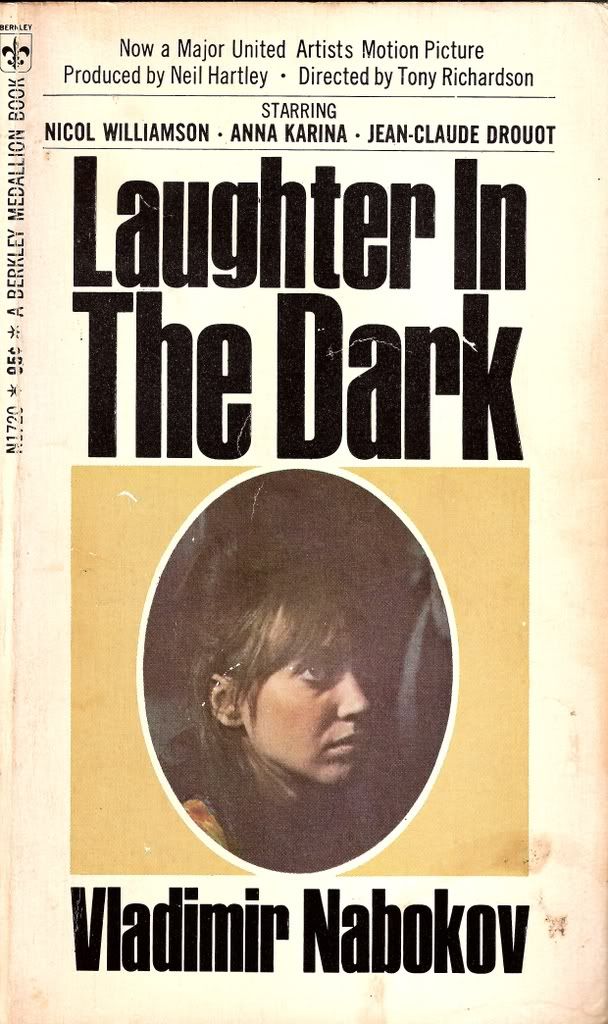
Review: Laughter in the Dark

An early Nabokov novel about a man named Albinus, a well-to-do German businessman who becomes infatuated with a callow younger woman. There are some similarities here with Pandora's Box or "Der Blaue Engel" (for fans of Weimar Cinema) in this story of a rather pompous individual brought low by his romantic entanglement with a younger woman.

Overall, it's a fairly tragic story, as Albinus loses first his marriage, then his daughter, then, in quick succession, his sight, dignity, fortune and life. It has its moments of humor and unique prose. Though hardly as brilliant or radical as Nabokov's later works, Laughter in the Dark is still a well-crafted narrative of one man's folly.

10 July 2009

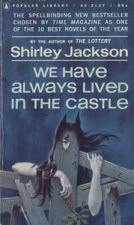
Review: We Have Always Lived in the Castle


The title of the novel is no accident, for it is as gothic a tale as any that was ever set in a crumbling castle on the banks of the Rhine. Its treatment of human evil, isolation and madness could easily qualify it as the pinnacle of 20th Century American Gothic.

A shadow has fallen across the house of Blackwood. Though once a prominent family, a possibly accidental poisoning has reduced their numbers to three (two sisters, an uncle) and made the townspeople suspicious of the survivors. The uncle, Julian, has been left physically crippled and one of the sisters, Constance, has developed a phobia about the world outside the house which does not prevent her from accepting visitors. It is left to the younger sister, Merikat (short for Mary Katherine), to venture into town on necessary errands.

Gothic literature often features singular characters, individuals who seem eerily plausible yet who are warped in a way that makes them unlike anyone else we've ever encountered. Merikat, who is the narrator and thus our guide through this story, is just such a character. It is clear that she views the townspeople with hostility, going so far as to craft charms--ordinary household items such as books or mirrors placed in odd locations or strange configurations--to keep the world at bay.

But soon it does intrude, in the figure of Charles, a cousin from an estranged branch of the family. His healthiness and level headedness seem to promise an opening up of the Blackwood home, a return to normality. But Merikat sees in him a representative of the crudity and selfishness of the outside world and seeks to drive him out through more and more powerful charms. The last of these results in a terrible reaction from the townspeople which sends the Blackwoods into greater isolation, leading to a hauntingly melancholy end to the story.

We Have Always Lived in the Castle is an incomparable achievement, a story that will equally charm and disturb in ways that sometimes can be almost intolerable. And you will probably never forget Merikat Blackwood.

09 July 2009

Review: Lamb; the Gospel According to Biff, Jesus' Childhood Pal


In The Last Temptation of Christ, Judas finds himself in a terrible situation. Jesus has told him that it will be necessary for Judas to betray him in order for mankind to be saved. As Christ acknowledges, God gave Judas the really hard task, that of betraying someone who he holds very dear. By comparison, all Christ has to do is die.

Though it's never acknowledged, the narrator of this book finds himself in a similar bind. As the lifelong friend of Joshua (aka Yeshua aka Jesus) and under the dictum that "dying is easy; comedy is hard," he has been left the harder path. All Joshua has to do is die. Biff has to make it funny.

Biff has been brought back to life by God so that he can write the definitive gospel since he was there from nearly the beginning. In order to ensure his cooperation, God has an angel chaperon Biff. Though it makes up very little of the story, the scenes of Biff and the angel in the hotel room are some of the funniest of the novel, especially in the angel's befuddlement at modern life.

Biff first met Joshua when they were both kids, and Joshua was bringing lizards back to life for the benefit of his younger, lizard-killing brother. From there they strike a lifelong friendship not impeded by the fact that Joshua knows he will one day be the Messiah. Biff is your quintessential underachiever, and his philosophical outlook, which has been derived from the teachings of Cynic, makes for a nice foil for Joshua's earnest desire to fulfill the task that has been set before him. When Joshua decides he will never learn how to be the Messiah if he does not seek out his origins, it is Biff who accompanies him on his travels.

They go in search of the Three Wise Men in order to learn the truth of Joshua's birthright. In their travels, this Hebraic Hope and Crosby encounter bandits, Taoist magicians, herbalist concubines, a hungry demon, a Buddhist monastery, the Tibetan Man of the Mountains, martial artists, a Kali ceremony, Tantra, untouchables and the Kama Sutra. After their travels, Joshua comes to learn what he has to do to become the Messiah, so they return to Palestine for the more familiar part of the story.

Christopher Moore here has a fine line to tread in attempting to make the story of Christ funny and believable yet keeping Joshua as the earnest Messiah figure we can all look up to. (No Last Temptation-style dream sequences of Christ experiencing the temptation of giving it all up here.) Having the story told by the underachieving and very sardonic Biff is a great way to thread that needle.

Moore makes the most of the sections where the gospels are silent, which give him a lot to work with. It yields great comic touches, like the time Joshua, Biff and Maggie decide to "circumcise" a well-endowed Greek statue, or the origins of the Jewish custom of Chinese food on Christmas. Though not every joke works, the passages overall maintain a high level of humor without robbing Joshua's quest of meaning.

The humor does begin to lost its impact near the end. Once Joshua and Biff return to Nazareth and Christ begins his ministry, Moore has less leeway with which to play. Once the ministry and the inevitable path to Golgotha have begun, the humor becomes more forced. As Joshua himself once said (though not in this book), a man cannot serve to masters, for he will honor one and neglect the other. The book has to choose between the earnestness of Joshua and the cynicism of Biff. It opts for the latter, for which one cannot entirely blame Moore. To have gone with the latter would have been to write a different, much edgier book. That Moore manages to make both elements work for as long as he does is testament to his talent and his great sense of humor.

30 June 2009

Denevi: La cola del perro

"La cola del perro" is that last of the stories in this collection, this one in the fable mode. A farmer is trying to maximize efficiency at his farm by making sure his animals are not goofing off. Since he doesn't have a good sense of how to judge their output, he decides to prohibit the dog from wagging his tail, under the theory that if the dog is wagging his tail he must not be working. The farmer goes so far as to threaten the dog with death if he will not stop wagging his tail.

The dog finds this very unnatural, but does learn that if he concentrates, grits his teeth and squeezes the right muscles, he can keep from wagging his tail. But he finds it very frustrating and stressful. As he becomes more stressed, his behavior becomes more hostile and threatening. Although the other inhabitants, including the farmer's wife, begin to think the policy has cost the dog his sanity. The farmer, though, thinks it is great, especially since a hostile dog makes for a much better guard dog.

Interesting story, which struck me either as a satire on workplaces that fixate on productivity or a commentary on communism. (They may seem like pretty divergent possibilities, but the Soviets were pretty fixated on productivity numbers in their days.)